
An interview with Tom Pace, Hal Smith, and Michael McNeir on the Hobie 16 North Americans
by David Schmidt 23 Sep 2025 08:00 PDT
September 27 – October 3, 2025
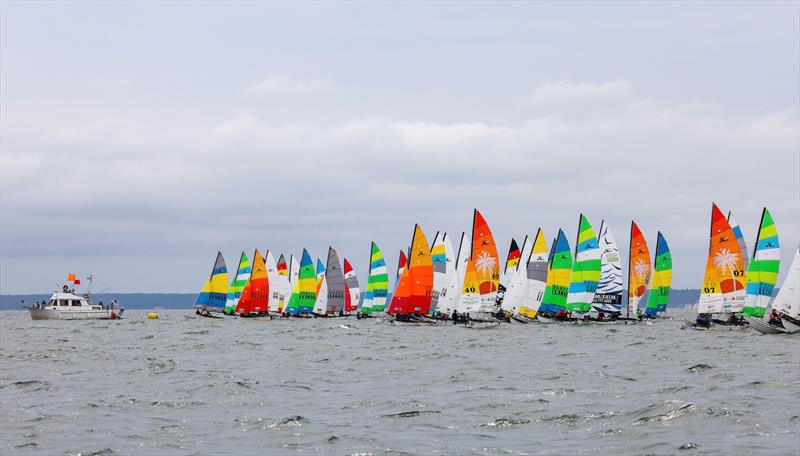
2024 Hobie 16 Open North American Championship at Roton Point Association © Shoreline Photography
Spoiler alert: The Hobie 16 is far from a new design. But that doesn't matter: When Hobie Alter's first 16-foot fiberglass catamaran hit the Southern California beach scene in 1970, the sailing world was forever changed. Finally, beach-cat sailors had a catamaran with the speed and power to punch through the surf and access the better hull-flying waters a bit farther offshore. Second spoiler alert: Great multihull racing soon followed.
Now, some 55 years after the double-trapeze rocketship made its debut, the class still attracts many of the world's best multihull sailors for a simple reason: The boats are a joy to sail, and their sheer numbers (it's estimated that over 75,000 have been built) ensure great competition.
Take, for example, this year's Hobie 16 North American Championship (September 27 - October 3), which is being hosted by the Pensacola Yacht Club, in Pensacola, Florida. Racing will take place on the waters of Pensacola Bay, and—as of this writing—there are 60 teams registered for this high-level event.
I checked in with Tom Pace, Hal Smith, and Michael McNeir, who serve as the regatta chair, principal race officer, and the Hobie Class Association of North America's event coordinator (respectively), via email, to learn more about this exciting multihull regatta.
In the ideal world, how many races do you and the other organizers hope to score over the course of the regatta? Also, what shapes do you think these courses will be?
TP: The Class limits to max of four races per day, but if weather gets ornery, Hal Smith will work with the racers to be flexible. We can get great conditions that time of year, and barring storms that could peel a day or two off the regatta, we should be above 15 races for the series.
MM: Twenty races for the week would be a great series.
HS: The class prefers windward-leewards with options for windward finishes.
Weather-wise, what kind conditions can sailors expect to encounter on Pensacola Bay in late September/early October? What are the best-case and worst-case wind and sea-state scenarios?
TP: This will sound like I'm hedging the bet here, but we could get local sea breeze that builds throughout the day from a starting point east-southeast moving to southwest by end of the day. We could get a hard draw ahead of an early cold front that will pull wind from the east, then slam hard to the north-northwest as the front comes through.
If we get a strong front, once it passes, it will leave very gusty/shifty northerlies.
And velocity? Regular sea breeze likes to start at 5-6 knots, then as it moves to the right and builds out of the southwest, 15-22 knots is likely. The strong draw ahead of a front will be in the upper teens-low 20's all day, and a hard front usually brings 12-25 knots, but again is very, very shifty; just as tough for the RC to set a fair course as it is to get the shifts and puffs right !
How much of a factor do you see local knowledge playing at this high-level regatta?
TP: It always helps, but we are very open to sharing what we know and will give a daily morning brief of what we expect to see during the day. Of course it's just an advisory, but there is some nuance to the surface current as it interacts from wind and normal tide.
The local sailors will answer any question, so visiting racers can have at least some idea of what they will be looking for on the water.
If you could offer one piece of advice to visiting (and local) sailors, what would it be?
TP: Listen to the locals if we get any of the basic patterns. Pensacola Bay can be surprisingly tactical with even that single daily tide. Even with that, it will still be tactical on shifts and velocity swings. Local knowledge wont unfairly tip any of this, but paying attention to it can make a difference.
HS: The lunar current on Pensacola Bay is minimal with one tide change per day that is less than one foot. However, there can be significant current generated by wind, especially during a northerly breeze combined with a recent heavy rainfall that filled up the upper bay that is draining out. The typical low chop helps to disguise the current.
Do you have any entries that you're eyeing for podium finishes? What about any dark horses who you think could prove to be fast, once the starting guns begin sounding?
MM: The likely top finishers are Jason Hess (Guatemala),
And Francisco Figueroa (Puerto Rico). Ben Brown (USA) could be our dark horse.
You mentioned that you are expecting 80-90 boats at the 2025 North Americans. Does the regatta plan to split the fleet into different divisions, or will there be a single starting line? Can you please explain?
HS: We discussed a cut-off point for a single fleet or divisions created by round robins. I recall we decided to let 100 be the total number before splitting the fleet.
As a follow-up to that last question, does the event plan to use any starting-line technologies (e.g., the Vakaros' RaceSense platform) for determining if any competitors are OCS? If not, how does the event plan to manage such a large fleet?
TP: Hal will use traditional timing, with sound and flag signals. For large fleets, Hall manages by usually allowing the fleet to set their own tone, but if that results in repetitive general recalls, he likes to use the U-Flag to keep the starts more tidy, and the races running on a good schedule.
HS: We have never discussed the use of Vakaros. It is expensive when starting from scratch, which this fleet would be doing. I am not anxious to manage a start line with 50-100 H16s, but we will do our best.
I had close to 120 Optis at one regatta in a common start. Of course, the Optis immediately asked for a black flag.
What I will likely do for more than 50 Hobie 16s is to use Uniform for the Prep Flag. This cleans up the line a minute before the start and generally helps boats manage their starts better. World Sailing recommends that all races should be started under U.
In all cases, we will have a RC Vessel stationed off the starting pin on the port side of the course to provide for calling the line from that side. I do this often with an open cell phone conversation between the Start Pin RC Vessel and myself (on the Signal Vessel) during the starting period.
When the fleet realizes we are doing this, they try harder to make proper starts.
What kind of evening entertainment do you and the other event organizers have planned?
TP: That's still TBD because of some club details and light construction on property, but we do have a great relationship with several bar and restaurant owners in the area. One such owner has no less than eight bars within one large complex that features brick alleyways, multiple types of live music, a sports bar with pool tables and darts, and a restaurant as well. This is Seville Quarter.
Competitors will receive annual membership cards printed with their names that takes out cover charges and sets them up for specials, and will work if they come back at any point during the year!
We've found that after racing is done, beer kegs and light food is preferred over seated dinners, as it allows racers to get into downtown Pensacola for a variety of options. We will have kegs chilled and waiting for the end of the days, and the food options will vary daily.
We will have an awards ceremony off PYC grounds on the final day, and that will have food and drink as well.
Is there anything else that you'd like to add about this year's Hobie 16 NAs, for the record?
TP: We have a great PRO in Hal Smith who is experienced with the class, running Alter Cups (U.S. Multihull Championship) as well as performance regattas from Wasp/Moth, to A-Class Cats, to Windsurfers.
We are looking to stay in stride with the laid-back nature of most of the racers in the Hobie 16 Fleet, while being fully aware the racing will be sharp and hotly contested. Safety remains the top priority, and we will have boats and personnel on water monitoring the fleet for any required assistance.
So, it will be professional-grade race committee on the water, and easy hospitality back ashore.