
An interview with Dr. Peter Puskic on The Ocean Cleanup's Pacific Data Expedition
by David Schmidt 17 Sep 2025 01:00 AEST
September 16, 2025
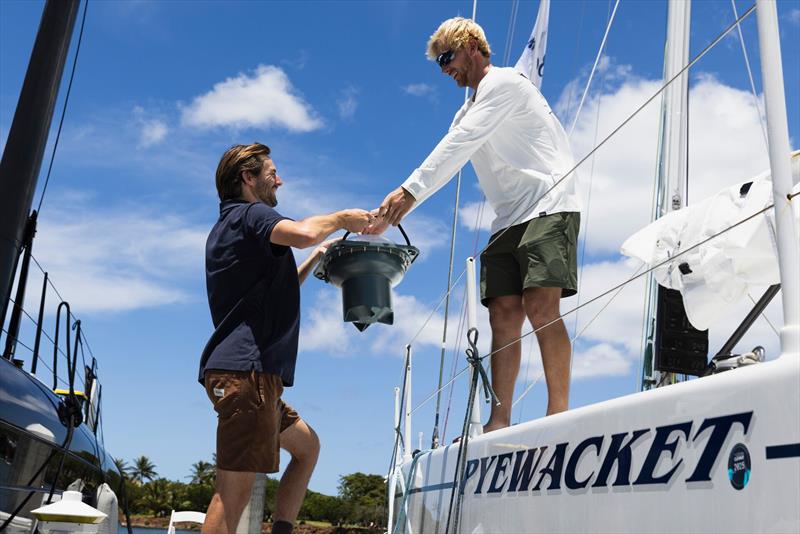
The Ocean Cleanup partnered with boats returning from the 2025 Transpac race for the organization's Pacific Data Expedition 2025 © Shaun Wolfe
Racing to Hawaii in the biennial Transpacific Yacht Race is one of the coolest adventures in the sailing world, but—once the awards ceremonies and parties are over—the boats need to be delivered back to their respective homeports. While this oftentimes involves loading raceboats onto transport ships, other times it involves deliveries that cross vast stretches of brine that are seldom seen or empirically studied by scientists.
For boats that are sailing back to Canada, Mexico, or the U.S., this involves crossing through the Great Pacific Garbage Patch (GPGP), a massive ocean gyre that contains shameful amounts of plastics and microplastics.
Enter The Ocean Cleanup, a non-profit that was founded by Dutch inventor Boyan Slat (who was 18 years old at the time) in 2013 to rid the world's oceans of 90 percent of floating plastics by 2040 using advanced technologies and clever innovations.
This year, The Ocean Cleanup teamed up with some of the returning Transpac fleet to gather data on the GPGP using innovative camera technology and AI that the organization developed. This effort was called The Ocean Cleanup's Pacific Data Expedition, and over the next few months scientists should start seeing the fruits of this collaborative effort.
As the cliché goes, if one wants to change something, one should start by measuring it.
I checked in with Dr. Peter Puskic, who serves as The Ocean Cleanup's senior field scientist, via email, to learn more about this important data-collecting effort.
Where did the idea for The Ocean Cleanup's Pacific Data Expedition 2025 come from?
The idea came from a need to collect data on larger debris items. Much of our knowledge comes from surface water trawls, which often sample microplastics, but we want to target the large legacy pollution—like fishing gear—that dominates the GPGP.
We have worked with sailors in the past (The Mega Expedition 2015 theoceancleanup.com/milestones/mega-expedition) and wanted to work with sailors again, as they are passing through the GPGP annually. They bring with them skills and knowledge, as well as a low-carbon way of conducting science.
How many boats that were returning from the 2025 Transpac participated in The Ocean Cleanup's Pacific Data Expedition 2025?
Most boats said yes to working with us (many boats although interested were shipped back to their home port so this limited options).
We had limited resources and so we targeted 18 of the most engaged vessels to help us out on their return leg. We specifically chose boats that were returning to a range of ports on the North American coastline—from Victoria, Canada to San Diego, USA.
Can you please give me a 35,000-foot overview of how the Automatic Debris Imaging Systems (ADIS) work? Also, are there daylight cameras, thermal-imaging cameras, or both?
The ADIS cameras take regular red, green and blue (RGB) images of the surface of the water. They use a machine-learning algorithm to detect plastics and determine plastic type.
They then store only [data pertaining to] the plastic items, and the associated metadata, vastly reducing the amount of information they need to keep, and once in cell service (i.e., back in port), they send the data back to us at headquarters, also leading to cost savings.
This data is going to help us optimize cleanup operations by targeting areas with the highest plastic concentrations.
How do the GPS tracking buoys work? Do crews have to attach the buoys to discarded fishing gear and ghost nets, or do the sailors just drop the buoys overboard? Can you please explain?
Both methods are used.
Free floating helps calibrate our models and understanding of ocean currents (like meso-scale eddies). And tagged ghost nets help us understand and model how these large and complex debris items move.
So, some sailors deployed the [buoys] overboard as free floating, and some attached them to ghost nets by tying them on. All sailors expected to hit ghost nets on the crossing back to the U.S. and Canada, so many of the tags were actually attached [to] fishing gear that was wrapped around their rudders or keels - showing just how dangerous this debris can be to people and their vessels, and how it can interfere with racing boats' ability to perform!
Have you already started to receive data (and/or imagery) from The Ocean Cleanup's Pacific Data Expedition 2025? If so, can you give us an idea of your findings?
We have received four transects from ADIS with lots of plastics detected, we have deployed 72 [buoy] drifters, of which 17 are attached to ghost nets.
We need a few months to assess how oceanographic conditions effect the movements of these large items, [and] we are excited to see the results.
How will The Ocean Cleanup use this data (and/or imagery) to help rid the ocean of plastic?
This data helps us fill some big knowledge gaps on the GPGP, a gyre system that is rarely visited for science. The data will help calibrate our models and we hope that we can use the data to detect "hotspots" of marine debris.
We hope to target these hotspots during our cleanup operations so that we can increase the efficiency of our cleanup systems. And more broadly, the strategic integration of AI, drones, machine learning, and remote sensing, can revolutionize the detection, tracking, and removal of plastic debris, not only from the GPGP, but also from the rivers where our Interceptor barriers stop the trash 'tsunamis' entering oceans.
Is there anything else about The Ocean Cleanup's Pacific Data Expedition 2025 that you'd like to tell us about or add, for the record?
I think it is worth highlighting that sailors and seafarers are highly engaged in marine science and have strong knowledge of the marine environment. Working in partnership with our scientists allows us to generate rare and useful data on the GPGP. It's great to see us all working together to tackle the plastic pollution problem.
N.B., to learn more about the underlying technology behind The Ocean Cleanup's Pacific Data Expedition, check out this really interesting video, called "How AI Is Helping Us Clean the Ocean":
And to donate to The Ocean Cleanup, please visit theoceancleanup.com/donate