
The IMOCA sailors - key contributors to global oceanographic science
by IMOCA Globe Series 25 Oct 2024 08:11 PDT
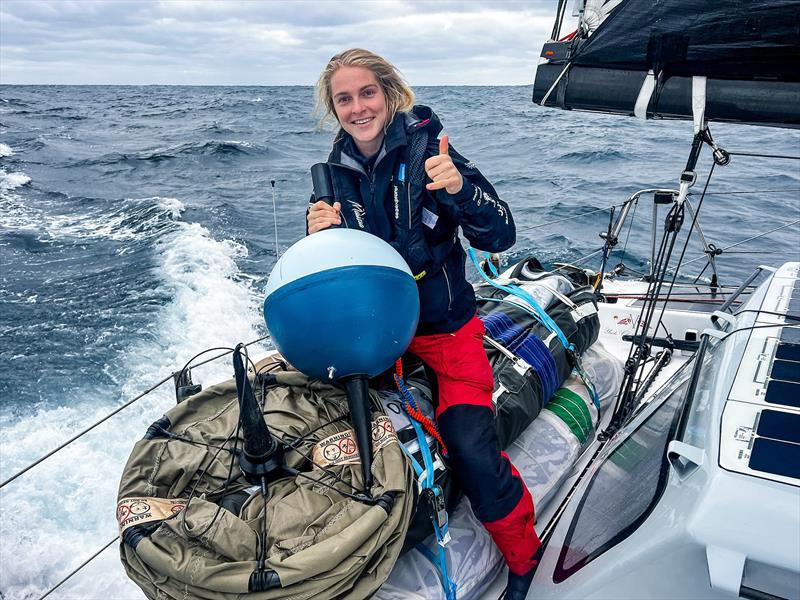
Rosalin Kuiper with a buoy for collecting Real-Time Marine Weather Data during The Ocean Race © Antoine Auriol / Team Malizia / The Ocean Race
The Vendée Globe is not only an exceptional human and sporting adventure. Behind each race also lies a major scientific contribution, often unknown to the general public.
Since 2015, the IMOCA Class has been working closely with UNESCO's Intergovernmental Oceanographic Commission (IOC) to make skippers key players in oceanographic research.
In partnership with UNESCO, these sailors carry advanced instruments to measure crucial ocean parameters. Their contribution thus enhances the understanding of global climate and the health of our oceans, while also helping to improve weather and climate models.
This collaborative initiative is part of the Odyssey project launched by OceanOPS to support the United Nations-declared Decade of Ocean Science. The Odyssey project aims to recognize and organize, within a coordinated program, all contributions to ocean observation made by civil society, the private sector, and offshore racing.
Born from an ambitious partnership between UNESCO, the Vendée Globe, and the IMOCA Class, this collaboration aims to accelerate oceanographic research and improve weather forecasting. Specifically, 25 skippers from the 2024 Vendée Globe fleet will carry measurement instruments, transforming the race into a true 'floating scientific station' around the globe. These devices will collect valuable data, particularly in under-sampled regions such as the Southern Ocean. This mission will help enhance weather forecasting services while providing crucial information for scientists studying climate change.
The scientific instruments on board, provided by major players such as Ifremer, Météo France, the UK Met Office, CNES, GEOMAR, the TARA Foundation, and ETH Zürich, offer cutting-edge technology. The data collected by these instruments will feed into the Global Ocean Observing System (GOOS). The coordination of all operations is handled by OceanOPS, the international centre of excellence of UNESCO and the World Meteorological Organization (WMO), responsible for overseeing these weather and oceanographic observation systems.
In parallel, this project includes educational initiatives aimed at schools, raising awareness among young people about ocean protection and climate challenges.
The collaboration between sailors and scientists: a winning synergy
As explained by Emanuela Rusciano, oceanographer and Director of Science and Communication at OceanOps/UNESCO, this collaboration is built on more than 10 years of work with offshore racing skippers, particularly those from the IMOCA Class. "It's a win-win relationship," she says. "By deploying weather buoys, the sailors directly benefit from their scientific contribution. These buoys collect data such as atmospheric pressure, which helps improve their weather forecasts during the race. This information, crucial for the skippers' performance, is also shared with the global scientific community."
However, the sailors' contribution goes far beyond merely improving their own forecasts. The data they collect is crucial for feeding the Global Ocean Observing System, which requires the collection of as much marine weather data as possible each year. "Research vessels cannot access all oceanic areas at all times, especially in the Southern Hemisphere, where we severely lack data. This is where the collaboration with the Vendée Globe skippers becomes truly meaningful," emphasizes Rusciano.
Onboard Instruments for a Better Understanding of the Oceans
During the 2024 edition of the Vendée Globe, several types of scientific instruments will be on board the boats. Among them are the famous Argo floats, capable of collecting data on ocean temperature and salinity, two key parameters for studying large-scale ocean currents. These floats also allow for the analysis of the thermal content of the oceans, an important indicator of global warming. "Since the 1970s, we have known that the oceans have absorbed 91% of the excess heat due to the increase in greenhouse gases," explains Rusciano.
Measuring these temperature variations is essential for understanding the ocean's role in climate regulation and climate change. This data is then used in weather and climate prediction models, helping experts refine their forecasts and better anticipate extreme phenomena.
Buoys for Collecting Real-Time Marine Weather Data
Another central device in this data collection campaign is the use of drifting buoys. These buoys will be deployed by the skippers in the South Atlantic and the Southern Oceans. "The ocean around Antarctica is the least known on the planet. It is one of the few regions where an ocean current literally circles the globe, transporting these buoys in a nearly continuous loop," explains Sébastien Péré, an expert from Météo France.
These buoys track the currents for several months, or even years, providing continuous data on oceanic conditions. "This is a true opportunity to collect valuable information in under-sampled regions," he adds.
The Innovative Project - Paul Meilhat and Biotherm
As part of his project with Biotherm and the Tara Foundation, Paul Meilhat is actively participating in ocean research, particularly on plankton - micro-organisms that cannot move against ocean currents. Biotherm, has been committed to ocean preservation since 1952 and has been a partner of Tara since 2017, with the motto "Purpose Drives Performance." This collaboration is bearing fruit aboard Meilhat's IMOCA with the installation of a 35kg automatic microscope. Its images feed into a database analyzed by artificial intelligence with a recognition rate of 98%. This device, which has been in preparation for two years to withstand the extreme conditions of the race, continues the work of Tara, which has been dedicated to public research across the oceans for 21 years, under the leadership of Romain Troublé.
The microscope, positioned at the centre of the boat, collects water samples every hour and takes photos every 20 minutes. A total of 4 million images have already been gathered, with the goal of collecting an additional one million photos during the Vendée Globe 2024. These images, time-stamped and geolocated, are accessible to all researchers via the EcoTaxa database, allowing them to study marine ecosystems with unprecedented precision. This sensor represents a major advancement in ocean study, contributing to Tara's overall mission to find solutions for their preservation.
The Future
Sailors in future editions of the Vendée Globe have an important role to play as their contribution continues and expands. Rusciano hopes that by 2028 all the boats in the race will be equipped with measurement instruments. "It is essential to support ocean observation, and skippers have a key role to play in this mission," she said.
Thanks to these collaborations, IMOCA skippers are transcending the boundaries of sport. Sailors are not only solitary competitors at sea, but also ambassadors for science, contributing to the understanding and preservation of the oceans.
What equipment is carried by each skipper?
- Oliver Heer: OceanPack + Argo Float
- Antoine Cornic: TSG Gaillard + Weather Buoy + Weather Station
- Tanguy Le Turquais: Weather Station
- Kojiro Shiraishi: Argo Float
- Sam Goodchild: Argo Float + Calitoo
- Sébastien Marsset: Argo Float + Weather Station
- Romain Attanasio: TSG Gaillard + Weather Buoy
- Boris Herrmann: OceanPack + Weather Buoy
- Guirec Soudée: Argo Float
- Maxime Sorel: Argo Float
- Szabi WEORES: Argo Float + Weather Station
- Arnaud Boissières: Weather Buoy + Calitoo
- Sam Davies: Calitoo
- Pip Hare: Calitoo
- Paul Meilhat: Planktoscope
- Nicolas Lunven: OceanPack
- Benjamin Dutreux: Weather Station
- Clarisse Crémer: Weather Buoy + ARGOS Marget II
- Denis Van Weynbergh: Weather Buoy
- Fabrice Amedeo: OceanPack + Argo Float
- Yoann Richomme: Argo Float + ARGOS Marget II
- Louis Duc: Weather Buoy
- Manu Cousin: Weather Buoy
- Louis Burton: Calitoo
- Jingkun Xu: Argo Float