
The INEOS Interviews: David 'Freddie' Carr
by Mark Jardine 19 Aug 2024 07:00 PDT
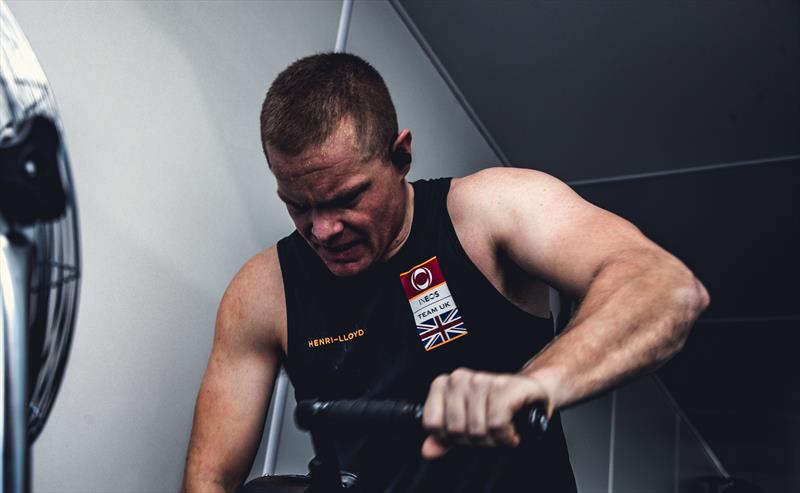
INEOS TEAM UK's David 'Freddie' Carr during training © Harry KH / INEOS TEAM UK
There are certain people you want on your team no matter what. Freddie is one of those people. A top sailor in his own right, he has transitioned from grinder to cyclor for his sixth America's Cup campaign, but does so much more for the team behind the scenes.
Mark Jardine: For this America's Cup, the biggest change, from your point of view, is probably upper body strength switching to lower body strength. How have you found that transition?
Freddie Carr: It's been a challenge. I'd be lying if I said it wasn't a challenge. All I've known my America's Cup career is grinding and, as you've said, using your arm power to turn the handles, to power winches and move ropes, and now to live in a world where I am constantly cycling to power a hydraulic system, to move hydraulic cylinders - it's been a big shift in the sport.
Not only that, certainly from ten years ago I was - I dread to use the phrase - like an athlete that had to have repeat spirit-sprint performance, where every one minute you attack or do a spinnaker hoist or do a spinnaker drop or something like that, it's now a constant input. So we've gone from not only just using our arms to we are now just using our legs, but we've also shifted from an anaerobic athlete, a fast twitch athlete, to an endurance athlete. I think that's been more the harder shift for me to try and turn this frame into a very, very heavy road cyclist, basically.
Mark: From that point of view, I hesitate to use the word, but you are now a veteran of the America's Cup.
Freddie: Absolutely use it! I mean, this is my sixth Cup now. My first exposure was in 2001 with GBR Challenge, Peter Harrison's team doing the America's Cup Jubilee. I loved the America's Cup up until that point, and then to go and do the Jubilee with the British team, to racing Prada in New Zealand! I was hooked.
America's Cup racing is a sport that has, more than any other sport in the world, changed beyond recognition in the last 20 years, but it's also exactly the same as I remember it throughout - the core values - the things that make a team tick are exactly the same; but going around the race course is more different than you could ever imagine.
Mark: This America's Cup is the first one where you are fully enclosed. You are not actually putting your head up out of the boat whatsoever. How disorientating and odd does that feel?
Freddie: I don't love it. I've got to be honest, I don't love it. We have a very good display in front of us. From that display, with a good match racing knowledge, you can build a really nice picture of where you are on the race course. You're obviously not seeing the gusts of wind coming down on you any more - not that that's relevant for a cyclor.
The thing I really miss on this class of boat is the human contact. In every previous America's Cup boat, certainly the IACC class, and then moving on to the AC72s, the AC50s, and even last time around, on the first generation of AC75s, you were in cockpits with other people, and you could share a glance down the line. You could throw a wink, you could give a nod of the head when someone's pushing.
In the old IACC classes, you'd be looking at feet buttons to see what combinations people are clicking in. This is the first boat I've ever been on where you are alone in your cockpit, and it's taken me a long time to get used to being there without human interaction, other than the communication you have in your ears.
That's been a hard thing for us all to transition to, and has put a huge emphasis on the quality of that communication. For example, on a pre-start previously I've often been an aft-facing or side-facing grinder, and I would see Ben change his hands on the wheel to start the wind up to the line, so you're already a second ahead of him, changing the gears and clicking people in to get the mainsheet ripping on to get you off the line.
Now you don't have any of those visual clues any more, trying to guide you through the race. Relying solely on comms and not being able to have a smile with your mates is pretty different.
Mark: You've got two communication channels on board: your cyclor channel and your tactical channel. When you're racing, you're just full-on energy generation, but, being a sailor yourself, do you have any kind of input back to the tactical team?
Freddie: No, not at all. It's all one way. You're taking information all the time from the trimmers, the helmsman, be it trim-wise, boat setup-wise, tactics, and what's next. You're very much on receive, and we never communicate to the wider loop.
Our cyclor channel, between the four guys racing on the boat, is pretty active, talking about gear selection and what's next so if the tactics are (say) a bear away, early gybe or bear away, matching our opposition, we're talking to each other a bit.
It is full on a lot of the time. But the biggest moments in the race are when we return to our baseline. I say our 'relaxed' state, but it's not relaxed, but when we return back to an energy output where we can recover.
The real skill on these boats is recognizing when to take those 30 seconds, when you can take your foot off the gas, and when you do that well, it means you're not burning so many matches in an area of time that isn't important. Then, when you come to the top mark, bear away, and you have to give it all the watts in the world to catch the roll, to get you ripping downwind, you've got more energy.
More than anything, you don't need to gee people up for the push, for the big moments. You need to reign people back, to get their breath, to push again.
Mark: Talking of people, being out on the water is actually a tiny percentage of the time that you are involved in an America's Cup cycle. You have always been integral to a team's morale. How big is that part of your role in this campaign?
Freddie: It's kind of you to say that. I think it's huge. I think not only are we operating in a very high pressure sporting environment, like all top athletes. You only have to look at the Olympics to recognize the really high pressure sporting moments, but we're having to do it with a shore team, a design team, a level of fatigue that is generated naturally over the build-up to an America's Cup.
There can be moments where people rub each other up the wrong way. It's important to recognize that everybody is trying their hardest, everybody's pulling in the same direction, recognising the common goal.
For me, accepting that feedback is for the greater good of the team is important. I think more than anything, always just checking in with people - we call it 'testing the ropes' here - helps. Making sure your teammates are all right, making sure the designers you work with are all right.
Every day you have a nice conversation with everyone, or as many people as you can, so that when it comes to the really hard conversations down the line, you've got a relationship where that hard conversation isn't hard because they are your mate.
I think that's something that I work really hard on - making sure that you've got a relationship with everybody - so that when it gets hard in these last two or three weeks, two or three months, you can have really frank, tough conversations and it's not a surprise to anyone. You've got a relationship that allows you to do that.
Beyond that, I think enjoying the challenge, and that's something that Ben says a lot. It's really important to recognize that we're extremely privileged to be doing this. Yes, it's bloody hard work, but you've got to stop and enjoy the challenge and poke your head above the parapet every so often and go, "this is bloody cool."
Enjoying this is something that I think we have to do. You have to have fun. If you're not having fun, you're not going to make the boat go faster.