
Cadet class anecdotes from the fifties - 'the human jamming cleat'
by Magnus Smith 1 Aug 2024 06:28 PDT
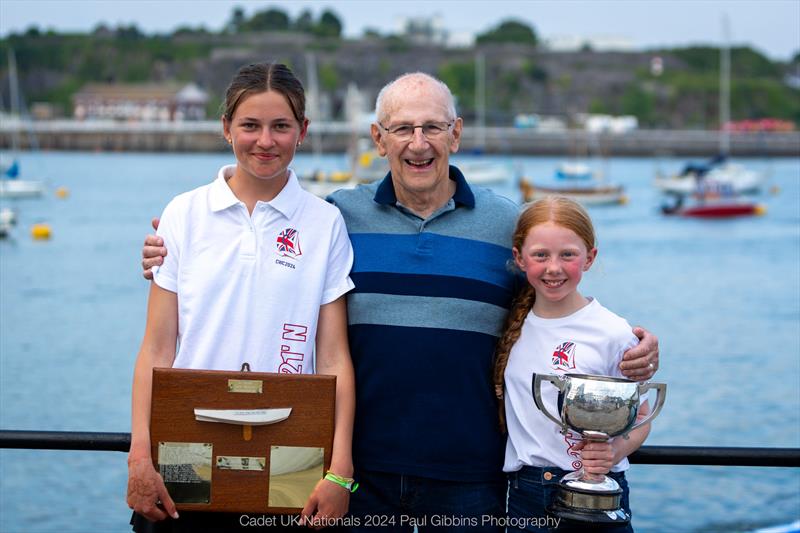
Barry Steel (1957 champion) with the 2024 champions - ABP Cadet UK Nationals in Plymouth © Paul Gibbins Photography
"My brother Rodney was called 'the human jamming cleat' when he crewed for me."
These are the sort of amusing anecdotes you hear amongst the shoreside spectators who are enjoying watching the huge fleet of Cadets in Plymouth. It was a great pleasure to chat to Barry Steel, National Champion from 1957, who thinks it is wonderful to see the class flourishing.
He explained that the joke was born because the Cadet had no cleats on the jib or spinnaker back in the fifties. In fact, it did not even have fairleads for the spinnaker sheet/guy. The helm and crew would hold one each, direct from the sail. Likewise the spinnaker pole was simple: just a pin on the outboard end (not a clip) and no uphaul/downhaul - it was forever bobbing up and down.
The mainsheet had the luxury of a block on the end of the boom.... but on the transom it ran through a fairlead! Barry much prefers the modern ratchet and ball bearing blocks on the RS Aero he currently races, but still speaks nothing but good of his youth sailing at Aldenham SC.
"It was nice because it was simple," he explained. "So many gadgets make a mere marginal difference." (Strange words for a man that once raced a Merlin Rocket!)
I asked him to tell me more about number 655 'Chips' which he had sailed to victory. His dad and uncle had built the boat, like so many others in that era. The hull would be instantly recognisable to any modern Cadet sailor, even down to the breakwater; but the spars were wooden, the sails were cotton, and the rudder was aluminium plate. The kicking strap was fixed, and you clipped a toggle onto the boom whilst hauling it down manually, then were stuck with that same tension all race long.
It sounds primitive to us in 2024, but at least it wasn't dangerous... like the bulky buoyancy aids were. Barry recalled how big these were across the shoulders, and how one sailor got caught under the kicker during a capsize, and struggled for a long time to get out.
With this terrifying thought, I quickly asked Barry for some more heart-warming stories of the early fleet racing. He then revealed he had known both Jack Holt (the designer) and Group Captain E F Haylock (class chairman) and that they were both wonderful souls.
Apparently Jack Holt was a very encouraging and humble man. He would come to Cadet Week, where his son John was racing, and gave several talks. Of the other chap, let us read Barry's own words from an old class publication.
HAYLOCK'S VISION
Group Captain Haylock's vision for International sailing and
racing for the youth of the world was inspiring. As Editor of
Yachting World he was in a unique position to influence the
massive worldwide growth of Cadet Sailing. He worked
tirelessly following the war to see youngsters of all nations
engage in friendships afloat.
He wrote: I am quite certain that boys and girls who enjoy
sailing against each other at International events would never
want to go to war with one another.
Having met him many times at Cadet Week I can vouch for his
caring concern for youth. He was a father to the Cadet fleets of
the world. Henri Leten of the Royal Belgian S.C. shared the
same vision and encouraged major growth in Cadet Squadrons
in Belgium and across Europe.
One of his proteges was one of my great rivals at Cadet Week, a
Belgian lad by the name of Jacques Rogge. Following a great
Olympic and sailing career he went into the medical profession
then later still took up Haylock's baton to become the I.O.C.
President! Amazing what our sailing comrades do!
You might expect an ex-RAF officer to be aloof and stern, but this chap even took the time to write individual letters to youths like Barry, thanking them for being helpers on the ramp at a championships.
Unsurprisingly, these examples inspired Barry to get involved - all his life - in training youth sailors at his home clubs of Aldenham and Rickmansworth. "I've just always enjoyed sailing, and I've been a teacher, and having never quite grown up myself, I've always enjoyed working with youth," he said.
I asked for a top tip, and heard that he has many 'Bazza Top Tips'; one is that he advises kids to develop a 'radar head'! This is where you learn to manage the tiller/sheet automatically, so your head can spin round like a radar: seeing the wind, seeing other competitors, and thinking about tactics.
Barry's parting words on the topic of sailing coaches:
"If you think you know what you're doing, share the love."