
Performance vs. Participation or Correlation vs. Causation?
by Mark Jardine 25 Jun 2024 08:00 PDT
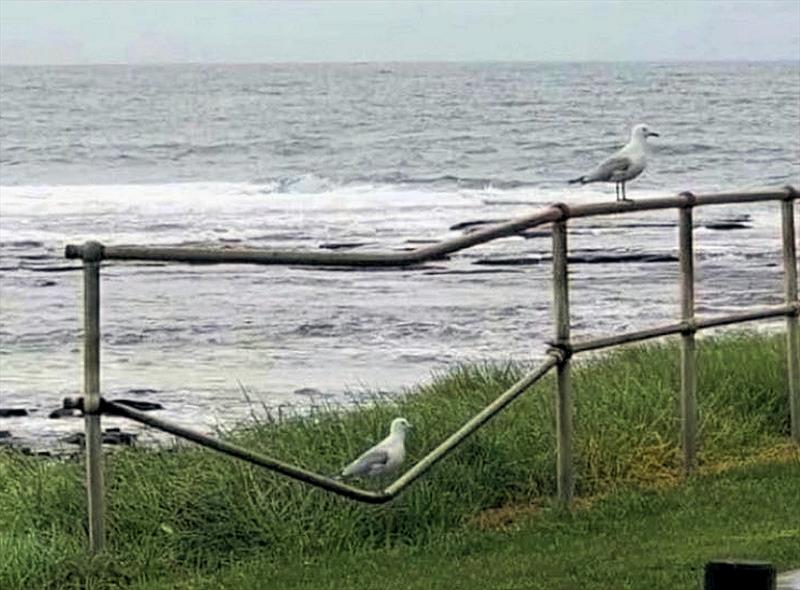
That's one heavy seagull... © Editor
I've heard many a time that one of the reasons for a fall in participation in sailing is the increased performance of boats. Effectively, the skill level and athleticism required in high performance boats excludes a range of people from participating.
Personally, I cannot agree with this rationale for one simple reason: just because high performance sailing is available, does not mean that traditional, or lower performance boats, suddenly aren't available for all.
In other words, a perceived inverse correlation doesn't necessarily imply a causation. Case in point being the photo above, where you could argue that the seagull must be super heavy to have bent the railing.
I tend to believe sailing can be more accessible than ever, and attendance - while very different to 50 or 60 years ago - isn't half bad.
Those who believe that performance is to blame for perceived falling participation often hark back to the days of the dinghy boom of the '60s and '70s, which I referenced in the opening paragraph of my last editorial. Class championships during this time could gather up to 200 boats - sometimes more - which is used as the 'evidence' for falling attendance, when those same classes now attract a tenth of that number.
The counterargument is that the modern equivalents, such as the RS200, are in this echelon, with 182 taking part in the 2022 UK Championship. Yes, overall, there are fewer classes with ultra-high attendances, but there are more classes overall - for better or for worse.
The dinghies that were designed for the dinghy boom years were mostly 'general purpose' (that's what the GP stands for in GP14) and frequently built at home out of plywood, coming in kit form. Nowadays that's a rarity with sailors wanting their boat to be ready to race out of the box, but that's more a reflection of the changing behaviours in general rather than that of sailing as a pastime.
A modern International Moth, taking one example, cannot in any way be described as general purpose, but it has attracted people to the sport who may otherwise have been uninterested in it, due to it lacking the thrill factor. It has also spawned more accessible foiling classes, such as the WASZP, which again has developed its own loyal following. Then there's the explosion in popularity of the wing foil - I've said it before and I'll say it again, sailing is a diverse sport!
Another reflection of changing lifestyles is how more and more clubs are implementing pay and play. This isn't just the big clubs, it's across the board, and the booking systems work seamlessly online, meaning you know what's booked when, and can quickly rent out the boat you want to sail.
The growth in the pay and play model also reflects changes in modern lifestyles. Phones, appliances, cars and houses are much more are likely to be rented rather than purchased.
When you look closely at pay and play, it often works out far cheaper than boat ownership, and gets around dinghy park waiting lists. Going back to lifestyles, those whose work is nomadic may jump from club to club as their location changes and never actually own a boat. The first thing they'll be looking at when choosing a club is the availability of pay and play. Something to think about if your club is struggling to attract members...
One more common misconception is that club fleets have to be dinghies. Sail-World.com's North American Editor David Schmidt showed this isn't the case when he talked with Ashley Walker about Lakewood Yacht Club's new RS21 fleet back in 2019. The club bought twelve of the sportsboats, recognising changes in people's lifestyles, as well as the times in life when sailors are unable to commit to boat ownership, but want to remain engaged with the sport.
Ashley's words on the scheme, and its reasoning, are a must-read for any sailing club:
"Lakewood Yacht Club has built a nationally recognized Youth Sailing Program over the years. Many of those youth sailors have moved on and completed college sailing programs as a result of their skills developed at LYC. We want them to return to our club as members and saw a pay-to-play option as providing a high level of value in return for their membership.
"Many young sailors, fresh from college or building a family, often have to choose between investing in either a club membership or purchasing a boat, and cannot do both. We'd rather they join our club and let us provide them with a fleet to sail at a nominal cost compared to boat ownership."
Championship attendance also isn't necessarily the sign of sailing's health. For sure, gathering a large number of the same type of boat in a single place at a single time makes for superb racing, and often an even better social scene, but it isn't the be-all and end-all.
The ILCA 7 class (or Laser as most still call it) attracted 57 boats to its UK Nationals in 2023, but there are regional and local events around the world which equal or better that number.
The ILCA with its three rigs can attract extraordinary numbers at their events, for example the 533 helms taking part in May's EurILCA Europa Cup Italy at Punta Ala. That's a serious turnout of sailors, and shows the class to be in rude health, over 50 years since the late, great Bruce Kirby designed it.
My point is that highlighting numbers in a certain class, or certain event, doesn't necessarily give an overall picture of the health of sailing in general. Habits change, people change, events and classes wax and wane, and the broader picture shows the sport in good health.
Can we do better? Of course. Should we be constantly analysing the figures and behaviours? Absolutely. Should clubs, classes and events be adapting to the changing times? Without a doubt if they want to survive.
Sailing needs to be constantly mindful of its position in the world. The rental lifestyle of today means people can be fickle in the pastimes they choose, and the options available as to how you spend your free time have never been more plentiful. Sailing needs to be attractive to bring new people in.
I said earlier that sailing can be more accessible that ever, and at some clubs that is true, but conversely there are clubs where it isn't - those are the clubs where I'd say a declining membership is where correlation and causation do align.
Mark Jardine
Sail-World.com and YachtsandYachting.com Managing Editor