
Reflections on a great spring season of Puget Sound Racing
by David Schmidt 4 Jun 2024 08:00 PDT
June 4, 2024
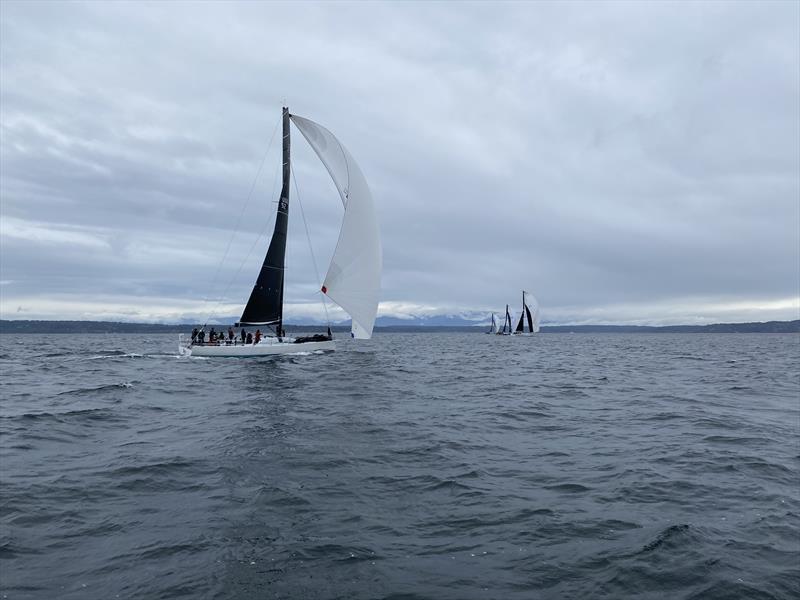
The start of the wet and wild 2024 Smith Island Race © David Schmidt
Things happen a bit differently in the Pacific Northwest compared to many other parts of the country. Take, for example, our sailing calendar. While the season is in full swing in most parts of North America, our typical lack of breeze during the late-spring and summer months (read: high-pressure systems arriving from the North Pacific) tendsd to make for great cruising. Sure, there are Wednesday and Thursday night races, which can be fun (when there's wind), but the bigger weekend races on Puget Sound wrapped up for the season with last weekend's Blake Island Race, which is part of the Seattle Yacht Club's greater Tri-Island Series.
This year, I was lucky enough to sail in all three of the Tri-Island Series races aboard Jonathan and Libby McKee's always-quick Riptide 44, Dark Star.
The series began on April 27 with the (ballpark) 90 nautical mile Smith Island Race, which is usually one of the year's best races. The 2024 edition didn't disappoint, even if I'm still nursing a pulled muscle in between my ribs from the day's efforts.
Driving down I-5 from Bellingham to Seattle that morning, it was obvious that we were in for an athletic experience. Dark, low-slung clouds shuffled across the sky, which was struggling to illuminate, and the tops of the conifer trees that help to visually define this part of the country were already acting as early telltales of plenty of breeze.
Our crew of five worked hard to nail a great start, and we quickly went from our J2.5 to our kite and staysail as we rocketed up Puget Sound on a gun-barrel straight southerly breeze, bound for the open waters of Admiralty Inlet and, eventually, the southern reaches of the Strait of Juan de Fuca. The tide cooperated in a big way, and we enjoyed fast SOG metrics that regularly exceeded 20 knots (our SOW was often between 16-18 knots).
We rifled off some clean gybes, thanks to Fritz Lanzinger who boldly corrected our spinnaker sheet leads, which—in the excitement of the start and a last-minute change from a port to starboard hoist—got accidentally set up for outside jibes (mea culpa: I was on bow), using a boat hook and a bit of extra rope. Given that we were ripping along at about 16 knots, it was some damned fine seamanship that required great skill and athleticism.
Sailing doesn't get much finer than our run toward Port Townsend, but the forecast and the change of tides spelled a rowdy return. Tim Scanlon, who handled our weather briefing, was spot-on when he advised that things would get rough later. Still, that was in the future, and this was now, and our whole crew enjoyed what would turn out to be the finest off-the breeze sailing of the entire Tri-Island Series.
The sea state began to evolve as we trucked north, matriculating from flat waters to rolling waves as we exited the relative protection of Puget Sound and got into the open stretches of the Strait of Juan de Fuca. Ahead lay Smith Island, and we followed the TP52s around this baren-but-beautiful bit of terra firma before their waterlines allowed them to extend their leads.
The cooperative tides that boosted our SOG on our way north clocked more or less south with us, providing push to towards the starting line. That was the good news. Less-great news was that this same tide was now bucking that southerly, which stiffened as the afternoon progressed.
Things were downright rough by the time we passed Port Townsend, with puffs registering in the low-30s.
Fritz, Jonathan, and Alyosha Strum-Palerm took turns on the helm and kept us going fast into seas that—at times—turned triangular, their tops scudding off in the now-piping breeze. The seas had piled up to several solid feet, with rapid frequencies that meant that Dark Star was often negotiating several waves at the same time. This was especially acute in areas with shoreline reflections and made for some of the roughest Puget Sound brine that I've seen in darn close to 15 years of sailing here.
Sitting on the windward rail, I quietly sang the praises of Stugeron (a seasick medicine) and the homemade brownies that Fritz and his wife had baked the day before.
Things remained boisterous for hours, but Dark Star took the thrashing like a champion, with zero damage to report, aside from a lightly tattered top batten pocket on the J2.5. The wind abated from the high 20s/low 30s by the time we reached Point No Point, which was roughly when the rains arrived, washing the salt from our well-doused gear. I'll admit that I was a bit cold by the time we crossed the finishing line, a few minutes astern of a TP52, but I'll also admit a great feeling of accomplishment. Few day races on Puget Sound test a crew or boat as hard as this one did, and it took weeks for the smile to fade.
The (ballpark) 48-mile Vashon Island Race (May 11) was the second of the Tri-Island Series, and it could not have presented more different conditions than Smith Island. The RC wisely postponed the start by an hour or so, waiting for the goose eggs to turn to solid integers on their anemometer, but the fleet enjoyed great views of the Olympic Mountains to the west while we waited.
We were sailing with a crew of four this time, but we again nailed our start, thanks to some great driving by Tim and some bang-on tactical calls from Jonathan. Our kite was pulling by the time our stern crossed the starting line, and we found ourselves ahead of most of the fleet, again hanging with the TP52s.
The winds were gentle, probably in the 5-10 knot range, which is plenty to get Dark Star moving. Gybes and crew work were super fun, as everyone had to cover multiple bases, but we managed clean maneuvers and smart tactics the whole way to Point Robinson Lighthouse, on Vashon Island's easternmost point. Here, it was good to have some "telltales" (the TP52s) ahead, as we were able to avoid some wind holes that stymied the leaders, who got parked in a wind hole just to the west of Piner Point.
Jonathan and Tim managed to stitch together some fleeting bits of water-surface texture, and we soon found ourselves ahead of all boats, save for two TP52s. This was a great feeling that was heightened by the appearance of a humpback whale that put on one heck of a show and threatened to pull my concentration away from trimming the kite (I'll come clean...I gave it a bit more attention than I should have).
Things were going great until we reached the often-dreaded, typically windless southern end of Vashon Island. Sure enough, the restart commenced. Looking ahead, the leaders were also displaying vertical rigs as we all shuffled through our sail wardrobes, sometimes flying headsails, other times kites, hoping to lock onto any moving air.
While heavy airs present an obvious focal point, ghost winds are the antithesis, and I'll admit that my mind did some wandering, especially around the time when we were passed by a guy out for a solo ride on his kayak. Thankfully, our afterguard maintained their usual missile-lock focus, searching sky, water, and tree tops for any sign of action.
Sadly, when the wind did arrive, it carried along the fleet's forerunners, who were able to sail close to Vashon's southern tip—usually a massive no-no—and we got rolled. Such is sailboat racing, however riches to rags isn't ever the desired trajectory. We eventually locked into some breeze, which we rode up Colvos Passage towards the finishing line off of Seattle's Shilshole Marina.
Still, it was strange to peel from my sunglasses to bare eyeballs as the sun set on a race that was only 48 miles long.
The (ballpark) 22-mile Blake Island Race (June 1) was our final hurrah of the spring season, and our crew of six made the most of the day, knowing that Dark Star would soon go into cruising mode. Blue skies stretched over the starting area, punctuated by some thickening clouds, a whale sighting, and a gentle northerly that gave us our third downhill start of the series. Alyosha and Jonathan again nailed the boat-end start, and we again found ourselves leading the fleet alongside the TP52s.
Blake Island is an interesting race in that the rules allow crews to choose their own destiny by rounding the island in whichever direction they choose. We again benefited from some racecourse foresight courtesy of the leading TP52s, and we opted for a clockwise rounding. While this was the smart-money move, we again discovered light airs at the island's southern flank that allowed some boats to roll up our once-strong lead.
Still, the onboard mood never flagged, and all six heads stayed locked on the day's action.
Fortunately, the park-up and restart was far kinder than on the Vashon Island Race, and while we did get passed by a kayaker who was racing in the human-powered Seventy48 Race, we were able to hang onto our kite for the vast majority of the day's miles. Things got light towards the turning mark at near Seattle's West Point, and again the pursuing pack worked our once-proud lead, but we enjoyed a great final beat to the finish line.
The day's last call came courtesy of Joe Besrch, who suggested that we bang the corner by sailing around the top of a moored tanker. While unconventional, the tactic worked and we took the bullet for our fleet—our third for the Tri-Island Series. Granted, the picture wasn't so pretty on corrected time, but that didn't matter as we enjoyed a celebratory round en route back to Seattle's Shilshole Bay Marina.
Coiling spin sheets and tack lines on the foredeck, I couldn't help but smile at what was one of my best spring seasons in years.
Thanks again to Jonathan and Libby McKee for their many years of great friendship, and for always ensuring a wonderful time aboard Dark Star.
May the four winds blow you safely home.
David Schmidt
Sail-World.com North American Editor