
The Evolution of the Load Pin
by Cyclops Marine 20 May 2024 07:02 PDT
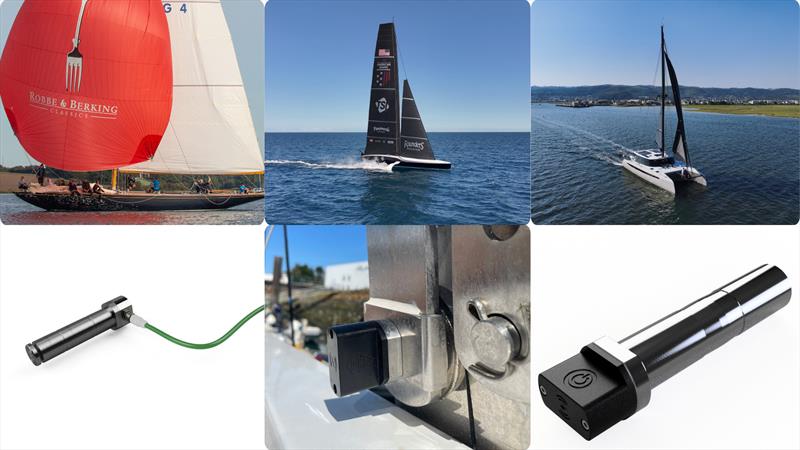
The Evolution of the Load Pin © Cyclops Marine
Innovative sailors are constantly observing other fields and looking for new technologies that have the potential to change the way they sail. Few adaptations have had quite the impact of the load pin, which made its way into sailing from the world of structural and industrial engineering, originally for racing at the highest level.
While it is unclear who can claim the distinction of being the first to use load pins onboard a yacht, some believe it was 1983 America's Cup winners 'Australia II' onboard their famous 12m. In any case, load pins were certainly being used by the 1987 Cup, and by the Deed of Gift Match in '88 load sensing was essential.
For racing, it seems a no-brainer - the loads running through your standing rigging determine your sail shape and overall performance - so monitoring and controlling them delivers a clear advantage. Unsurprisingly, load sensing solutions have evolved in all directions, many diverting away from the load pin entirely. But load pins have endured, and evolved in their own right, and in this America's Cup and Vendee Globe year, they are playing a key role for many of the teams set to take on sailing's greatest challenges, both inshore and offshore.
The Trickle-Down Effect
The evolution that has taken some by surprise is the uptake of load pins in the cruising world. But, the essential realisation has been that - if load pins are good enough to get IMOCA 60s through the world's toughest passages quickly, safely and efficiently - (with a few modifications to make them more user-friendly for the average joe), they're perfect to empower confident, comfortable cruising.
But of course, the pins being used by professional teams with in-house data management personnel are not the same as those being used by weekend cruisers.
So, let's take a closer look at how they've evolved to meet the needs of different sailors...
Analog
For race teams with data professionals, pins with analog outputs are still a regular choice. Forestay installations are most common, alongside a range of others. In the IMOCA class you'll find pins in the D0, bobstay, J2, J3, J1, backstay and lower shroud - with some of the top teams opting for full sets for an all around picture of their dynamic set up.
Analog pins are also popular among the America's Cup teams - where the data output lends itself to flexibility. Racing teams often have their own ways of processing and analysing data in-house, using a range of software - giving them the ability to get the most out of it in their own way.
Digital Direct (wired)
If there are technical reasons why you need wired rather than wireless pins, Digital Direct pins are the practical choice for most sailors, providing live data directly into the boat's digital network and into the onboard instrumentation.
As the load pin has evolved, it has become more streamlined, reliable and easy to use. Analog load pins have historically been associated with impracticality and unreliability - tending to need regular recalibration. Water ingress and changes in temperature have also caused them to malfunction. Modern digital pins have sought to address these issues.
Through internal amplification, Digital Direct technology has eliminated the need for an external amplifier, refining the solution into a single, durable unit with a robust digital signal. Factory calibrated, with no need for recalibration, Digital Direct pins assure accuracy to 1% of working load limit - with temperature compensation and a range of anti-rotation methods allowing them to remain reliable even in the most extreme conditions.
Also popular among race teams, you'll find Digital Direct load pins onboard lots of TP52s. They've also been installed onboard innovative yachts like NEO570-C 'Carbonita', which recently set a new course record at La Lunga Bolina.
Some of the world's most eminent racer-cruisers also opt for Digital Direct pins, such as the first ClubSwan 80 'MySong' and Oyster's first 885GT 'Babiana'.
Cruising Cats
Modern cruising multihulls are optimised for both high performance and high safety. Being so well designed for fast, efficient, comfortable sailing brings huge benefits to the sailor, but as they heel much less than monohulls, rig loads can escalate without tell-tale signs, increasing the risk of overload, which can pose a safety hazard. Live load data on-screen lets cruisers know how close they are to their limits, alerting them when it's time to reef.
A range of other load sensing solutions are available for cruising cats, but larger models are fitting load pins to both shrouds to provide an overall picture of rig loads - protecting their equipment and helping them stay safely within loading limits, also allowing them to hit and repeat fast settings.
Digital Direct pins are fitted to a wide range of cruising cats, including several new Gunboats, HH catamarans, and Kinetic catamarans like the one featured here:
Wireless
Continuing the curve into increasingly streamlined packages, wireless solutions are the newest incarnation of the load pin.
When it comes to cruising yachts, simpler, more streamlined solutions will normally mean enhanced practicality and ease of use. Eliminating wires radically increases ease of installation, simply dropping in as replacements for existing pins. It also delivers a weight saving, and decreases the likelihood of water ingress. Wireless pins can be used for a broader range of applications, like locations that move, or where wires cannot safely reach e.g. structural furling systems.
Using the data
While the hardware collecting load data has undertaken quite a journey, the software used to harness it has had to evolve with it. From the days when load data was reserved for expert teams, to its widespread uptake, the most significant change has been the increased simplicity of data to access, understand, and use effectively.
For racing teams at any level, load pins connect quickly and easily to every major instrumentation brand, as well as to any number of third party apps and analytics software platforms. For cruisers, for whom raw numbers may be less meaningful, more display options have been created, such as B&G's safety warning system, which displays data in green, amber or red to indicate safety level - simply letting the sailor know when to take action to depower the rig.
A wide range of wireless load sensors, as well as custom designed wired or wireless load pins are available from leading innovators in this space, Cyclops Marine.
Get in touch to learn more. Or visit the website.