
The Next Generation
by Mark Jardine 17 May 2023 10:00 AEST
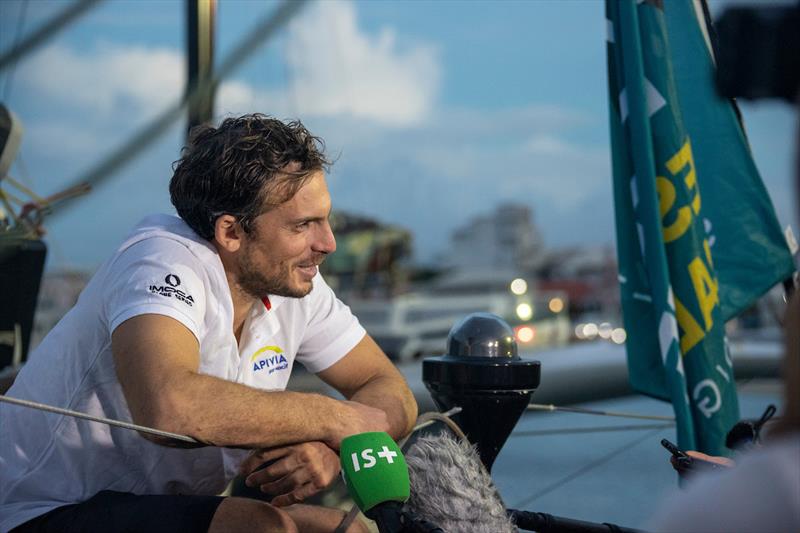
Charlie Dalin, skipper Macif © Alexis Courcoux
What's going to come out of a shed in Lorient? That's a question that's almost constantly being asked as the latest IMOCA builds are revealed. The class is always innovating, always changing, and always pushing the boundaries of what's possible.
Used in both the Vendée Globe and The Ocean Race, it is the monohull weapon of choice for top end offshore sailing and attracts the greatest skippers to take on fellow sailors, the elements, and the limits of endurance and technology.
The Ocean Race has shown the new foilers leaping out of the water and reaching previously unheard of speeds, but we've also witnessed the limits being reached, with two out of the five yachts entered in the race having their masts crash down. The shock loading on these boats has to be seriously intense, and while we don't yet know the cause of either Holcim-PRB or GUYOT environnement - Team Europe's problems, the way the boats slam back down to the water has to cause issues over time.
IMOCA class yachts are rarely 'helmed' anymore. The autopilot does that job, while the sailors trim the sails and calculate where to be to keep the boat sailing at its optimum angles. You could say they're the passenger to a computer, but it's no smooth ride on these machines and the sailors have their work cut out to keep everything together and fast.
The recent generation of IMOCA designs launched are varied. We've seen the aggressive lines of Jérémie Beyou's Charal 2, filled with radical thinking, and we've seen the sleek curves of Thomas Ruyant's For People. The yachts often reflect the character of their skipper, with their design philosophy fed to the naval architects, who then create that particular sailor's desires, and then the builders lay down the carbon to realise their dream.
In the last Vendee Globe Charlie Dalin in Apivia was the first to finish in Les Sables d'Olonne, but as Yannick Bestaven on Maître-CoQ was awarded time for assisting in the rescue of Kevin Escoffier on PRB, Dalin ended up finishing second overall. Since then he's been dominating in the class, and proving that both he and his IMOCA yachts are class acts. In June he's launching his new yacht MACIF, which could truly be The Next Generation. I spoke to Dalin to find out more about his aspirations and design philosophy.
Selling on a proven yacht and building a new IMOCA is a leap of faith, but Charlie is convinced they're on the right track:
"We're confident for many reasons. First of all the design of Apivia will be six years old in 2024, so it's quite a long time in offshore racing. There have been 14 launches since the last edition of the Vendée Globe, so that's 14 potentially faster boats. What we really wanted was to still be in charge of our destiny. While Apivia is a successful boat and fast, we could have just said 'Let's wait and see', but that would mean I would leave our destiny in the good or bad work of our competition. This passive mode didn't feel like an option. So we've worked as hard as possible, putting all our experience, and all the knowledge that we've gained, into the design of the new boat.
"We are the only ones who can compare the performance of the new boat against that of Apivia, as obviously we have all the data and the same architects. We had our benchmark for the new boat, and ran the Apivia design through the latest design tools, so we could really compare the performance side-by-side."
Certain yachts looks right on the water, and Apivia always looked smooth when racing, which can't be said for some of the more aggressive designs, and it's clear that Charlie is looking to continue that route with MACIF:
"We haven't changed the design brief. We wanted an all-round boat, fairly easy to sail, which doesn't need permanent attention to go fast, so that if you're slightly off balance or trim, you don't see a big drop-off in speed - that was definitely a strong point of Apivia - and what we've really tried to do is keep all the good points of the boat, but improve the weak points that we isolated. Downwind VMG in medium to big seas was definitely a weak point of Apivia. I believe we've achieved this with the new design."
Charlie's first race in his new IMOCA will be The Fastnet, which he won two years ago. There are always teething problems, so watching the performance will be interesting, and he outlined his goals for the race:
"I'd love to win it! Truly! All our experience has gone into the new boat's systems, so I believe we will be less far away from optimum performance when we start. I'm sure we'll have problems to solve during the race, but hopefully not enough to take us away from the performance side of the race. It really depends how the first few weeks go after we launch. Obviously we'll be facing boats which have had more sailing time than us, but I'm confident in the ability of the team to deliver something good from day one."
The IMOCA class is very much data-driven, where teams collect data about their competitors, as well as the autopilot learning on the job how to steer the boat perfectly:
"When you switch on your pilot, it takes less than a minute for it to adapt to the conditions. After that we activate or deactivate extra levels of control. If you want to add some heel parameters you can, plus upwind angles and speed goals. So you can adapt the pilot's goals according to the conditions. Being able to tune your pilot on the go is nearly as important as being a good sail trimmer. It's a deciding factor."
The ergonomics of the boat and the kit the sailors now wear has becoming increasingly important, as Charlie explains:
"The limiting factor is definitely the human in these boats. You need the ability to sustain the harsh conditions, with the deceleration, acceleration, and the slamming, so we've done a huge amount of work on the ergonomics on MACIF. Our philosophy is to make a boat with no compromises in terms of performance, but making it possible to sustain that performance for the sailor on board. My Musto sailing gear is a big part of the equation, as in theory it's impossible what we ask the kit to do. We have to go on deck to put the sails up, and drag 150 kilos when they're on the deck, stack them from one side to the other. Your kit needs to be fully waterproof otherwise your under and mid layers are wasted for the rest of the Southern Ocean, as in the South it never dries."
After the disappointment of the last Vendee, finishing first but not winning, I asked Charlie what it would mean to win the Vendée Globe 2024:
"It would mean a lot (he chuckles). I've spent a countless number of nights redoing the race in my head, chasing for lost minutes. The Vendée was actually only my second race solo in an IMOCA, so I've learned a lot since. It's funny as in the two years since the race I believe my sailing ability has improved a lot. And in my sleepless moments I can chase and find more lost minutes which could have been saved. I believe in myself, but there will be more competitors this time, the level will be higher, and there is always the risk of hitting something or breaking something. There are a lot of parameters you can't control, and no-one is guaranteed to succeed, even with the best of the best level of preparation. That's the tough part of this race; you never know whether you're going to make it to the finish, let alone win it."
Charlie Dalin certainly has the talent to win, the drive to succeed, the right team around him, and soon we'll see if his new IMOCA MACIF is everything that it should be. When talking about favourites for the Vendée Globe 2024, no conversation can be held without mentioning him. He's also a charismatic and engaging personality, which of course makes him a favourite with the French population, which in turn draws in the best sponsors.
I'm very much looking forward to watching to sailing out to Hurst Castle on 22nd July to watch The Fastnet fleet race out of the Solent, and seeing first-hand what his new boat looks like.
Mark Jardine
Sail-World.com and YachtsandYachting.com Managing Editor