
When Flares Were in Fashion - the story of the Magnum design of International Moth
by Dougal Henshall 18 May 2021 04:00 PDT
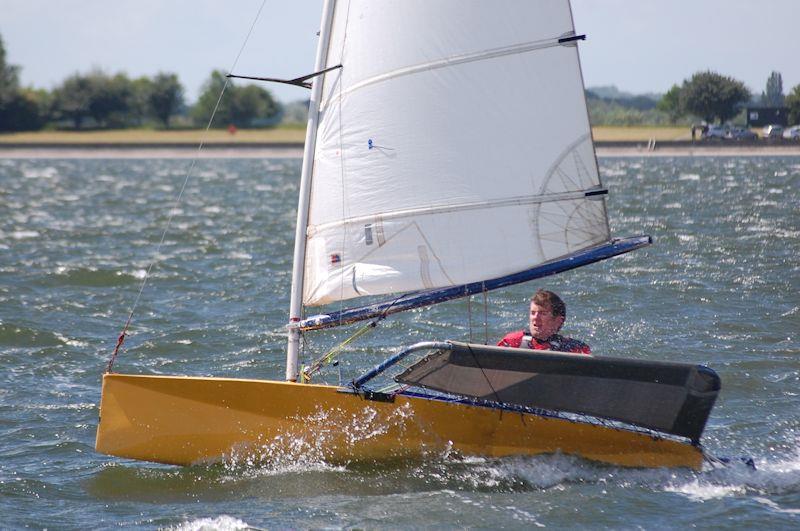
An International Moth from back when flares were in fashion © David Henshall
Those of you who logged on to the RYA's Virtual Dinghy Show earlier in the year may remember that I closed the event with my look at influential dinghy designs across the seven decades of the Show. From the many comments that I received after this I was happy to see that the majority understood that this was not simply a case of 'my favourite boats' but a far more rigorous exercise to look at those dinghy developments that would go on to break the existing rules and move the sport forward.
These strictures made one decade, the 1980s, particularly difficult for me to determine, because there was a standout boat (the B14) that I could not ignore. Set against this was a boat that - had I allowed my personal preference to rule - would have been the 'boat of the decade' and would have been right up there for consideration of the best boat across all seven decades, only to have to play second fiddle to the 5o5.
However, if I had been choosing a best-of-breed singlehander, it would have to be the International Moths that resulted from the World Championship-winning collaboration between designer Mervyn Cook and Lymington boat builder John Claridge. These of course were the Magnums, the dynasty of increasingly skinny boats that would start out by rewriting the rule book for dinghy design whilst in the process stretching the PY system to the maximum.
To understand the importance of the Magnums, we have to go back a bit further in time to when the Godfather of the International Moth, Tony Hibbert, had finally succeeded in bringing the disparate worldwide Moth rules together under one unified set of rules, which saw the more powerful, higher aspect, fully battened rigs quickly followed by stubby wings that would aid sitting out.
Internationally, the Moth fleet were becoming dominated by the blistering performance of the tunnel scow hulls that had been perfected by the Australians; if there was any breeze at all, these 'kitchen door' Moths (so called because in plan profile they were a simple rectangle) skated away across the water in a cloud of spray. Now this might have been great down in the Antipodean big breezes, but with much of the UK and European sailing being conducted in sub-12kt, shifty inland winds, the downside of the scow Moths was all too apparent. No matter how quick they might be, their performance was highly binary, for in light conditions they struggled and were left to prop up the back of the fleet.
The European and UK Moth scene was equally binary but in the reverse, for the hulls were more generally designed for light breezes and sloppy sea states, which had resulted in sharply V'd or round bilged hulls (some being almost completely semi-circular) with a good deal of rocker.
This hull form had proved remarkably fast but they had been optimized for the lower aspect, soft rigs. Though a number of hopeful sailors experimented with the big rigs on the round hulls, Mervyn Cook realised that a radical rethink was needed. The Moths were not the only fleet looking to make the next big steps, with Mervyn referring to the flatter rockered Merlin Rocket designs of Keith Callaghan and the Kirby V International 14 as just two sources of inspiration.
Mervyn already had produced a successful Moth design with his Chelsea Morning, which - though a deep V hull shape - was already establishing a trend towards reduced rocker. Mervyn's thinking would have but one major constraint; thankfully the International Moth Class is remarkably free of rules, but the one that counts most is that the maximum hull length is 11ft long. At the heart of his design philosophy would be a U-sectioned hull form, with a flat, but narrow, scow like bottom, with hard bilges to provide shelf stability. Hull rocker would be minimal, so that at rest the whole of the hull length would be immersed, with the thinking being that once the boat started moving, the flat underwater shape would develop dynamic lift and once the hull was up onto the plane, hull length becames less of a factor.
The plan was that the resulting hull shape would plane flat, rather than adopt the bow up angle taken by the traditional boats. At the same time, everything had to be moved further aft in the hull, with the mast heel moving back from the more traditional position up in the bow, with the intention being that this was essential; it was the aft area of the hull were most of the power was being generated.
This of course is taking a fairly simplistic approach to the theory of hull design, but the bottom line would be that together Mervyn and John Claridge also had the insight that their radical new hull form would depend on two other factors. Firstly, the boat would have to be built a whole order of magnitude lighter than other conventional dinghies of the day, and secondly, the existing conventions surrounding the beam-to-length ratio would need to be consigned to the history books.
To create the light weight hulls John Claridge, who Mervyn would describe as a supremely talented boatbuilder, would employ what was known as 'tortured ply', a technique for curving thin ply in two planes. Tortured ply had been used to great effect by multihull innovator John Mazzotti, but to get the double curvature required in a Magnum hull would take the technique to the current limitations... but with each new development of the design, the curves required would be tighter and more demanding for the builder.
The first Magnums would pose Moth sailors some interesting boat-handling issues that would require a rethink in terms of sailing techniques, with breezy weather presenting a serious challenge to those who wanted to get around a course whilst keeping a dry mast tip. Bearing away would be the real weakness, with spectacular pitchpole capsizes being the subject of many a conversation in the bar ashore.
Little surprise then that designer Mervyn Cook would include wide flares above the waterline hull on his subsequent versions of the Magnum, which helped create the almost iconic Magnum hull shape. The Magnum story then hit the headlines when David Iszatt won the Moth World Championship in a Magnum, then followed up this achievement by taking a boat to the next Championship, which was scheduled to be run at a traditionally windy location in New Zealand. The expectation was that in their favoured conditions the tunnel scows would dominate the racing, but instead Izatt retained his title, a result that would sound the death knell for the scows.
By now Mervyn and John had reached the Magnum 5, a popular all-rounder, but one that could be decidedly tricky downwind in breeze and waves. The next iteration would be the Magnum 6, which would take the design philosophy on a stage further whilst pushing the ply bending techniques to extremes, with even more in the way of double curvature. The hull was narrower, with less area in the mid-section and a slightly deeper rocker that was aimed at improving light airs performance. The 6 would soon be established as perhaps the most successful of all of the Magnum derivatives, with the likes of Roger Angell and Robin Woods proving to be consistent race winners in the boat.
Such was the demand for the boat that John Claridge would start selling hulls with a kit of parts to complete the decks, which would prove to be a very cost-effective way for people to gain access to the Moth fleet. Following on from the Magnum 6 would come the 7 (which was targeted at the very specific range of conditions found on a Swiss lake), then would come the equally famous Magnum 8, which was now taking the narrow hull form onto the next level. The 8 might well have been quicker, but as the designer himself would later say, the Magnum 6 had proven to be a very sweet boat to sail!
These then are truly game-changing boats, but there was so much more to the Magnum than just the scow-beating performances on the race course, as the step function they delivered in performance would create tensions with the operation of the UK's PY (Portsmouth yardstick) system. Before the Magnums, when many of the UK's International Moths still looked like small versions of larger boats, the Class rated about the same as a Firefly, but suddenly the new boats, still sailing off 113 were performing at a new level, which saw them able to pace boats such as the Merlin Rocket, rated at 109, on the water. If there was anything of a reach in the course the differential could be even bigger. When Moths started overhauling Fireballs on a reach, it was clear that something had to be done.
By now the Moths were THE boat to beat in the increasingly popular big handicap events, which accounted for a number of grumbles that a relatively cheap, plywood lightweight singlehander was comfortably beating the best of the high specification, sophisticated mainstream boats.
For those wanting to tap in to this new wave of sailing, the learning curve out afloat was steep but the rewards were there to be enjoyed.
There was plenty of support and advice from within the Class, both on sailing the boats, and keeping them in one piece, as everyone had been through the same experience of more time swimming than sailing, but once the techniques had been mastered, the rewards were there!
Blistering acceleration was matched by amazing speed but more that was the sensations that came with the awareness that you were sailing right at the very edge... a feeling than was maybe more akin to being on snow or ice, with the knowledge that it could all go very wrong in the blink of an eye. This really was fun sailing with a capital F!
The Magnum Moths offered so much in terms of 'bang for your buck', an affordable, accessible, high-octane experience afloat and a great shared togetherness ashore. On a breezy day just being able to get one of these boats around a course was a victory in itself and, in these pre-skiff and foiling days, in terms of fun afloat the Magnums didn't just tick all the boxes but would be laying the foundations for what was to come next.
Sadly, all this sparkling performance would come at a cost, as the whole ethos of the Magnums was focused on the lightweight construction which was hardly consistent with longevity.
Moreover, as Mervyn Cook later said, it was a time of great creativity, with his Moth designs being developed at an incredible pace and, though the boats were hardly 'throwaway' items, it was hardly any surprise that few would survive through to today. This makes the discovery of a mid-1980s Magnum something of a red-letter day amongst the growing ranks of the classic low-rider Moth fleet, even if the boat has a worrying collection of holes and fresh air where there should be ply. Luckily, the hull has found its way into the capable hands of boatbuilder Ian Ridge, who in his younger days was a highly successful Moth sailor.
His first task was to see if a positive identification of the boat could be made, which meant trying to make sense of a number created by many shallow drill holes made into the hull. But with only 3mm of hull to work with these were never that prominent, then time and the layers of paint have obscured things further. At first the best that the dinghy detectives could come up with was K3903, which would have suggested a Magnum 6 from 1985. The problem was that too much rubbing with sandpaper would remove the numbers for good, so this part of the task had to be undertaken with all the care of an archaeological investigation. It was a slow process but one that was worthwhile as a combination of careful removal of layers of paint and some very bright lighting eventually forced the boat to give up its secret as the number K3931 emerged, making this the last ever Magnum 6 registered!
More detailed investigations were made by delving into the class magazines (a great source of detail for those interested in the history of the class) showed that this had been the boat of none other than Steve Norbury when he raced it at Weston SC on Southampton Water, but after that the story becomes sketchy in detail.
The intention now is that the damage to the hull will be repaired and then the boat will complete a full restoration before reappearing on the classic low-rider Moth scene. The good news is that the boat now sports carbon spars, for, as those who know about these things will painfully recall, in terms of sheer trickiness to sail, a narrow Moth with a heavy alloy rig is widely accepted as the 'most difficult to sail' boat yet devised. Watch this space - there will be pictures as this is supposed to be FUN!