
A Q&A with Nikki Barnes and Lara Dallman-Weiss on earning their berth to the Tokyo 2021 Olympics
by David Schmidt 11 May 2021 08:00 PDT
May 11, 2021
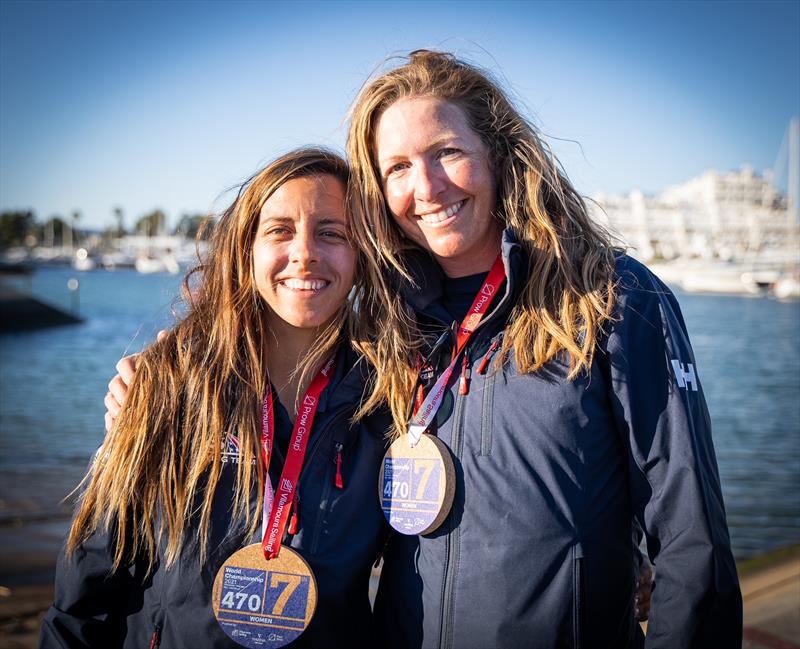
Nikki Barnes and Lara Dallman-Weiss will represent the USA in the Women's 470 event at the Tokyo 2020 Olympics © Perfect Vision Sailing
Earning a berth to any Olympic Games for any sailing event requires serious sailing skills, blinders-on determination, and nonstop drive, but few recent Olympic trials have been tougher than the multi-year battle to determine which Women's 470 team would represent the USA at the Tokyo 2020 Olympics. While most other U.S.-flagged teams had already earned their berths to the Tokyo Games by the time that the pandemic grabbed society's collective lapels and began shaking, hard, competition was so tight in the talent-rife Women's 470 class that Olympic Trials for this event were slated to conclude at the 2020 470 World Championships (March 13-20, on the waters off of Palma de Mallorca).
Unfortunately, this regatta, like so many other 2020 events, was cancelled due to the global surge of the novel coronavirus.
This meant that the three highly polished American Women's 470 teams that were vying for a single berth had to wait until the 2021 470 Worlds (March 5-13, on the waters off of Vilamoura, Portugal) to complete their Olympic Trials and find out if they would be representing the USA at the rescheduled Tokyo Games (July 23-August 8, 2021).
Impressively, everything boiled down to the final race of the 2021 470 Worlds, with two teams—sisters Carmen and Emma Cowles, and U.S. Coast Guard Lieutenant Junior Grade Nikole 'Nikki' Barnes* and Lara Dallman-Weiss—still in serious contention when the starting gun sounded.
Ultimately, the Cowles sisters finished in 12th place, while Barnes and Dallman-Weiss finished in seventh place, sealing the deal. (A third team, comprised of sisters Atlantic and Nora Brugman, finished in 19th place at the 2021 470 Worlds.)
I checked in with Barnes and Dallman-Weiss, via email, to learn more about their hard-fought berth to the Tokyo 2020 Olympics and the state of their campaign.
What was the hardest part of your Trials—the racing or the really long wait?
Barnes: The hardest part of our Trials was the actual Trials. When we are training, we go full-on, and we didn't have the threat of the other teams at our training sessions.
During the Trials, we had to have a strong strategy against both the fleet and the American teams to win the Trials and finish at our top potential at worlds. We loved that extra year of sailing!
In that same vein, do you see your prolonged Trials as being an advantage or disadvantage compared to other Women's 470 teams that will be racing in Tokyo?
Dallman-Weiss: An absolute advantage for us! We were racing the clock for the first two years of our campaign, and especially because we were only with coach Robby (Bisi) for one year before the pandemic.
He was cramming all his 470 knowledge into our short timeline and the additional year not only gave us a chance to take a breather, but it allowed us to dig deep into 470 theory and be able to develop our own style.
As a crew, I used to obsess over watching videos and studying photos of other sailors. Now, over the past year, I no longer look outward. The best thing for me is to watch a film of my own sailing and come to my own conclusions.
Nikki and I are also now very familiar with what the boat needs and how to problem solve within any given condition. Earlier in the campaign, we used to always stop and ask Robby for answers and now we see what we can do before bringing him in.
This is an incredibly fun stage for us because the more comfortable we become on the 470, the less we have to focus on board, and we can bring in our knowledge from all of our past racing experience!
The saying goes that if one constantly sharpens a knife, the blade will eventually dull. How are you guys managing your campaign so that your boat speed and racecourse smarts don't suffer as a result of the amount of time that you had to focus on earning your berth to the Games?
Barnes: One major thing that this campaign has taught us is that balance is key! We were training to win the Trials but also focusing on reaching our highest potential.
Since the Trials process was so long, we used every qualifier as a steppingstone so that we could maintain growth in speed and smarts while using these trials as checkpoints on how our training had helped us.
When do you plan to travel to Japan and begin sailing off of Enoshima? Also, how much experience do you have sailing on these waters?
Dallman-Weiss: Oh, we love Sagami Bay!
In 2019 we spent 50 days there and saw a full range of conditions, especially the waves; they were very dynamic. The one thing that stayed consistent was the heat! We aren't sure yet when we will be allowed to start training in Japan.
What do you see as your biggest strengths going into the Games? Also, what do you plan to do to further bolster these strengths before the starting guns begin sounding?
Barnes: Our biggest strength going into the Games is our mindset and the willingness to continue pushing despite being the underdogs in the fleet. We will continue working on this mindset and operating in high-pressure situations so that we are ready for anything at the Games.
What do you see as your biggest weaknesses going into the Olympics, and what are you doing in the remaining two-plus months to address any soft spots?
Dallman-Weiss: We took some time after the Trials to see where our biggest areas of improvement could be. There are a few pieces of technology we are bringing into the program that Robby has wanted to use that will help our boatspeed in certain conditions. That really excites me; I love looking over data.
Other than that, compared to our competitors, we are still very new to the 470 so we will keep refining our technique until the day before racing in the Games begins!
Can you give us a description in a typical week in the life of an Olympic 470 team a few months before the Games? What does your training look like, and what's your typical breakdown of gym time and sailing time?
Barnes: During the fall we trained with some high-level teams in Santander, Spain. While there, our weeks added up to about 100 hours per week.
We spent long hours on the water, in the gym, on campaign work, working on our equipment, and debriefing about the sessions. We would wake up, workout for about 1.5 hours before sailing, meet, and eat breakfast, rig, sail for four to six hours on the water, de-rig, debrief after getting off the water, workout for an hour, watch video, eat dinner, stretch, and head to bed.
The on-the-water time is always greater than the gym time, but the ratio depends on how far we are outside of competition and what our goals are for the current training camp that we are in. It's a balance!
How has the pandemic affected your campaign? Also, what kinds of hurdles is it presenting as you enter the final stretch before Tokyo?
Dallman-Weiss: Well, the most significant effect was on our budget. We were the final class selected to Team USA, so several of our previous donors chose to support those who had already made the team and that was a big hurdle for us over the past year.
We had a few individuals step in to support our team and we cannot thank them enough for believing in us!
The other difficulty from the past year was navigating travel restrictions and training in a safe environment. We spent time in both Spain and Portugal, and it certainly taught us how to problem solve on a new level.
For all the craziness that the last year brought, we couldn't have come out of it without the help from our incredible support system.
Is there anything else that you'd like to add, for the record?
Barnes: We are so grateful for our coach Robby Bisi. He believed in us from the beginning and always adapts to new situations to make sure that we get the most out of our sailing. When we are out there sailing, there are only two people on the boat but on the water, we are always three people to complete the boat. Thanks for coaching us, Robby!
Also... our parents are just like Robby, but they have had to put up with us for all our lives. They showed us from a young age that we can accomplish anything we put our minds to if we work hard, enjoy the process, and never take no for an answer. Thank you, Carol, Dean, Sue, and John!
*Nikki Barnes will receive a promotion to Lieutenant in the USCG on May 17, 2021