
America's Cup: The science behind the Sky-Jumps
by Richard Gladwell 17 May 2020 17:43 PDT
18 May 2020
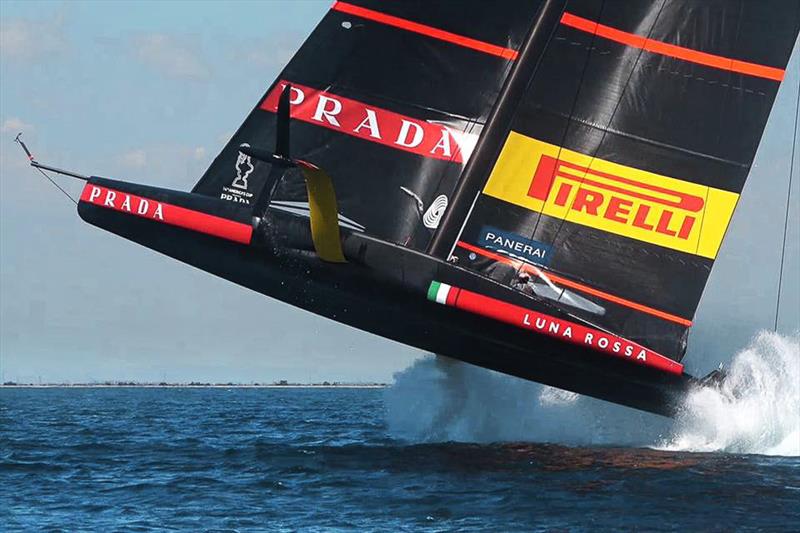
A short-crewed Luna Rossa lights their afterburner during training in Cagliari, Sardinia © Luna Rossa
The new class for the 36th America's Cup, the AC75, a 69ft monohull with a 6ft bowsprit, presents a new set of challenges for teams, and some great spectacles are on offer for Cup fans..
In over 200 years of yacht racing, no-one has raced a foiling yacht of this size and type, to say nothing of the technology.
While the AC75 is unique, so is one of its vices - the Sky Jump - where the 7,500kg yacht jumps almost completely clear of the water, before crashing back back into the water with all the elegance and grandeur of a humpback whale broaching.
The AC75 is as much aircraft as it is a boat, with teams now quite openly referring to the canoe body of the yacht as a hull when it is in conventional sailing mode, and as a fuselage when it is airborne and governed by a completely different set of physical criteria.
It is likely that the next America's Cup will be determined by the lower metre and a half of the boat/aircraft - or the foil arms and their attached wings and flaps.
The wings on an AC75 are quite different in concept to the daggerboards used on the earlier AC50 and AC72, where the amount of lift was controlled by raking the angle of the board using hydraulic power.
On the AC75, foiling system is very similar to an aircraft wing, comprising the wing itself, with controllable flaps on the trailing edge.
The crew use a "flight control" to control the foils and rudder - to lift the boat from the water into foiling mode.
When racing, the flight control has to be manually controlled by the crew. It comprises a number of functions which effectively control the flight of the AC75.
During testing, the teams are allowed to use a completely computer-driven system, free of crew intervention. That's fine in a controlled state, and probably better than in crew operated mode - but it is a bit like a driverless car - when things go wrong the outcome is spectacular.
In the AC50's used in Bermuda, when systems went awry in the flight control department, a nosedive was the usual outcome. The boat could go bow-down in a 10kt breeze and the lift the rudder wing clear of the water, instantly releasing 500kg of downward pressure at the back of the boat.
The phenomenon was graphically displayed in the Kiwis spectacular nosedive in the second day of the Semi-Finals in strong winds however all teams had "near misses" in much lighter wind strengths - as low as 10kts.
The buoyant bows on the AC75 turn a nosedive into a spectacular splash which can extend up to a third of the rig height.
But the AC75 has a unique characteristic - rearing up clear of the water at a takeoff angle sharper than that of a commercial airliner taking off from a runway.
On balance, the AC75's while wetter are probably a lot less dangerous than a high speed nosedive in a foiling catamaran, with the crew being dropped from a great height into a carbon-ribbed wingsail.
Te Aihe, Team New Zealand's AC75 was the first to give her aerobatic display just before Christmas, leaping completely clear of the water before crashing back on her side, skidding sideways, and eventually capsizing.
Ten days ago, Italian challenger, Luna Rossa - did the same while training in Sardinia, but without the capsize.
Even so Te Aihe was up and sailing within five minutes, after her leap and capsize - way less than the 40 minutes to recover from their AC50 nosedive in Bermuda
A video of Te Aihe taken just before the incident showed the boat being spun through a sharp high-speed gybe, where the foil control systems could not keep pace with the rate of turn.
As as the boat exited the sharp turn, the various adjustments were not synchronised, causing too much lift to be generated from the immersed main foil. At at the same time a second wing on the rudder wing dramatically stalled and lost its lift.
Foiling is all about equal and opposite forces, wind, water and the control surfaces effecting them - get those out of kilter, and the results is far from optimal performance
On the two AC75's the effect was for the leeward side of the boat to be pushed high, while the stern sank, with the stalled rudder wing incapacitated and unable to generate a sufficient lifting force to offset compliment that coming from the main foil.
Both the Italian and New Zealand incidents appear to have occurred under similar conditions 10-14kts of wind and relatively smooth seas when the AC75 is at its most powerful relative to the wind speed.
The outcomes were different with the Kiwis capsizing, while the Italians did not. Both crashed back into the water with all the elegance and grandeur of a humpback whale broaching.
“The AC 75 Luna Rossa Prada Pirelli Team came out of a slightly too high gybe," Luna Rossa coach Philippe Presti told leading French sailing magazine Voiles et Voiliers, giving a verbal description of the Luna Rossa incident which appeared to have a similar genesis to that of Emirates Team New Zealand's last December.
He added that generally an AC75 would come out of a gybe at around 130 degrees to the true wind. The double skinned mainsail does lose a little power, but the helmsman can correct the situation putting the bow down to 140 degrees to rebuild power and boat speed.
“On this spectacular action," Presti says "the angle was closer to 120 degrees [to the true wind angle], which brought the AC 75 closer to what we call the power zone. The forces generated by the sails with this tight angle are more powerful. Once again, this remains manageable at the helm, but this can lead to the boat heeling. And the heeling action, when you are high on the foils, it can bring the rudder foil out of the water, which ventilates and stalls. "
Presti says the rear of the boat, which is lifted by the rudder foil, drops suddenly when the rudder wing stalls. This phenomenon serves to increase the angle of attack of the main foil [which is bigger and still generating lift].
The leeward main foil generates much more power which propels the bow of the AC 75 upwards, because the stern of the boat is no longer supported by the rudder, he explains.
"The boat stopped dead before coming to rest in the water," Presti reported.
Of course, in the simulator driven world of the current America's Cup both teams will have gained valuable on the water data to analyse, replicate and then develop and boat and foil management strategy to prevent a re-occurrence. By Cup time it may well be that the crews have usd their simulators to find the antidote for this phenomenon.
But if not, spectators are in for a treat if there are similar aerobatic displays in the America's Cup racing.