
Reflections on a life afloat: Learning about frostbiting
by David Schmidt 12 May 2020 08:00 PDT
May 12, 2020
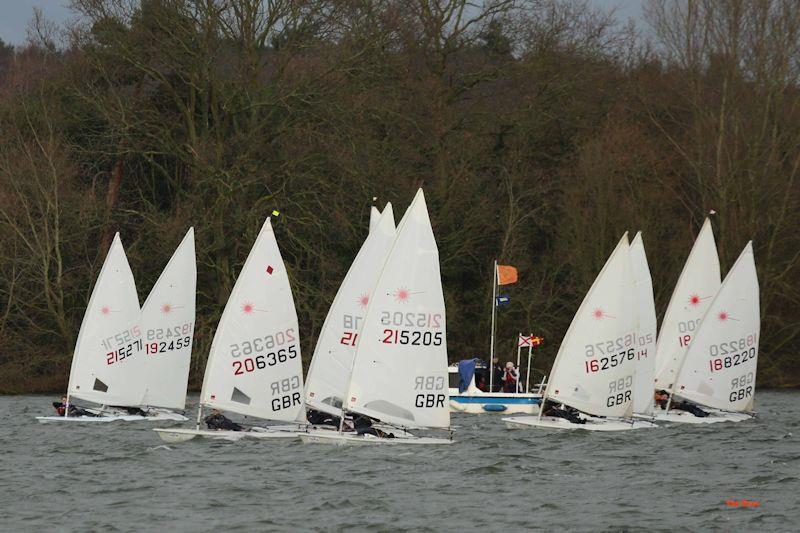
Start of the Laser fleet on week 5 of the Alton Water 2020 Fox's Chandlery & Anglian Water Frostbite Series © Tim Bees
As longtime readers know, much of the racing calendar around the Puget Sound area unfurls during the fall, winter and spring months, allowing teams to harness the winds that are usually absent during summer's high-pressure-system months. While these races are a heck of a lot of fun, they often require the same fleeces, puffy jackets and Merino wool long johns that one typically dons to go skiing on a cold winter day.
Really, the only difference is the saline shots that seem to regularly find their way down the foredeck to the rail meat. Chilly, yes, but my background frostbiting Lasers in New England as a kid helped prepare me for the less-than-peak moments that are involved with cold-weather sailing. And while I'm no Wim Hof (Google him - he's an interesting bloke) when it comes to negotiating cold weather, these early experiences opened my mind to the fact that sailing doesn't have to be a fair-weather endeavor. Given the amount of time that Washington State's novel coronavirus lockdown has given me for contemplation, I've recently found myself reflecting on my first day of frostbiting - and Laser sailing - in 1989 at the ripe age of 13.
As a kid growing up in a sailing-obsessed house in Connecticut, I spent large parcels of my late grammar-school and middle-school years dreaming of owning and racing Lasers. I'd already graduated from Blue Jays, but when I approached my parents with what I assumed would be a wonderful "investment opportunity," my dad wisely elected to instead teach me about financial responsibility and instill a work ethic. Twenty-four hours later I was in business mowing lawns, doing yard work, and - my personal (least) favorite - spreading mulch in flower beds. Glamourous it was not, but after a "quick" two years, I was the proud new owner of a yellow, Canadian-built Laser.
The first catch was that I bought the boat in late October. After reviewing my options, and the get-me-out-on-the-water-now mentality of a then-13-year-old boy, waiting for summer sailing lessons was out. So instead I looked into the local frostbiting fleet.
The second catch was that, while I had a lot of big-boat (thanks, dad!) and Blue Jay experience, I'd never actually sailed a Laser before that late-November Saturday. No worries, I remember thinking as my parents drove me down to the yacht club. I was fairly strong for my age, and how hard could sailing a Laser be?
The third catch was my personal kit. Since I had bankrupted myself buying the boat, I stood on the dock rigging the boat (with some help from other older and wiser competitors) wearing a one-piece foul-weather gear suit and a pair of dinghy-racing boots. No wet suit, no dry suit, just a heck of a lot of enthusiasm and excitement to finally be sailing my own boat.
Freshly fallen snow lined the shores and a stiff wind blew down Long Island Sound, but I can remember being the first sailor off the dock that day. I foolheartedly figured that a half hour of practice before racing began would be plenty of time to get the feel for the boat.
Wrong.
My dad helped push my bow off the dock, and I immediately felt the boat power up. It would have been hard to miss, as the wind was hitting my sail at a broad reaching angle, so the foils immediately started humming as the boat hopped up on a plane. I still remember my face threatening to split from the massive grin and feeling of accomplishment. All the chopped firewood, the grass clippings and the mulch felt light years removed from my vantage point in my tidy cockpit.
I started imagining myself thumping the adults once the starting guns began sounding later that morning. While the Laser was a way higher-performance dinghy than I had ever sailed before (again, this was 1989 and I was 13), the boat felt reasonably well-mannered, allowing my daydream to continue.
Then came the first gybe.
For anyone who isn't familiar with Lasers, they have a pronounced gunwale and lip that run all the way around the boat. If you're sailing a relatively deep angle and have a lot of mainsheet out, the stern quarters present themselves as meat hooks that can - and often do - grab the sheet coming from the boom end as it swings through the breeze.
I just remember pulling the tiller towards myself and ducking under the boom as my entire world flipped 90 degrees. I barely even had any time to figure out what happened before I hit Long Island Sound's cold, cold water. I immediately worked my way to the centerboard, but as I applied my weight, I noticed that the boom was thrusting awkwardly out of the brine at the sky, exposing significant sail area to the gathering wind. The boat came up, I beached-whale'd myself aboard, only to instantly be back in the water, thanks to the mainsheet-grabbing gunwale.
While 30-plus years have elapsed since that day, I just remember the feeling of fear mixing with plummeting body temps and mouthfuls of brine as I wrestled with the boat, not yet understanding that the key to solving my predicament lay in unhooking the mainsheet. Instead of solving the problem, history began repeating itself.
That is, until the boat turned turtle and the masthead found - and augured itself into - the harbor mud.
By now my fellow competitors - the ones I was planning on thumping - were out on the racecourse and came by to offer assistance. I remember standing on the inverted gunwale lip, pulling back mightily on the daggerboard but to no avail. Finally, a chase boat came to my rescue, but not before feeling started evacuating my fingers, toes and hands. Even my nose went numb.
Eventually, the chase boat driver and I managed to get the boat upright, and a fellow competitor clued me in to the issue with my mainsheet.
Any foolhardy thoughts of racing - let alone winning - were long gone, replaced only with the strong, strong desire to get warm, dry and out of my sopping-wet clothes. Glancing up at the top of my mast revealed that my inexperience was on full display: Instead of a crisp white triangle, the top of my rig was flying a "mud flag", compliments of the auguring job and harbor sludge.
I managed to get the boat back to the dock, but not before I capsized a few times while sailing to weather, thus furthering my education about the fact that, while I might have been rich with enthusiasm and love for my hard-won new toy, I was flat broke with experience about keeping a Laser flat in a late-fall breeze.
My parents helped me de-rig the boat and get it back onto its rack on the dock before plying me with hot chocolate, soup and kind and reassuring words in the YC bar. I watched the adults racing their Lasers from the windows, and made two resolutions. First, I would find a way to get a wetsuit (dry-suits were way out of my financial grasp back then), and second, I would return as soon as I was properly equipped.
Bruised, yes, but undeterred.
More importantly, instead of ignorantly daydreaming about thumping far, far more experienced sailors, I resolved to instead study their boathandling techniques, to ask a lot of annoying questions (specifically about how to avoid death-rolling and catching the sheet on the gunwale lip), and to trade all illusions for grandeur for the opportunity to learn.
Humble pie might have its own memorable aftertaste, but even these days, as I find myself riding a carbon-fiber rail on cold and blustery days on Puget Sound, I often remember that first day of Laser sailing - not to mention the hundreds of other considerably happier and warmer days of sailing that wonderful little boat - as the first shots of seawater douse my Gore-Tex bibs and leather sailing boots. Puget Sound sailing may be cold, but I've yet to see any mug flags.
As for Wim Hof, he could have a great career as a frostbiting sailor.
May the four winds blow you safely home,
David Schmidt
Sail-World.com North American Editor