Fedor Konyukhov moving north - Antarctica Cup Race
by Bob Williams on 15 Mar 2008
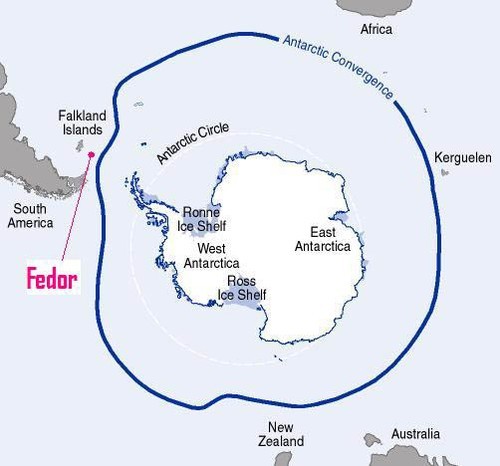
Antarctic Convergence Antarctica Cup Racetrack
http://www.antarcticacup.com
Russian solo circumnavigator Fedor Konyukhov is now moving northwards after rounding Cape Horn on Wednesday, to clear the vast number of icebergs the C-CORE Ice detection service has located floating in the South Atlantic as far north as 45°S.
The 56 year old sailor, crossed through the Shackleton Gate – Gate 9 within the Antarctic Racetrack - at 23:55 UTC, and is now being routed by American weather guru Lee Bruce just above the Antarctic Convergence zone or Polar Front and the sectors of the Racetrack that have either been 'Closed' or are have a 'Yellow Flag' alert applied due to icebergs.
Bruce reports: 'The satellite picture suggests squalls in the area near Fedor—but some breaks of sunshine. However, a heavier bank of clouds is moving in from the WSW. I have suggested a route that stays close to theFalklands which will set Fedor up for the northerly winds forecast for 15th March. For Fedor to leave 50S 50W to starboard, he will need the westing. To accomplish that, he must gybe either side of a line about 52°S 57°W. It is not ideal, and we will have to see how he fares over the next two days. It may be difficult for him to stay out of the yellow caution zone of the CENTER LANE.'
Forecast: 14th March 08/0000 UTC: SW 30-35 knots 1200 UTC: WSW 20-25 knots 15th March/0000 UTC: NNW 15-20 knots.’
Konyukhov’s Open 80 yacht Trading Network Alye Parusa, crossed longitude 62W – the half way point of the Antarctica Cup Racetrack - at 14:00 UTC 13 March and is now homeward bound for Albany. Yesterday, however, Fedor was still reflecting on his fourth rounding of Cape Horn.
'It is very emotional to be on deck and see this massive rock which is a milestone for my journey around the Antarctica Cup Racetrack. The approach was very difficult. The ocean was indescribably wild and powerful. My 30 ton yacht was dragged like a tree leaf, the waves were hitting the port rudder, stern and starboard rudder. There was no place to hide as waves were coming from N-W, W, S-W. On the approach to Diego Ramirez Islands one of two Raymarine autopilots burned out, the boat lost control, turned up into wind and was hit so hard by the seas that I thought we would lose bow and mast. It took me half a minute to sort things out and switch to the reserve unit. After a terrible night, things then began to improve 20 miles from the Cape. All of a sudden I saw this stunning sun rise! It was a greatest gift possible. Visibility improved and I could see Cape Horn 15 miles on my port side. It took me another hour to get close enough to see the Horn in all its beauty. This is the first land I have seen since leaving Albany!
On the VHF – channel 16- I heard Chilean fishermen talking to each other. It is such a great thing to hear someone on the radio! I am not alone in this Ocean! The fourth time for me proves to be lucky – I can finally see Cape Horn from the deck of my boat. That was my dream. My three previous roundings have always happened at night.
I’m 56 and don’t know if I will have a chance to see Cape Horn again, but with four successful passages around – I think it is enough. I’m satisfied and feel complete. This time it is a special rounding – we are not heading north towards the Equator but staying in the Southern Ocean for another 8,000 miles back to Albany'.
Fedor Konyukhov’s 4 solo Cape Horn encounters.
31 December 1990, 36 ft yacht Karaana,
17 March 1999, ‘Open 60’ Modern University for the Humanities
09 April 2005, Open 85 Trading Network Alye Parusa
12 March 2008, Open 85 Trading Network Alye Parusa
The Antarctic Convergence: better known as the Antarctic Polar Frontal Zone (or 'Polar Front' for short), is a line encircling Antarctica where cold, northward-flowing Antarctic waters meet and mix with the relatively warmer waters of the sub-Antarctic. Antarctic waters predominantly sink beneath sub-Antarctic waters, while associated zones of mixing and upwelling create a zone very high in marine productivity, especially for Antarctic Krill. The line is actually a zone approximately 32 km (20 mi) to 48 km (30 mi) wide, varying somewhat in latitude seasonally and in different longitudes, extending across the South Atlantic, Pacific, and Indian Oceans between the 48th and 61st parallels of south latitude. The precise location at any given place and time is made evident by the sudden drop in temperature from north to south of, on average, 2.8 °C (5 °F) to 5.5 °C (10 °F), to below 2 °C (35.6 °F). Although this zone is a mobile one, it usually does not stray more than a half a degree of latitude from its mean position. Fedor is now sailing above the Antarctica Convergence. The Antarctic Convergence extends its furthermost north across the South Atlantic Ocean and is thought to be the northern extent of 'Iceberg Alley' the massive field of icebergs located to the east of South Georgia Island.
GATE 9 of the Antarctica Cup Racetrack is named after SIR ERNEST SHACKLETON 1874 – 1922. Shackleton led the Imperial Trans-Antarctic Expedition and Ross Sea Party 1914-1916. After losing the ship Endurance in giant ice floes Shackelton and his men reached Elephant Island and awaited rescue. Elephant Island was an inhospitable place far from any shipping routes and thus a poor point from which to await rescue. Consequently, Shackleton felt it essential that he set out immediately upon arrival, and to him, it was obvious that he must head back to South Georgia, even if it meant traversing 1,287 kilometres (800 mi) of open ocean in one of the lifeboats. The lifeboat James Caird was chosen for the trip. The waters that Shackleton were to cross in his boat of 7 metres (23ft) are among the most treacherous in the world. Weather reports confirm that gale-force winds of 60 kilometres per hour (37mph) to 70 kilometres per hour (43mph) are present in the Drake Passage between South America and Antarctica on an average of 200 days per year; they cause ocean swells of 6 metres (20ft), and the ship's captain, Frank Worsley, suggested that waves of 16 metres (52 ft) were not uncommon. Of the journey, Shackleton wrote:
'At midnight I was at the tiller and suddenly noticed a line of clear sky between the south and south-west. I called to the other men that the sky was clearing, and then a moment later I realised that what I had seen was not a rift in the clouds but the white crest of an enormous wave. During twenty-six years' experience of the ocean in all its moods I had not encountered a wave so gigantic. It was a mighty upheaval of the ocean, a thing quite apart from the big white-capped seas that had been our tireless enemies for many days. I shouted, 'For God's sake, hold on! It's got us!' Then came a moment of suspense that seemed drawn out into hours. White surged the foam of the breaking sea around us. We felt our boat lifted and flung forward like a cork in breaking surf. We were in a seething chaos of tortured water; but somehow the boat lived through it, half-full of water, sagging to the dead weight and shuddering under the blow. We baled with the energy of men fighting for life, flinging the water over the sides with every receptacle that came to our hands, and after ten minutes of uncertainty we felt the boat renew her life beneath us'– Ernest Shackleton.
http://www.antarcticacup.com/
If you want to link to this article then please use this URL: www.sail-world.com/42633