Please select your home edition
Edition
MarkSetBot

New York Yacht Club opens Queen's Cup to all qualified entries

by NYYC on 27 Aug 2015
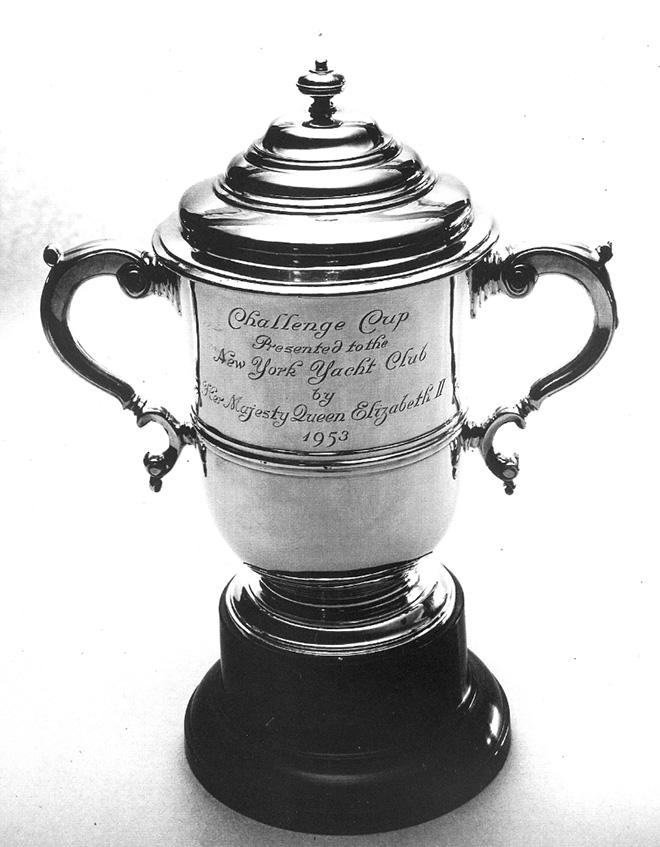
Queen's Cup NYYC
The Queen's Cup was first contested in 1953 on Rhode Island Sound, just over a year after Queen Elizabeth II assumed the throne of England following the death of her father George VI. It was scheduled during the New York Yacht Club's Annual Cruise—as had been the case with the King's Cup—so only yachts skippered by members of the Club competed. Gilbert Verney's 67-foot yawl Sea Lion was the first boat to finish the 16.6-mile course, and the winner on handicap as well.

The Queen's Cup has remained a part of the Annual Cruise ever since. Only in 1966, when John B. Kilroy's Kialoa II, representing the St. Francis Yacht Club in San Francisco, was invited to compete for the Queen's Cup, has a non-member won the sturdy double-handed trophy.

This September 20, however, the race will be sailed as a stand-alone event off Newport, R.I.; and the Club is inviting to compete any boat that meets qualifications for entry, which include an IRC rating of 1.07 or greater and an ISAF Category one helmsman.

'The Queen's Cup is one of the Club's most coveted annual trophies,' says Commodore A. Rives Potts Jr. 'The winner's list includes many of the Club's top racing programs from the last half century. We're excited to see what other top IRC boats will come out to contest the race this September.'

Unlike many modern regattas, the Queen's Cup is just one race; usually a lengthy windward-leeward affair. It also features a unique starting procedure. Provided a yacht starts within two minutes of the starting gun, her elapsed time starts the moment she crosses the line.

Winning the start, normally a crucial part of any sailboat race, isn't nearly as important. In 2008, Stuart Saffer put together a pick-up crew, borrowed Barry Gold's J/122 Sundari for the race and took full advantage of the 'starting window'.

'Being one of the slowest boats on handicap, we used the extra time to see what would be our first shift, and started almost two minutes later than the fleet,' says Saffer. 'We were doing OK, but the bigger boats were so far ahead we had no clue of our positioning. A squall came through while rounding the weather mark for the last time, and we broke the boom while jibing. We had no idea we won until we were back at the dock at Newport Yachting Center and got a call from a friend. We were shocked, amazed, elated and thrilled.'

The result of the Queen's Cup is the subject of an annual correspondence between the Club and the British Monarchy, with the winner receiving a copy of the Queen's reply.

'I still have my copies of those letters framed on the wall in my home,' says Saffer. 'Having my name on the same trophy as the best big boat skippers at NYYC is certainly humbling.'

The Queen's Cup start is scheduled for 1300 EST on September 20, with the racing to be held on Rhode Island Sound or inside Narragansett Bay.
Seawind 2026 Trade CampaignMaritimo M75Armstrong 728x90 - HA Foil Range - BOTTOM

Related Articles

57th French Olympic Week in Hyères day 1
Chess on the water, philosophy in the kites, and Italian profits The 57th edition of La Semaine Olympique Française de Hyères - TPM (France's Olympic sailing week) began on Monday in Champagne Côte d'Azur conditions as 705 competitors from 59 nations started six days of racing.
Posted on 20 Apr
Foiling Week 2026 - entries open
A key meeting point for the international foiling community The event confirms its role as the leading platform for technical exchange and a key meeting point for the international foiling community.
Posted on 20 Apr
Sigrid Greven to Speak at Women Sailing Conference
Her presentation is open to all attendees on Saturday, April 25 Sigrid Greven, an accomplished and inspiring offshore sailor, will be a featured speaker at the Women Sailing Conference on Saturday, April 25, 2026, in Barrington, Rhode Island.
Posted on 20 Apr
470 class at French Olympic Week Hyères Day 1
Racing Kicks Off in Style The opening day of French Olympic Week is complete, delivering light winds and three races that saw Italians Elena Berta and Giulio Calabrò take a commanding lead. The second stop of the Sailing Grand Slam is now officially under way.
Posted on 20 Apr
Introducing The Next Generation Of Moth Sails
Helix™ Moth sails feature seamless 3Di construction that precisely aligns fiber pathways North Sails new Helix™ Moth sails feature seamless 3Di construction that precisely aligns fiber pathways with true load paths, and a fully molded luff and deck sweeper for America's Cup–inspired speed, control and stability.
Posted on 20 Apr
Antigua Classic Yacht Regatta overall
Perfect trade wind conditions for the classic regatta finale After four days of hard sailing, the crews set off with as much enthusiasm as on day one — though with a touch of sadness, knowing it was the final outing. And yes, I watched them depart from the Hot Spot Café (eggs Royale and espresso).
Posted on 20 Apr
Charleston Race Week at Patriots Point overall
Champions Crowned in 14 Classes Tej Trevor Parekh has been competing in the VX One class of Charleston Race Week at Patriots Point for many years and loved every aspect of the event except his results on the water.
Posted on 20 Apr
Two things
The first time something occurs it's happenstance. Next is circumstance. The third is enemy action. So, there's an axiom that states, the first time something occurs it's happenstance. The next is circumstance, and the third is enemy action. Now on paper, and under that ruling, that makes this here Ed the latter. Hhhmmmm.
Posted on 19 Apr
Built to Perform in the Heat
The redesigned HybridGear™ Range is built for sailors pushing hard in warm conditions The redesigned HybridGear™ Range is built for sailors pushing hard in warm conditions, delivering lightweight protection, cooling comfort and unrestricted movement in a more refined high-performance system.
Posted on 19 Apr
Summer Cloud: More Soul Than Speed
The Carriacou sloop is racing at the Antigua Classic Yacht Regatta 2026 Long before motor boats and aircraft began making the Caribbean accessible to tourists, sail was the region's great connector. Across the islands, working sloops carried people, produce, livestock, building materials, mail and just about anything else.
Posted on 19 Apr