Intrepid skipper and Star World Champion Bill Ficker dies at 89
by Sail-World NZ and Various Contributors on 15 Mar 2017
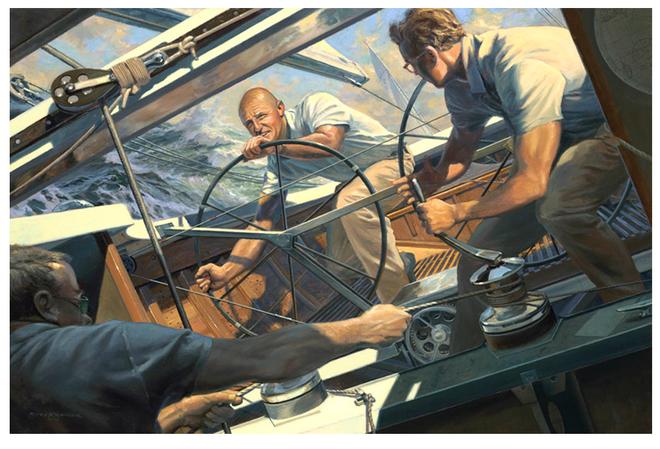
Russ Kramer - "Onboard Intrepid, 1970" - Bill Ficker helms Intrepid during the 1970 defense of the America’s Cup as crew trims a backstay. www.russkramer.com SW
William P 'Bill' Ficker, best known as the skipper of Intrepid in the controversial 1970 America's Cup has died at the age of 89 years.
One of USA's most distinguished sailors, Bill Ficker was a winner of the America's Cup, a Star World Champion and the winner of the Congressional Cup.
The 1970 America's Cup Match will always be remembered for the start line collision in Race 2, between Gretel II (Australia) and Intrepid, as the Australians under starting helmsman Martin Visser attempted to close out the room they had left astern of the starting vessel, Incredible.
Both boats protested in the first protest in the America's Cup since 1934 (and the previous one was in 1895).
The NYYC Protest Committee headed by 30year old B. Devereux Barker III found that Gretel II had sailed above close hauled after the starting signal (which was not permitted under the racing rules of the time).
That decision did not sit well with Sir Frank Packer the backer of the Australian Challenge, prompting the famous comment that 'an Australian skipper protesting to the New York YC is like a husband complaining to his mother-in-law about his wife'.
A word play on his name began in the 1970 US Defence Trials when Intrepid in 1970 after being the skillful co-skipper of Columbia in the 1967 Defence Trials - prompting the production of buttons and stickers proclaiming that 'Ficker is Quicker', during a three-way battle between the re-vamped Intrepid, new yachts Heritage and Valiant, and Weatherly the 1962 America's Cup winner.
The Challenger Gretel II was reputed to be faster than Intrepid, but Ficker's match racing and sailing skills were believed to be a key factor in the 4-1 win for USA.
As top America's Cup sailor and sailing editor Bob Bavier noted, the 1970 America's Cup was one of three which the USA should have lost. He claimed that Intrepid had been slowed by the design changes made, the new designs for the Defence Trials had similar weaknesses, being sluggish in light air, accelerating slowly after tacks and making excessive leeway until she regained headway. The other three US designs had similar weaknesses, and all were considered excessively heavy. However Bavier believed that Intrepid's performance in winds above 16kts was improved in 1970 after the changes. Bavier believed the score could well have been 4-1 to Australia.
'The Cup was up for grabbing and only a superlative job by Ficker and his afterguard kept Gretel II from taking it to Australia. Let it be recorded that Ficker did one whale of a job.'
'Particularly in the last race, but also throughout most of the match it was Ficker and his crew who had prevailed over a boat which was usually going faster than Intrepid.'
After that win and controversy Ficker continued to be involved with the America's Cup, for as long as it was held by the New York yacht Club, moderating the press conferences held during the racing through to 1983.
A former world champion in the Star class, the class reported in 'Starlights' in November 1970, after his Cup win, that Ficker, a prominent architect of Newport Harbor, California, has been racing sailboats all his life, and owned his first Star in 1950.
With it he won the Southern California Yachting Association's midwinter championship, but he did not attract much attention in the Class until he captured the Blue Star of the always high-powered Fifth District in 1954 with No. 1560, which was then sixteen years old. The district secretary reported in Starlights at the time that Bill had spent many long hours refurbishing and modernizing the boat. His thoroughness, as well as his sailing abilities and ambitions, were already becoming evident.
Carl Eichenlaub then built him a new hull, which was completed and fitted out by Ficker himself. With this boat he began to win with great frequency. His sights have always been set high. 'If we go away somewhere and win a series,' he once said, 'we want to be fitting representatives of our club. Hence the name NHYCUSA, standing for Newport Harbor Yacht Club, U.S.A.' The boat was one of the most beautifully built and finished Stars of its day. In it, with Mark Yorston crewing, Ficker finished second to Lowell North in the 1957 North American Championship at San Diego, and the following year the same combination in the same place won the World's Championship.
Although he has sailed in many other classes, both on and offshore, Bill always maintains close contacts with the Stars. He was a member of the Technical Committee from its inception in 1965 through 1968.
After one previous summer on a Twelve, he undertook the campaigning of the re-designed and re-built Intrepid in the spring of 1970. His wife Barbara came east with him to be the Den Mother at Newport for the crew for most of the summer. From the outset things went well. Bill did not whiplash his crew; he only told them that he knew how good they were, and hoped that they would live up to his expectations. The result of this mutual trust was a happy ship and a superbly functioning crew. Those who saw the hour-long show of the Twelves on a U.S. national television network last summer could not fail to be impressed with the calm but efficient way things were done on the Intrepid as contrasted with the more hectic atmosphere on some of the other American Twelves. And the skipper seemed to maintain the same excellent rapport with his management syndicate, the Star class newsletter commented.
Bill Ficker was admitted to the America's Cup Hall of Fame in 1993 as one of the first group of inductees, and last year to the US Sailing Hall of Fame.
In the commentary for Bill Ficker's admission to the US Sailing Hall of Fame, Roger Vaughan recalled the genesis of one of the most famous slogans in sailing and outlined the keypoints in a sailing career always punctuated with his unassuming nature, good humour and grace:
One afternoon in 1970, Bill Ficker, the Star World Champion (1958) and Congressional Cup winner (1974) who would steer Intrepid to an America’s Cup win that year, encountered Ted Turner after winning a trial race in Newport, Rhode Island. “He walked up to me,” Ficker recalls, “and said, `Ficka is quicka.’ The next day he arrived with a box full of buttons bearing that slogan. I cringed a little bit.”
Putting aside superior tactics and his allocation of responsibility that produced a happy boat, Ficker credits Cal Tech with Intrepid’s quickness. “They interpreted all our speed data,” he says. “We sailed precisely to the numbers they gave us. The crew was very disciplined. Tactician Steve van Dyck and navigator Peter Wilson did a good job keeping me on the numbers.”
Wilson says Ficker had a unique way of motivating the crew. “He wanted all of us to decide how best to do our jobs. If I said we were over our numbers, guys trimming would have freedom to make changes so we’d point higher, and vice versa. Once Bus Mosbacher came to practice with us in case something were to happen to Bill. The jib trimmer made an adjustment. Bus said, `I didn’t call that.’ Bill’s way was very different. He built teamwork, with never a harsh word.”
Bill Ficker has had a cat bird seat for watching both his beloved Star class and the America’s Cup go through significant changes. The Star class was one of the few games in town 75 years ago, and at one time, the only class with a world championship regatta. He applauds its ability to police itself and to adapt to new materials and technology. Ficker helped direct that adaptation as a member of the class’s technical committee.
As for the Cup, Ficker has said the big catamarans were “flat out dangerous.” Those who sailed them would agree. But lately, he has become more philosophical. “I’ve always thought of the Cup as yachting,” he says, “not sailing, with something about the social end that bound people together. When I sailed, people in the syndicates truly loved the sport. It wasn’t commercial at all. The possibility of making money from something substantially changes the attitude. But it also permits a lot of people to enter into the sport when previously they could not,” Vaughan concluded.
As well as his top level sailing success, Bill Ficker made an outstanding contribution to sailing adjudication and administration on the West Coast of the USA, and was one of the few sailors who both the East and West Coasts of the USA regarded as one of their own. Ironically his two home-towns shared the same name - Newport, RI and Newport, CA.
If you want to link to this article then please use this URL: www.sail-world.com/152444