HUD Vision- An interview with Afterguard Marine’s Alex Moret
by David Schmidt, Sail-World USA Editor on 17 Apr 2014
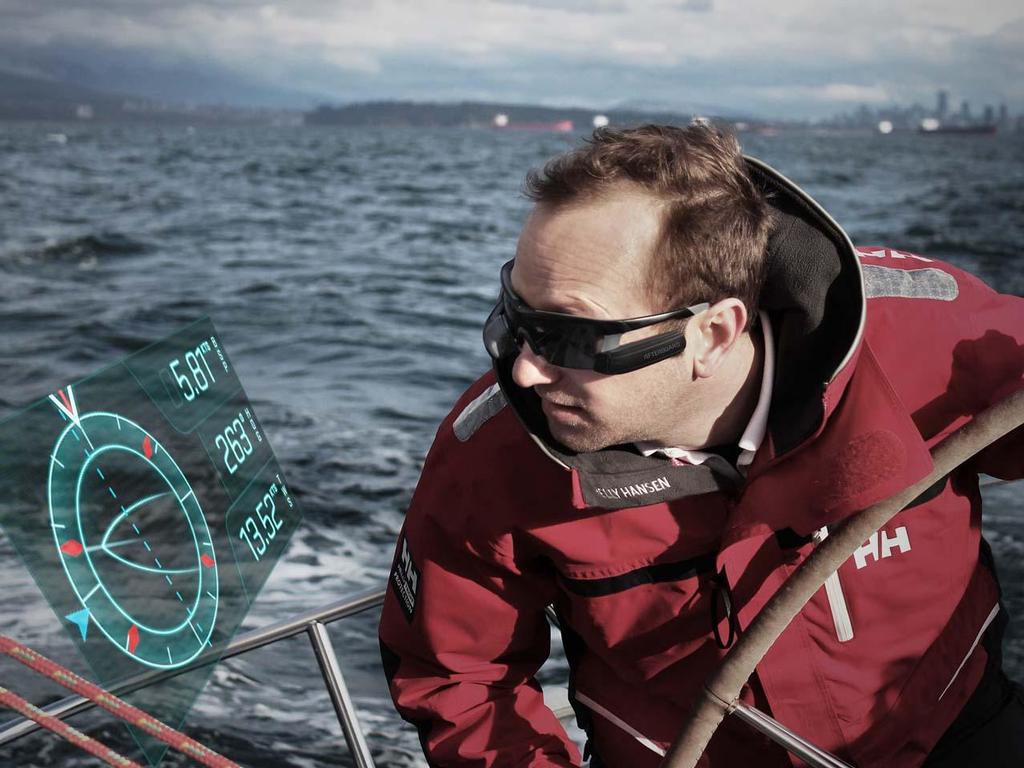
Afterguard-in-action with screen Afterguard
Heads-Up Displays (HUDs) have long been the holy grail of the tech-savvy racing sailor. This technology was developed to give fighter pilots there-when-they-need-it information at a glance, without pulling their attention away from the task at hand. While racing sailors are more interested with discovering new tactical edges over their competitors than getting missile lock on an enemy, the basic information needs are the same.
Cup teams have long worked towards a good HUD system and Jimmy Spithill, skipper of Oracle Team USA, famously used a pair of HUD glasses (with a corresponding backpack-fitted computer) when he claimed the biggest comeback in sailing’s venerable history against Emirates Team New Zealand in the 34th America’s Cup, and now this technology is hitting racecourses everywhere.
But unlike other Cup technology that trickles down from the America’s Cup to Corinthian racers, Afterguard Marine’s new Heads Up Display glasses actually represent a huge advance over Spithill’s AC34 kit.
I recently caught up with Alex Moret, Afterguard’s founder and technical guru, to learn more about his cutting-edge system.
Can you give me some background on the Heads Up Display (HUD) glasses? Where did the idea come from, and how long have you been working on the concept?
We’ve been working on it kind of on and off. I came back from sailing around the world about a year ago and since then I’ve been talking with Recon Instruments here in Vancouver-they designed the actual Heads Up Display, and we’ve integrated their technology into the sailboat racing world.
[Recon] has always kind of been talking to the America’s Cup teams to get [the technology] on their boats, but it wasn’t really there for them yet—they didn’t have the Recon Jet glasses that we’re utilizing, and they couldn’t get a product out in time for the [34th America’s Cup].
That’s kind of where we rolled out, utilizing their technology and talking to those guys and seeing what they were doing, with myself executing to incorporate onboard instruments.
Recon was primarily about the display, but me being a lifelong sailor and racer, I immediately saw the possibilities and [I understood] what these displays can do. So from there I started developing [the HUD glasses] and working on [Recon’s] prototypes and writing software.
Am I correct that the HUD glasses use Recon Instruments' Jet glasses, as well as a ton of proprietary Afterguard software?
Yes, we use Recon’s HUD, and we have proprietary software that we’ve developed, and we also have our Central Communication Unit, which connects to your boat’s instruments and sends the boat’s instrumentation to the glasses. We do [our] computing in the central communication unit, and we send it to the glasses.
The glasses also do [some] computing because the glasses have [onboard] instrumentation such as a magnetometer. So, you get all of your boat’s instrumentation such as wind direction, heading and boatspeed, but with the magnetometer and the data on the glasses, you can look at another boat and [the HUD glasses] will tell you if you’re in front or behind it. You can also look at a mark and it will tell you if you’re going to lay the mark or not.
The combination of the magnetometer and the HUD knows where you are looking, and it also knows the direction you’re going, as well as the wind direction. If you turn your head, the compass rose on our Virtual Tactician page rotates. It takes quite a few variables in to [make these] calculations, and it also incorporates the boat’s polars.
Before, you’d look at your laptop and then look up [at the real world]. Now, this is all instantaneous.
Is this the same system that Jimmy Spithill used to win the 34th America’s Cup? If so, does it offer all of the same functionality and features as Spithill’s system, or has this been designed for a different market?
No-it’s a totally different system. He had a computer in his backpack. The America’s Cup teams weren’t using Recon equipment. They had HUDs, but their version was [physically] much bigger and it had a smaller processor. The two systems are not even comparable-ours is much more advanced.
You can see quite a bit of data, but the trick is to not show too much information-only key data. We don’t want the HUD to be complicated or hard to read. It could be a lot more detailed, but we want it to be easy to use as well.
Has the system been used by other high-profile sailing programs? If so, can you give me some examples?
It’s still in its development stage-we’re still testing and finalizing all the data. It’s high-tech equipment, so we’re dealing with a long lead delivery time.
We’ve got Ross MacDonald, an Olympian sailor here in Vancouver, and he’s really been a great help with the development, trying out the glasses and using them on the TP52 [circuit].
Did you guys have to make any physical changes to the Recon Jet glasses, or could this all be handled with software updates?
We get special glasses from the Recon factory, and then we put our own software on there. It’s a pretty standard Recon Jet, but we’re only dealing with prototypes [so far], so I’m still not sure what the final product will look like yet.
How does the Central Communication Unit connect to the rest of the nav instruments? Ethernet/USB to the MFD/PC, or do you tap into the NMEA 0183/N2K network?
There are so many different boat systems out there, so we needed flexibility as we want to connect to lots of boats. Because of this, we use [Raymarine’s proprietary] SeaTalk, NMEA 0183, NMEA 2000, but no Ethernet.
Also, boats are often a mishmash of different electronics [manufacturers], so we’ve built in quite a few inputs. So even if the systems aren’t networked, we can take multiple streams of data and put them on the glasses.
How many pair of HUD glasses can a single Central Communication Unit support?
We’re planning for ten different pair of glasses, as we want to be on larger racing campaigns, as well as smaller programs.
Does the system also pull information from satellites, or is each boat a closed-information loop?
It’s a closed loop. We pull GPS data from the boat because it has a better, more powerful GPS receiver, but we can also use the glass’s built-in GPS receiver. In this case, one pair of glasses talks to the satellite and then passes
[its GPS] information to the Central Communication Unit, which then sends this data out to all of the glasses, as we don’t want any competing information [in the system]. This is similar to the starting-line function-whoever clicks the 'start' function first becomes the master.
There’s a lot of technology in the Central Communication Unit, and it has been designed for sailors, by sailors. If we incorporate too much information, it gets too complicated.
Can a user interface the Central Communication Unit with a laser pinger, so as to be able to see speeds/distances of competitors, or is this still the province of a PC?
The Start Sequence and Virtual Tactician [features] give you this information. You can just look at the other boat and you’ll have this information.
How do the HUD glasses talk to the Central Communication Unit? BlueTooth? ANT? Wi-Fi?
We use a Wi-Fi frequency. ANT isn’t powerful enough, Bluetooth would have been nice because of its low power draw, but it’s not great going through fiberglass and carbon-fiber boats, so we chose Wi-Fi. On carbon boats [signal interference] can be difficult if you place the Central Communication Unit in the bowels of the hull, so you need to place the Central Communication Unit near the companionway.
At the dock with lots of other boats and other Wi-Fi, [the Wi-Fi signal] can [experience] interference, but on the racecourse there’s no signal interference. At the marina, boats are often using high-powered Wi-Fi, but on the racecourse [the Wi-Fi signals] are not competing with each other. Also, each [HUD] system talks to its own signals, and they all use their own communications protocol.
Is signal loss a concern? Or, have you guys figured out a way to ensure a streaky wireless data flow?
If the Wi-Fi fails, the glasses automatically get GPS information from satellites. If the Central Communication Unit fails, the glasses can still operate, but with limited information.
Can you walk me through the User Interface? How does someone who has never used the system before get started?
Before going out on the water [for the first time], you’d [drag and drop] the boat’s polars to each pair of glasses via a USB connection so that you get all of your polar information on your HUD.
Once you get out on the water, the first thing you do is to calibrate the magnetometer with the boat’s heading, which is very important because of declination, deviation and variation for where you’re at and where the boat is. This is a pretty simple screen, you just go to the Virtual Tactician function, a user swipes their finger on the display port’s optical sensor, similar to a Blackberry.
You can swipe forward or back to toggle between screens or up and down to go to the set-up screens for each function. The boat’s heading should be the same as the GPS heading and the ship’s compass. That way, everything is matched-up perfectly. It’s pretty straightforward, and most things are already set up.
If you’re doing a race, you’d go near the starting line and on the Start screen you’d go to the set-up and you’d mark one end of the starting line; then you’d sail along it, then you’d mark the other end of the line by holding your finger down on the [optical sensor]. Then, [the HUD glasses] will have all the starting information, time to kill and boatspeed information for the start.
Do you trace where the eye is looking, like on some digital cameras?
We trace where the eye looks, so if you’re not looking at the screen, [the HUD glasses] turn off to save battery power. When you gaze down at the screen, it turns on. It’s the only gaze detection that we have, and you don’t even notice it.
The glasses have voice capabilities and a nine-axis sensor, but we’re not using these yet.
How long does it take the average human brain/eyes to get used to sailing with the HUD kit?
It takes a couple of days not to look at the HUD all the time. At first, you’re always staring at it. But after a few days, you only look [at the display] when you need it. Then, it becomes second nature and you only look [at the HUD] when you look at your instruments, but it’s a lot faster [than looking at instruments].
It’s a novelty at first, but you get used to it. It doesn’t take long.
Is there ever a worry that the HUD glasses over-saturate a sailor with too much information?
Yes-you want the [HUD system] to be as simple as possible. If it displays too much information, the user will stop using it. So we tested the system to see what people will use. We gave it to people who hadn’t seen it before and asked ’is this too much information?’ to get a fresh perspective. The system is very intuitive, and this is a good test to see if it’s working for simplicity.
We’ve always been pretty lean [on displayed information] as we’re all sailors [here] and we know that you can have too much information. Every sailor wants different information-that’s the hardest part, figuring out what people want.
Can a tech-savvy user write code for his/her own custom pages, or is this closed-source software?
The system is closed-source software, but we’ll do some consulting for teams with big budgets and will make custom changes. If you’re paying us to make custom changes and request it, we won’t give [this proprietary software] to other teams.
Can you walk me through how a sailor switches the data/screens that are being fed into his/her HUD?
You use the optical sensor, which is located on the glass’ right-hand leg, on the glass’ 'engine'. The other side has the battery so that the glasses are perfectly balanced.
Can users order the glasses with prescription glasses? What about different lens?
We wish that we could offer this, but not at this point. We’re working on it.
If you need reading glasses, it’s OK. The HUD glasses use 'infinity vision', which makes the HUD look like it’s a 30-inch screen that’s seven feet in front of you. This makes it so that you don’t need to change your focus-it’s instantaneous.
We use polarized lens that are made in the same factory as a top sunglasses manufacturer, so I don’t see us in the market for [offering] custom lens. We have no plans to offer this. Our focus so far has been on the hardware and the software.
It sounds as though the glasses come equipped with additional cameras/mics/sensors and connectivity options-what future features could you potentially see Afterguard offering in the future?
We’d like to be able record the whole race in HD on the glasses, and then download [this file] to the Central Communication Unit. Then, later, you can sit down with your crew and dissect the race to see when you’re fast [and where you’re slow] and what you’re doing. You [could] also see when you were on your polars, and you’d also have the ability to [edit] your polar data. We’d also like to add voice commands so that you can talk to other crew-or if it’s hard to talk to your bowman-in the next version.
That’s only a few [other features]-I’m not going to tell you the best ones right now!
If you want to link to this article then please use this URL: www.sail-world.com/121205