Gladwell's Line - Does the America's Cup really need a Star Chamber?
by Richard Gladwell, Sail-World.com NZL on 23 Jul 2016
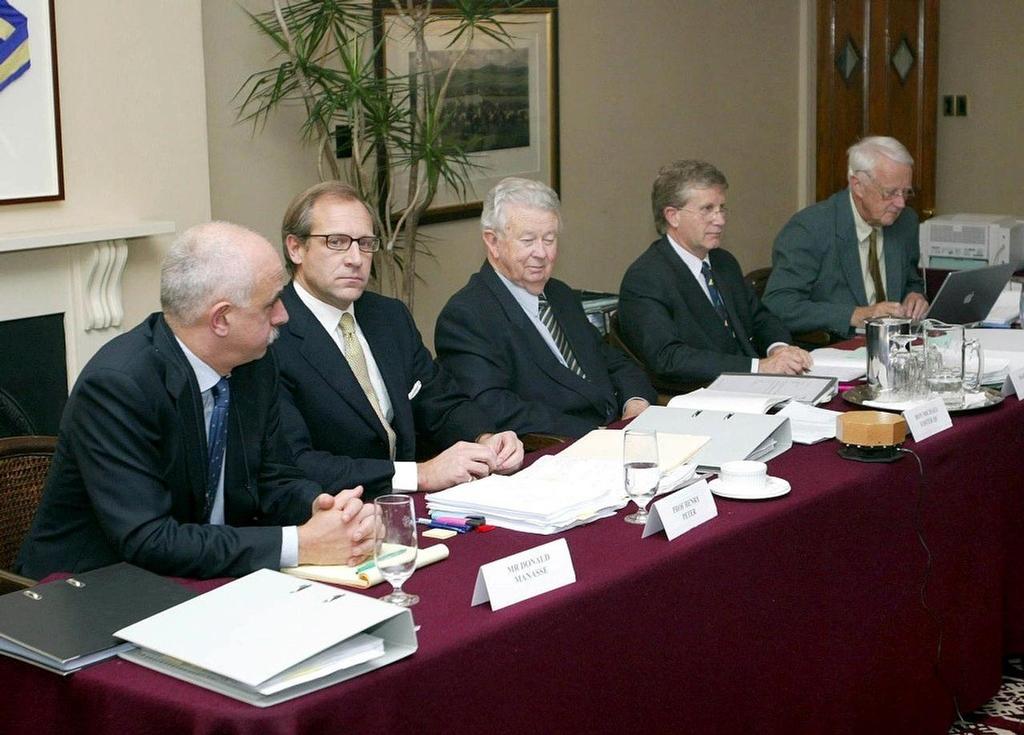
The Arbitration Panel meets in the 2002 Louis Vuitton Cup, in Auckland, a much more transparent approach was adopted then despite some very controversial matters being heard. SW
The first meeting of the three-man America's Cup Arbitration Panel is believed to have taken place in London in the past week or so.
Officially the date hasn't been publicly announced. The venue hasn't been publicly named, and the parties have appeared before a Panel that is publicly nameless.
By choosing to operate under a veil of judicial secrecy, the America's Cup has lost credibility with many of its fans, particularly those involved in sailing.
The sailing fans know that when they, or their competitors, are involved in a protest hearing, that the members of the Jury or protest committee are known; that the date of the hearing is posted on a club or regatta noticeboard; that the subject matter of the protest is known; and that the details of the decision and any penalty are posted on the same Noticeboard.
It's all freely and publicly available information, usually posted on a website as well for all to see and know. It’s a transparent process.
America's Cup organisers decided to place themselves above all that, implementing an adjudication system similar in concept to the modern-day 'Star Chamber' created in some western judicial systems to combat serious high-level crime.
Here, witnesses are summonsed with a prohibition from telling anyone about the Hearing or that they are appearing before the Commission. Disclosure is treated as a contempt of court, with a penalty of 6–9 months imprisonment. The Star Chamber, of course, holds its Hearings in complete secrecy.
That extreme process might be appropriate for dealing with terrorists, drug lords, and criminal masterminds – but the America’s Cup? Really?
In the America's Cup context, the same disclosure prohibitions are in place, but fines ranging up to a million dollars take the place of imprisonment.
The newly introduced provisions relating to Arbitration Panel Confidentiality are backed up by equally draconian provisions in the Protocol relating to the consequences for 'Adverse Public Comment.'
The new Protocol clause passed by a majority of competitors, a few weeks before the start of the Arbitration Panel Hearing reads:
11.13. Confidentiality: Proceedings before the Arbitration Panel shall be confidential. In particular: (a) no person or entity shall directly or indirectly disclose, comment upon, or confirm the existence of, a dispute submitted to the Arbitration Panel to any person or entity other than parties to that dispute, their counsel and advisors, and the Arbitration Panel itself, except as provided in this Article 11.13;
While America’s Cup Events Authority can claim that the move to secret proceedings was passed with the vote of the majority of competitors, the fact is that the Defender - Golden Gate Yacht Club - is charged with the running of the event, has the final approval on rules amendments and key decisions.
Dalton Clause backfired
In the last America's Cup, regular media releases were published as to proceedings and key milestone points in any elongated hearing, which were duly reported.
Agree with the Decisions or not, at least they were published along with the reasons. Teams could comment to the media until the so-called Dalton clause was bought in mid-series.
Ironically that same Dalton clause was used to slap a $250,000 fine on the Defenders, rather than ensnare outspoken Challengers who spoke their minds. But even the Dalton clause of 2013 had an escape clause allowing reasonably held and legitimate comment. That provision is gone from the current edition of the America’s Cup Protocol.
In bygone America's Cups, judicial proceedings were conducted under similar rules to that which prevail right through the sport, which has a high degree of transparency as to what an issue is about, when issues are being heard, and the outcome.
Occasionally in previous America's Cups, the Arbitration Panel adopted the practice of going a step further and allowed a couple of members of the media to observe the proceedings and report back to a general media pool.
However not this Cup.
Sail-World has twice asked an ACEA media representative for a response on basic points about information to be provided to media (and fans) on Hearings but has yet to receive a reply. Not that we are particularly bothered by that. There are other ways, including finding a 'Deep Throat' or two. The best obtainable version of the truth is all that is required in the face of media stonewalling.
Against the America's Cup backdrop of secrecy and hefty financial penalties, the media cannot set up interviews on banned issues with people who are in sensitive positions and say 'I'd like to talk on the record.'
Such sources in high places will sometimes talk off the record, with someone they can trust not to reveal their sources, and who they can maybe point in a direction where the information is buried.
These sources’ motivations for talking to the Fourth Estate are usually very simple - self-preservation, and the need to get their side of the story into the media ahead of the official version.
To paraphrase one top investigative journalist: “we get the spin by day and the truth by night.”
Italians exit on principle
Under the current Protocol, even if a media release were provided at the end of a Hearing, who would believe it?
If there was no way of verifying the content and facts before the Hearing, and if the participating parties were prevented from commenting on the matter (assuming those get revealed at some future time), how do we know that yet another self-serving release has not been pushed out?
The Code of Silence that has been imposed on the Arbitration Panel processes could compromise the integrity of the current America's Cup.
This is the same America's Cup that changed the class to be used by a simple majority vote nine months after entries had opened, and knowing that one team at least had invested heavily in design work for the discarded AC62 class. At least one team had parts built.
The issue that triggered the current Arbitration Panel Hearing occurred on April 1, 2015, when the America's Cup Events Authority withdrew the America's Cup Qualifier from Auckland.
The timing of the move was close to the downsizing from the AC62 to the AC50 class. The AC62 was announced on June 5, 2014, and changed to the AC50 on April 1, 2015.
April 1, 2015, was also the same day that Luna Ross resigned from the 35th America's Cup, because of the change of class without the unanimous consent of all competitors. A position that was publicly signalled three days before the vote.
Of course, Luna Rossa was the author of their own demise.
When they took over the mantle of Challenger of Record after the resignation on July 18, 2014, of Hamilton Island Yacht Club, the first Challenger of Record, one of the Italian team's first calls was to effectively waive their right of approval as Challenger of Record on all Protocol changes. Instead, they vested that right in the Challenger Committee which makes its decisions by a simple majority vote of the five remaining Challengers.
The Defender via their entities also have the requirement to approve Protocol changes. That is effectively a right of veto for both the Challengers and Defenders.
In the space of a day or two, playing that newly dealt Challenger hand of the majority vote, and assisted by an arbitrary decision from ACEA, the AC game changed from being an America's Cup sailed in AC62's with a Qualifier Series sailed in Auckland to one that was sailed completely in Bermuda in the smaller AC50's.
Time-lag compromises outcome options?
The collateral damage was that a three-time Challenger, with good America’s Cup pedigree and AC72 experience, walked away from the Cup. A second team, the most successful team in the modern era, was king-hit onto the financial ropes having all but lost a major sponsor, and their cashflow until commercial sponsorship kicked in.
Team New Zealand's response was to release parts of their claimed Agreement and announced that they would be taking their complaint to the yet to be established Arbitration Panel.
It took the America's Cup Events Authority ten months until February of 2016 to confirm the Arbitration Panel, and then another five months until July 2016 for the three-man Panel to agree on Rules of Procedure - and then hold the Hearing into Team New Zealand's complaint, and maybe others.
A few weeks before the Arbitration Panel Hearing on June 9, the majority of the Challengers plus the Defender signed off on a deal/Protocol Change which prevented any team or anyone associated with a team disclosing or commenting on matters before the Arbitration Panel, or even disclosing that a dispute had been referred to the Arbitration Panel.
Unfortunately, in Qualifiers issue, the genie got out of the bottle over a year ago in early April 2015, when Team NZ had said publicly they were taking the dispute to the Arbitration Panel.
A deal between Knights
Why the sudden need for such secrecy?
We may never know. Certainly, the agreement images waved online by Team NZ would seem to be strong. Doubly so, when, if Sail-World's information is correct, that it was negotiated between Sir Stephen Tindall and Sir Russell Coutts.
Sir Stephen is a highly respected, self-made businessman and was named as Businessman of the Year in 1997, winner of the Blake Medal in 2006, and named as New Zealander of the Year in 2015. It is hard to believe that he would have got this one wrong.
Few other sports conduct their dispute process in such secrecy. The Hearing time, date, place and issues are published. The Hearing itself may be behind closed doors, but the full Decision is always released for publication and comment.
Transparency is the best practice in top-level sport. You will never hear a journalist with an ounce of investigative ability say that a confidentiality code will be effective. The only people who believe that are lawyers, and others of that ilk, who are just demonstrating their complete ignorance of how the media works.
There would appear to be a clear competitive advantage to several teams in voting for the change from the AC62 to the AC50, and also in the consequences of the withdrawal of the Qualifier from Auckland for Team New Zealand.
The 15-month time-lag in setting up the Arbitration Panel and holding the Hearing has effectively made the staging of the Qualifiers in Auckland difficult, but not impossible. For sure it could be highly inconvenient for the teams now based in Bermuda. However, they should have been aware from the outset that the Arbitration Panel may come down on the side of Team New Zealand, and the correct decision is to reset the Qualifiers venue.
No Mid-Week Game
The various confidentiality and “adverse public comment” provisions of the Protocol are another move which reduces the colour of the event.
Being a professional sport does not mean that fans should be subject to endless good news and fluff stories about teams and sponsors. We all know that life is not like that.
Real professional sport has a weekend component and a mid-week component.
The weekend component is what happens on the field. The mid-week component is what happens off it. That's what fills the sports pages and TV sports news, Tuesday to Thursday at least. It builds the fan opinions, provides some discussion points around the office water cooler, and is eventually reflected one way or another in the weekend game.
The sacking of coaches, appointments of new ones; player hirings and firings: player injuries; what is going before the Judiciary and the outcomes; player payments; players comment on what happened on and off the field; occasionally a coach will have a crack at the officials - and usually with good cause; plus a pile of other issues on which the fans all have an opinion - good or bad.
These are the myriad of story angles which fill the column/screen inches in print and on the web, and the sports news segments on TV. The more intense issues will often make the main news bulletins.
Oddly enough the amount of tumult within a sport, or a team melt-down, seems to have little effect on the gate at the weekend - in fact often, the reverse is the case. Hit the headlines during the week and you'll have a probably bigger fan turnout come the weekend.
With all that is negative in the world, sport is the great escape for a big percentage of the population, and the off the field antics are a big part of it. The 'names' are often built during the week, just as player's reputations are built during the weekend - depending on their talent and form.
Sailing has consistently failed to capture the mid-week game. Due to a lack of resources, some amateur events will never do it. But for the professional side of the sport, there is no excuse.
Worse, in the America’s Cup, the controversy and characters are either hounded out of the game or hide-bound with pathetic rules and penalties designed to maintain media-silence on anything controversial.
The America's Cup used to have a great mid-week game with the likes of Tom Blackaller, Dennis Conner, Harold Cudmore, Alan Bond, Ben Lexcen, Michael Fay, Warren Jones, Peter Gilmour, John Kolius, Sir Frank Packer and many others who needed no public introduction, were always able to provide a quick and irreverent quip, or storyline that would grab the general sporting media's attention - and the column inches and media minutes flowed the way of sailing.
Now, outside the immediate venue, the America’s Cup is a largely grey canvas punctuated by the odd splash of colour from a sailing drama or calamity.
What's so wrong with expressing an opinion or comment that doesn't completely align with the message being pushed by event organisers?
What's so wrong with using the disinfectant of transparency - unless you've got something that smells or you want to hide?
Cover-ups, censorship and black-outs don't deter media speculation. They just encourage it.
If you want to link to this article then please use this URL: www.sail-world.com/146693