An interview with Ray Redniss about the STC’s annual Block Island Race
by David Schmidt, Sail-World USA Editor on 22 May 2017
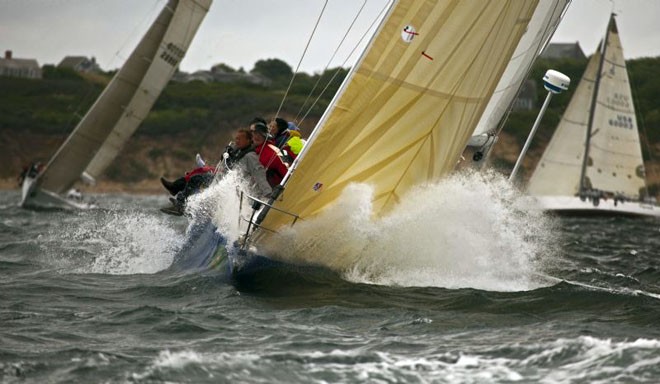
Malcom Clarke’’s J/44 DIOGENES2 crashes upwind in Monday’’s Around the Island Race - Block Island Race Week Rolex / Dan Nerney
The sky was grey and spitting a cold rain on the fog-strewn waters of Long Island Sound that late-May day in 2003 when I sailed my first Block Island Race aboard my Dad’s J/44, Southern Cross, but I will never forget the sound of what can only be described as boiling, hissing water rapidly advancing from our starboard quarter a little while after our start. I remember momentarily pulling my eyes away from the mainsail that I was supposed to be trimming to search for the sound, and while I’m sure my watch captain wasn’t thrilled with this momentary lapse of concentration, my trimming truancy was rewarded with the sight of a white, plumb bow ripping through the fog as Joe Dockery’s old Reichel Pugh 81 Carrera came smokin’ past us, making our seven to eight knots of upwind SOG seem as though we were standing still.
Flash forward numerous hours, and our crew was tested with everything from busted halyards to a tattered number-three headsail (if memory serves, it got windy at a few points that year), but-by the time we crossed the finishing line (ballpark) 36 hours later-it felt as though we had sailed a much greater distance than “just” the 186 miles (as the crow flies) that comprise the Storm Trysail Club’s (STC’s) annual Block Island Race, which unfurls each Memorial Day (the 2017 Block Island Race starts on Friday, May 26) on the waters just outside of Stamford Yacht Club’s break wall, and which takes the fleet down the length of Long Island Sound, around Block Island and then back home.
Yes, we got our butts kicked that year, but-much more importantly-we gave
Southern Cross a serious shakedown prior to sailing that same year’s Marion to Bermuda Race,
after my Dad had the pleasure of replacing all of his halyards (in an abundance of caution), rush-ordering a new number-three blade from North Sails, and fixing myriad other small items. Expensive, yes, but also the perfect medicine before crossing the Gulf Stream with a boat that we had only owned for 18 months.
But to sell the Block Island Race as just a feeder for longer distance races would be to short-sell one of the best Memorial Day adventures in the sailing world.
I’ve now had the pleasure of sailing this race several additional times, both on Southern Cross and later as a watch captain on the well-equipped J/122 Georgetown, and each time I’ve enjoyed some wild moments. These include going to the end of my tether on the bow of Southern Cross as my good buddy Dave Kruse and I battled to change headsails in 40-plus knots on the foredeck while screaming through the Race one year, to laying Georgetown’s top spreaders into the brine (I was driving) when a huge puff hit our port quarter at 0200 hours, a full kite flying…and only a minuscule amount of leeway separating our keel from the bricks to starboard (read: bearing-off was not an option).
These war stories all illustrate the fact that this 186-mile course can throw a lot of curve balls at crews and navigators, and while the duration (ballpark 24-48 hours, vessel-depending; much less if you sail on the go-fast maxi yachts) makes it a bit hard for your body to get into the rhythm of round-the-clock sailing, I’ve always loved this race. (Editor’s Note: In the interest of full editorial disclosure, my family are longtime Stamford Yacht Club members, so the length of delivery-roughly one to two nautical miles from our mooring ball to the starting line-is just about perfect.)
Since I now live in Seattle and haven’t had the chance to sail the Block Island Race since 2008, I caught up with Ray Redniss, who has served as the PRO for the Block Island Race and the Vineyard Race (September 1, 2017) for the past twenty-plus years, via email to learn more about the state of this classic, early season New England event.
Can you tell us about how the tradition of running the Block Island Race (BIR) on Memorial Day weekend came to pass? Has the race always been held on this weekend, and is there a special significance to the fact that it takes place on Memorial Day (perhaps to honor the fallen, etc.)?
The first Block Island Race was run in 1946 with its start “around” the weekend nearest Memorial Day (historically known as Decoration Day.) It was originated by Storm Trysail members out of Larchmont Yacht Club, the first year after many of them had returned from WWII. It was started and finished in Larchmont which made it about 20 miles longer than it is today. It became a Memorial Day Weekend event after the Uniform Monday Holiday Act of 1968.
Have navigators always been allowed to choose whether to exit Long Island Sound via the Race or Plum Gut? And are there any situations (say, weather or a particularly big tide) that force the RC to mandate that the fleet goes one particular way?
I believe the first mark of the course had always been Block Island, leaving the choice of how to get there, and originally which way to round it, to the navigators.
All of the elements that comprise sailboat racing come into play when making the decision of how to exit, and re-enter Long Island Sound: wind direction and strength; current; sea condition; keel depth, and crew skill. The Race and Plum Gut are the largest and most direct paths. Fisher’s Island Sound, the most northerly route, is a trickier one to navigate. It is a bit longer, but can pay off in the right conditions. There are also points between Plum Island and Little Gull Island, but you need to be quite careful as the combination of currents and rocks can be hazardous to your health.
There is an account of the 1965 race, the 20th running, wherein a fairly large number of the nearly 150 starters met their fellow competitors sailing in opposite directions on the backside of the island. The account suggested that the “select your own route’ deserved careful reconsideration and discussion.” The route had been written as “…leaving Block Island to starboard…” until 2008 when the race committee wrote in that flying a “Romeo” flag at the start would indicate that the course was to be sailed in reverse! The idea was to give flexibility in being able to provide a more challenging course, but the confusion, despite announcements, has left it an idle option since.
Historically, what do you see as the trickiest part of the course, from a navigational perspective?
That’s really dependent on conditions, but clearly entering and exiting have consistently been the most asked question topics. Timing the current right can make or break your race. But then again, how and where you sail back down the Sound can also be tricky. That’s what makes this and the Stamford Vineyard Race, two relatively short distance events, so challenging.
What about from a boat handling/performance-sailing perspective? Are some parts of the racetrack more challenging than others?
Yes, indeed. The trip around Block Island can be quite the challenge in some conditions. All of the wind-sea combinations, as well as visibility, can make just about any leg of the course tough. In the 20-plus years I have been PRO we’ve had everything from big breeze to little to no breeze, from beautifully clear skies to driving rain. In their own ways, each of those need to be met with appropriate boat handling.
I notice on the NOR that multi-hulls are allowed to participate…does the BIR have a long history with multi-hulls or is this a newer evolution? Can you give us the 35,000’ back-story on multi-hull participation in the BIR?
The Block Island Race had been a mono-hull event until 2014, when we introduced multi-hulls for the first time. There had been a few around and in 2010, we introduced multi-hulls in the Vineyard Race. That race is run on Labor Day Weekend when more of them are in the Sound. It took a few years for the Spring event to be attractive to the Gunboats, which seem to still be in the islands until a bit later in the season.
We do have one entry this year, Dragonfly, a regular!
Are there ever conditions that force the RC to cancel or heavily modify racing?
Yes, there could be conditions that would have us modify the course. In fact, we have a short course written in to the Sailing Instructions. It would keep all boats in the Sound in extremely rough weather, or possibly too little wind. But such conditions would need to be a surety for that decision to be made.
Anything else that you’d like to add, for the record?
The Block Island Race is a multi-faceted event that attracts everyone from highly competitive pro teams to club cruisers who want to experience a little competition. Its different legs offer navigators and crews alike, several challenges in a single event. It historically draws 20 percent to 25 percent more entries in the even numbered years when the Newport to Bermuda Race is run, but entries have been fairly consistently mid-60s to 70s for the recent odd years.
It is a qualifier for the Northern Ocean Racing Trophy, the Double Handed Ocean Racing Trophy, the New England Lighthouse Series, and the Gulf Stream Series. The Block Island Race is also a qualifier for the Caper, Sagola, and Windigo trophies awarded by the YRA of Long Island Sound and the 'Tuna' Trophy for the best combined IRC scores in the [Larchmont Yacht Club’s] Edlu Race (40 percent) and the Block Island Race (60 percent).
If you want to link to this article then please use this URL: www.sail-world.com/153889