America's Cup- Coutts repeats offer of second AC62 for Challengers
by Richard Gladwell/Sail-World.com/nz on 19 Jun 2014
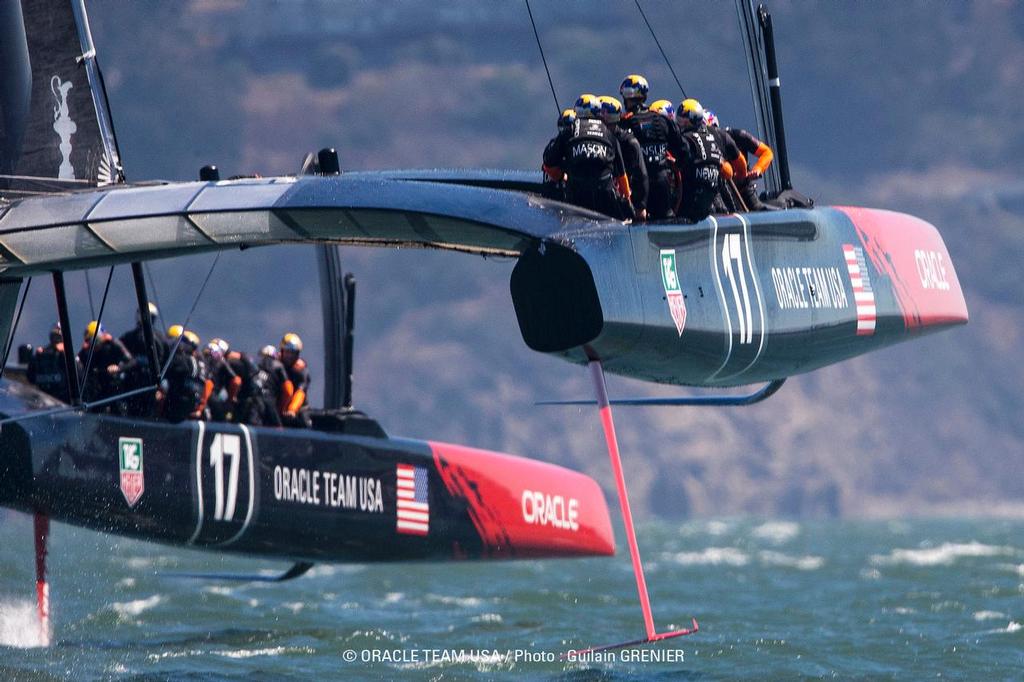
Oracle Team USA - Two boat testing session San Francisco (USA) August 30, 2013 Guilain Grenier Oracle Team USA
http://www.oracleteamusamedia.com/
Oracle Team USA CEO, Russell Coutts, has repeated the offer of a second AC62 for the Challengers in the 35th America's Cup, removing a major criticism of the Protocol surrounding the event.
Coutts' offer followed a comment made by Oracle Team USA skipper, Jimmy Spithill in the course of a radio interview broadcast a week ago in NZ. When questioned as to why Oracle, as Defender, had been allowed to have two AC62's yet the Challengers were restricted to one, Spithill responded that the same option had been put to the Challengers, but they had not taken it up.
Writing on his Facebook page in response to a NZ Herald article critical of some aspects of the Protocol, one of which was the single AC62 for the Challengers, Coutts responded:
In negotiations for the current Protocol, Oracle Team USA proposed that all teams should have the option of building two sets of hulls on the same terms as currently apply to Oracle Team USA (namely no extra wings or components, very limited sailing time, have to race the first set of hulls, second set of hulls built from same moulds). Oracle Team USA would continue to support that position should the Challengers wish to reconsider their position. Note that Oracle Team USA can’t unilaterally change the Protocol: it can only be changed by majority vote.
35th America’s Cup Protocol, Article 20.1: 'this Protocol may only be amended with the agreement of GGYC, the Challenger of Record and a majority of the Competitor Forum.'
When the second AC62 offer was raised the following day in the Black Friday media conference held by Emirates Team NZ, CEO Grant Dalton was questioned several times on the offer made less than 24 hours previously by Spithill.
Dalton said that the offer was news to Team New Zealand, 'We had no knowledge of that. It was a revelation to us,' Dalton added when questioned at the media session.
Later he said that, in the few hours that had lapsed, the team hadn't really thought through the implications of the second AC62. 'It has a budget implication, for sure. You might be able to balance that a little with the use of surrogates. But I don't even know how serious it is,' Dalton added.
Dalton was a little more hesitant about the offer. He made the point that their strategy was heavily predicated on the use of surrogate boats (under 33ft in length) to do the testing required, rather than using a two boat program - as has been done in the past with monohull campaigns.
It was not clear who had declined the offer, and indeed how much the Challenger of Record, Hamilton Island Yacht Club had discussed the offer with other Challengers.
Dalton deferred to Team New Zealand COO, Kevin Shoebridge over discussions with the Challenger of Record. Shoebridge said 'we had some initial discussions in the early day, in the first months. But since Christmas it has pretty well dried up and since then we have had very little, almost zero input.'
That situation is a little strange given the fact that Team New Zealand, in its various forms, has had a 30 year involvement in the America's Cup, and has competed in eight America's Cup cycles, being a Challenger finalist or better in all of those events. Hamilton Island Yacht Club is a first time Challenger.
Significant change from last Cup
A very significant change in the Protocol, compared to the rules that applied for the last America's Cup is the removal of all rules regarding two boat testing between the competing teams, exchange of performance data, and even use of designs, supply of moulds, etc.
The issue was highly contentious in the last America's Cup build-up. Oracle Team USA joined with the Challenger of Record, Artemis Racing (SWE), to go to the International Jury to have the other two Challengers' wings clipped on the design, performance information sharing and race practice arrangement agreed between the Italians and Kiwis. Both teams were in adjacent bases in Auckland, and sailing on the same water.
The two complainants believed that the cosy arrangement effectively gave Team New Zealand three boats, instead of the two that any team was allowed.
The US and Swedish teams had a partial success in the Jury room with the sale of a base design being cleared, along with racing between the two teams - however performance data sharing and two-boat training was ruled to be contrary to the Protocol.
All those restrictions are now largely removed, as well as the contentious 200 metre circle around yachts while training, except that one team cannot impede the boat of another. Infringing that rule cost Oracle Team USA five sailing days after a complaint to the International Jury by Luna Rossa.
It is not clear is whether teams could exchange performance information in real-time, something that would become more relevant in the context of the next America's Cup with the use of one design wingsails, which lend themselves to comparisons of settings twist and power data.
The 'no-rule' means that an experienced Challenger, or the Defender, can elect to work with a second, probably new team to get the second team up to speed more quickly, and share design and development costs. In the last America's Cup, the Italian challenger, Luna Rossa paid Emirates Team NZ several million dollars for their design. They commented at the time that they would have been unable to compete without the New Zealand assistance. The commercially based Emirates Team New Zealand were able to recoup some of the design cost they had incurred since establishing a large design team in October 2010 to work on the development of a foiling wingsailed AC72 catamaran.
The shared programs are a significant one for yacht racing where it is the custom for a boat to succeed on the basis of her own individual effort, and particularly so in the America's Cup where going back the designers and crew had to one come from one country. At one point even the sail cloth had to be manufactured in the country of the challenging club, leading to the Australians developing 'Contender' sailcloth, which is still trading today.
The obvious intention with the Protocol as it stood, and was known until last Thursday, was that a Challenger was allowed only one set of hulls and would then work up with other teams. They could only compete against other teams in the venue of the Qualifying series for the America's Cup.
Same for Challenger and Defender
The two AC62 offer was made under the same terms for the Challengers as the Defenders, in that teams would be restricted as to when they could launch the second AC62 (after the end of the Qualifiers). They have to sail their first boat in the subsequent Qualification Rounds, and Match, but it could be substituted under certain conditions in the case of damage.
Teams would still be allowed just two wingsails regardless of how many boats they had. The boats would have to come out of the same mould, but can still be altered 20% of their hull surface area after being built.
The issues for the Challengers to consider are whether the second AC62 is needed as an insurance policy.
Currently, if they did a faceplant and suffered significant damage to their hulls that could not be repaired quickly with a day or two, they would be out of the America's Cup completely, and their position taken by another team. That would put a very abrupt end to a Challenge expected to cost in excess of $50million.
Running a second AC62 would also require a second crew, and would that would increase expense, however that would also allow better crew training and succession, without having to work in with a second team. For Team New Zealand, with both Peter Burling and Dean Barker signed as skippers, the second boat could have major advantages.
A significant advantage is a time gain, in that the second boat could be shipped directly to the Match venue, and a team could start sailing at the Match venue as soon as the first round of the Qualifiers are complete. That would give an extra month or more of time, while the first AC62 is shipped from the Qualifier venue to the Match venue.
In many ways the situation is the same as used by Team New Zealand in the 1995 America's Cup, where they sailed their first launched NZL-32 in the Semi-Finals, Finals and America's Cup Match. (Under the current version of the Protocol, they have to sail the first launched AC62 right through the Regatta.)
Aside from the insurance aspect, the risk with the one AC62 strategy for a Challenger is that the first boat will have a long sailing and competitive life. She will clock up long hours, and will require very through careful maintenance and servicing if she went all the way to the Match. Offsetting that with two boats, there is obviously more servicing overhead, however properly managed this would not be at the expense of sailing time.
The Protocol could be loosened further with the agreement of all teams to make a second AC62 more workable option than at present.
The full letter text can be read by clicking here
If you want to link to this article then please use this URL: www.sail-world.com/123480