Gladwell's Line- ISAF Events Committee falls into its Heffalump Trap
by Richard Gladwell on 11 Nov 2010
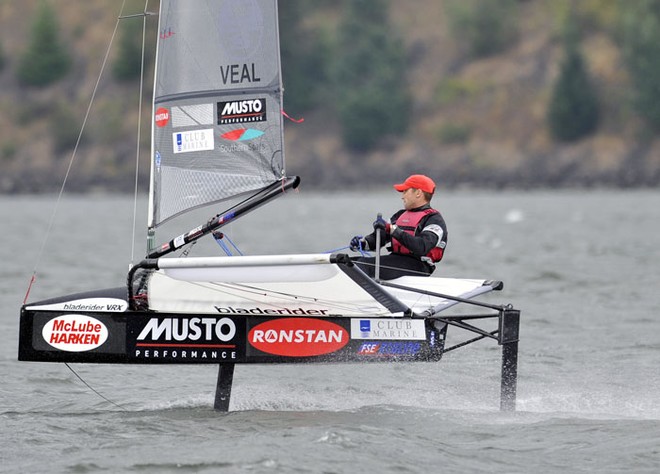
"Mr Foiling Moth" Rohan Veal flying with at the 2009 Int Moth Worlds - but the Finns get the automatic tick as the second Olympic singlehander Sean Trew (Pacific Fog)
http://www.pacificfog.net/
By design or default, ISAF's Events Committee seems to have fallen into its own Heffalump Trap after conducting two key votes at the International Sailing Federations Annual Conference in Athens.
The trap was set inadvertently by the ISAF's own Executive Committee in the form of two submissions which required that two votes to be undertaken, first by the Events Committee and then by the ISAF Council. The submissions came on the back of the ISAF's Olympic Commission Reports, in May and November calling for some very substantial changes in the way the Olympic Regatta and other feeder events are run.
Issues raised by the Olympic Commission have been covered extensively in Sail-World.com http://www.sail-world.com/NZ/Gladwells-Line:-Olympic-Decision---will-ISAF-get-caught-by-a-Yorker?/75967!click_here and http://www.sail-world.com/USA/Gladwells-Line:-Olympic-Commission-report-a-thunderbolt-for-the-sport/69444!click_here
In the first mentioned story we covered the trap that the ISAF has created for itself, with the submissions 096-10 and 097-10. To recap the Executive Committee prescribed that events would be changed at a minimum of six years notice. Then in Submission 097-10 set out two votes for Core Events which established a slate of six Core Events to be decided in Vote 1, and then in a second and third vote, a selection of four events made from a selection of six stated.
So far so good - remembering that (a) this a transition process ie it might not be 100% right first time - so there should be no problem deferring to May 2011 for a tidy up if required and (b) that the thrust is to determine the Events not link these with classes or Equipment in this round.
Having made excellent ground leading up to the current meeting, the trap became truly set when the passing of Submission 096-10 got interpreted as meaning that no new Events could be introduced in May 2011, because that would be inside the six year window for change set by 096-10. (Our apologies for the convoluted logic that seems to be de rigueur in ISAF circles.)
The effect of this process being that unless the Multihull or Boardsailing or any other of the several 'new' events were not passed in 2010, then they were forced out until 2020 Olympics at the earliest.
Sorry guys, but this fine-point needlework is not what the sport needs at this stage. The key is to get the basics right, not be driven by some intricacy of the process. No-one will remember this logic, even in just 12 months time, but the decision bred from it will remain for many years.
Changing the thinking
Part of the issue with the implementation of any change, is to change the attitudes.
In its May report the Olympic Commission got the right shoes on the right feet by talking about Events - which should be decided first, and then the Equipment selected and matched to those Events. All of which we have covered before.
The attitudinal change required was to get those present NOT to think in terms of their beloved Classes, but in terms of Events.
The Executive Committee failed in this regard with their submission (097-10) which set out the Events and then put Classes against some of those options. In others, they had specified Evaluation trials to be held, as was done to selected the best equipment for the Twohanded High Performance Skiff (49er being selected) and the Womens Keelboat (Elliott 6 Metre), and going further back, the Trials which produced the Tornado, Contender, Soling and Tempest - three of which eventually made it to the Olympic regatta.
The logical approach in November 2010, would have been to select the Events, and then propose Evaluation Trials for those Events, and select the best Equipment option in 2011. In other worlds the submissions should have been silent on the Equipment - then we would have had a debate on whether a second single hander was needed, or whether a Mixed Keelboat would have been better in the overall mix. Out of a potential Events slate of say 20 Events options, 10 would have been selected at the November 2010 meeting.
The Olympic Commission correctly recommended the conduct of Evaluation Trials to select some of the Equipment (aka Classes). While some may claim that is an expensive process, the simple point is that ISAF has to be seen to be fair to all classes.
Further, the state of the sport is such that the costs of conducting proper trials (which could be a paper based evaluation, based on known classes or options or a full blown sailing trials) are relatively minor compared to the costs to the sport of being asked to leave the Olympic family.
Do the Events Committee seriously expect the sailing world to believe that the best Mens Singlehanded class (if that is chosen as a second singlehanded Event) is the Finn???
And that by definition, a one man skiff, of which there are several good classes, a foiling Moth or any number of other options which grab the attention of the so-called Facebook generation don't really do the job required for the sailing Olympics???
The claim is that a class suitable for heavier males is required - if that is so - then factor that into the Evaluation Trial mix, and select accordingly.
Do the Events Committee seriously expect the sailing world to believe that the best option for a second Twohanded Dinghy with spinnaker is a Mixed 470????
In its reports, the Olympic Commission noted that a 'improved' 470 was required, which was less technical, for the better adoption for the new style Olympics. That gives a class within a class, which is always a lemon.
And taking that a step further, is a simplified 470 is what is required - then surely it is logical for these to be supplied boats - and which of the licenced builder's mould would be used to produce these? And what happens at Sailing World Cup events - are these sailed in regular 470's or the 'Olympic' 470?
Further the 470 is currently sailed as a Mens and Womens Event. For men it is a class for highly skilled lightweight sailors, and for women equally technically skilled sailors closer to the average female physiques. While these weights may be more suitable for Asian nations, the fact is that in 2008 Olympics only four Asian countries were represented in the 29 strong Mens fleet and three in the 19 strong Womens fleet.
As an aside, only one race has ever been won at Olympic level by a Mixed crew at Olympic level when the 470 was an Open class. (1984 - GBR's Kathy Foster and Peter Newlands).
Again, if a second doublehander is required then why not be consistent with two other Events, in the second vote, and choose that Equipment by by evaluation rather than specification??
While the Events Committee have been forced into the trap set inadvertently for them by their Executive Committee, the ISAF Council which is the final arbiter has a recent history of ignoring the votes of the Events Committee.
Hopefully this trend will continue and a consistent approach to the Equipment for Events will be adopted.
While the lobbying will be frantic ahead of the ISAF Council deliberations and vote, the simple point is that this is not about who is the best lobbyist, who runs the best PR campaign, produces the best DVD or YouTube clip, or who is the most politically astute. It is about the people who aren't there, particularly the young sailors who they need classes they aspire to sail, and which will make them want to stay in sailing.
And that is not in boats that are beloved by the older generation.
PostScript: By our calculations, and assuming that the Mixed classes will both be helmed by female sailors (being less weight in the stern of the boat) then of a 16 strong team in all events, there will be a total of nine female place and seven male places. Of the helming positions there will be six women helming places and four male helming places.
The official release from the International Sailing Federation reads:
It was the most packed session we have had this week to hear the Events Committee’s recommendation on the provisional Olympic events and equipment for 2016.
This is how the voting went.
The Events Committee recommends:
Board or kite-board for men and women – equipment evaluation
One person dinghy men – Laser Standard
One person dinghy women – Laser Radial
Two person dinghy (skiff) men – 49er
Two person dinghy (skiff) women – equipment evaluation
Second one person dinghy men – Finn
Two person mixed multihull – equipment evaluation
Two person mixed dinghy with spinnaker – 470
Women’s keelboat – Elliott 6m
In so doing the committee’s voting recommends taking out the men’s keelboat. The second one person dinghy for women was the other option not to be selected.
The Committee’s recommendations are of course just that. They will go to the ISAF Council for consideration this weekend. After Council vote they are then subject to confirmation at the ISAF Mid-Year meeting in May 2011
If you want to link to this article then please use this URL: www.sail-world.com/76751