Designer - Jim Young- Powerboats Account for 80% of the Market
by Daniel Johnston on 28 Nov 2010
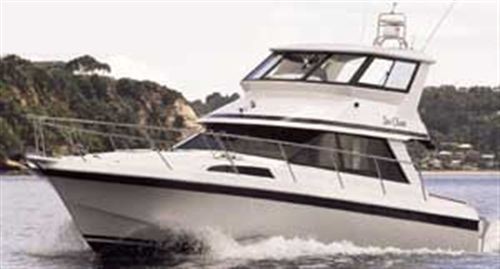
The Vindex 40 stemmed from the original Vindex designed for plywood construction in the late 1960’s SW
Powerboat pioneer and iconic local designer Jim Young describes the development of the powerboat market post WWII. Young is known as the forefather of modern New Zealand powerboat design. His hallmark Vindex and Formula series created the model for the deep vee powerboat as we know it. This article is part of a series based on Young's unpublished autobiography.
POWERBOATS ACCOUNT FOR 80% OF THE MARKET
Hop aboard, start-up, drop the lines, or clear the ramp, and drive off. Just like a car. The very simplicity hides the complexity. Possibly half the powerboats are owned by 'Grounded Yachties'. They’d rather have a yacht. They mostly understand why their boat behaves like it does.
How its features relate to life aboard and their boat’s reaction tot he myriad of sea conditions from flat water to rip breakers. Jet skis, speeding trailer boats, ski tugs, the family cruiser, the houseboat, the luxury gin palace. They all have reasons for being like they are. Even if it’s just to impress a buyer. Like wheel décor and rear air spoilers on cars, which do nothing but spoil rear vision. Yes, the salesmen can be more convincing than the expert.
What really counts in a power boat is what is from the deck down. Yet what sells is from the deck up. The marketing industry knows this well. Which is why more recent power boats get less and less practical and less in harmony with the rigors of the marine environment. Especially some of those imports aimed primarily at the well heeled of the northern hemisphere whose cruising is more limited to entertaining and visiting other marinas. I could go on. But first a little history.
Like most boatbuilders I was mad on sailing and yacht racing. In my ‘teens I would sit on the ferries eyeing the harbour, and dreaming my strategy in the next race in my Zeddie (12ft 6 hard chine one design with heavy ½' planking, a cat rig and flat spinnaker, sponsored by Takapuna Boating Club when I was at Bayswater). I’d build Z30, JAVELIN in the loft of a bakehouse (now the top floor of a small café in an arcade in Victoria Road Devonport). All my spare cash from apprentices pay went into running my 'Zeddie', so I spent little on clothes but somehow shivering on cold days was worth it.
I finished my 5 yr apprenticeship in 1945. (mostly wartime work, scrubbing and antifouling fishing boats and working on American ships). Freed from essential war work I joined the J Force and spent 1946/7 in Japan where, as Private Young, and the only one who knew boats, I was given charge of a requisitioned Japanese 45ft ex diesel tug. We had to visit the dozens of fishing villages on the west coast of Honshu. The Japanese engineer had to stop the engine and restart it rotating the opposite way ready to reverse when approaching a jetty.
Rotorua as she was renamed had a good strong bow which was as well when the engine wouldn’t start. I was also able to build a yacht for the army. 13 ft with a mainsail and spinnaker. Just like a Z class. Possibly the first yacht in Japan. They had of course, been a war with China for 12 years before they attacked Pearl harbour so had no time for yachting. The sails were made out of the roofs of two man tents. The Japanese fishermen who mostly sculled their craft, even big barges, and only sailed downwind, were astounded to see it sail to windward.
Back from Japan I joined Jack Taylor building 14 ft clinker outboard and inboard dinghies out at Onehunga. When we ran out of work I worked on the 54 ft Leda for Dooley and Sandy Wilson in Northcote in 1949 (Leda is now in Anchorage Alaska).
Before WW2, few powerboats were as fast as a horse. We forget, that little over one lifetime ago, a mere tick in time, the horse, with a top speed in a short burst of around 30 kph was still the fastest form of transport. A little over a century ago, ships with their ancient high poops and square rigs could barely sail across the wind. But once the fore n’ aft rigs took over and ships could sail to windward against the waves, they needed higher bows and finer entries. They still needed low waists for loading cargo and fish and this led to what came to be seen as beautiful sweet lines and sweeping sheers, expressing harmony with their natural element. Later, when engine power could drive them straight into a head sea, bows were even higher.
The first fast launches were long and skinny with little room and relatively high bows.
Convention dies hard but planing power boats with their nose high attitude no longer needed high bows which cut the forward vision so vital at speed. In a cross wind the sideways drift caused by a high bow causes a larger lee bow wave and a list to windward that needs helm angle to hold the desired course. Freeboard now is more related to interior comfort and the ability to self right.
After Leda was launched I was lucky enough to get my first self employed contract. A (then) modern 30 ft x 10 ft beam round bilge displacement launch designed by Bill Couldrey for Takapuna building contractor Bert Follas. Like all powerboats Cleone had a 'sawn off' stern. The brainchild of Nathaniel Herreschoff in the 1800s. At certain speeds the water breaks clear from the square end and leaves a hole the shape of the boat but without drag. The length of the hole before the water falls back into place depends on the speed. The cutoff stern also meant so much more room where everyone likes to be. But earlier launches and their engines were so much heavier so to go fast they had to be long and skinny with either counters or pointed sterns.
Named after Bert’s two daughters, Cleo and Shona, Cleone is currently moored in Milford Marina and still looks in new condition, thanks to kindly owners. It’s great to still see your own handiwork after 60 years!.
Before starting Cleone I had to build the 34 ft x 18 ft fibrolite clad workshop with a wood floor and aluminium roof down at Little Shoal Bay. I had bought a steep, bush clad section for 240 pounds in Hinemoa Street Birkenhead with a winding bush track to the tidal bay. Soon I was also building a two storey house up at the street, Book work, designing, writing for Sea Spray magazine, a series on how to build an Uffa Fox Tornado and looking for more work. I can’t believe I was doing so many things at once.
I was extremely lucky in having won the Sanders Cup in 1949, then seen as the top yachting achievement. That helped a little. There was no road access to the yard but there was an old slipway with a hand winch that had been built for wintering the 48 ft schooner 'Lady Sterling'. You could not buy kauri from a local yard so it had to be delivered mostly in 12 x 4 or 9 x 6 inch flitches. Jordan Bros the local carrier would deliver these large baulks onto the hard flat papa shelf across the bay. We would the raft it across on the tide and haul it up on the slip to be stored and air dried for 6 months. Later the procedure would be repeated when it had to be sawn and dressed to the sizes needed. Carted to and from Nicks mill in the heart of Takapuna. I built a 14 ft flat bottomed punt for floating other materials in.
We were still in the aftermath of WW2 and then there was the Korean war. Not many people wanted boats so the industry as still recovering and work hard to find. So what about powerboats? The plain fact was that, like it or not, in our (then) 'cottage industry' we boatbuilders needed to take an interest in powerboats. In the early ‘50s light weight imported two stroke outboards appeared. 25 to 40 hp.
But import restrictions meant you couldn’t just buy one. Only those with an import licence could. With more boatbuilders starting up, competition was strong so it was a buyers market. Marine plywood had also arrived and with it the first of the lightweight outboard 'fizz boats'. Carl Augustin led the charge with his conventional, near flat bottomed plywood runabouts and racing boats. They were all spectacular performers but limited to fairly smooth water. So the challenge was to develop an all round performer that could handle the various sea conditions and looked the part.
Dave Haydon sold high fidelity record players. I built him a 17 ft 'outboard cabin cruiser' for his new 18 hp Evinrude. But first I had to design it. Lindsay Lord, an American, designed PT boats for the Pacific war. I had read his very instructive book on planing hull design. Especially on hull forms capable of maintaining speed in a seaway. I based my hulls on his philosophy which advocated a 25 degree vee in the bottom at 25 % of the waterline length from the bow and on my yachting background.
Hi-Fi as she was called did 18 mph (30 km) and handled rough water including following seas (the acid test) surprisingly well although that could of course be different at higher speeds. The name stuck and in the growing market for the type, I went on to develop 6 different lengths, from the Hi-Fi 12, to the 22ft 9' each in four versions, cabin top or open, inboard or outboard. All in sheet plywood and glued, and the first with layed out sides.
One day I saw an ad for a new 18 hp outboard for 240 pounds. I was employing a tradesman and an apprentice and needed work. Motors were scarce so orders were few. Knowing that it would get an order for a boat I bought it. Next thing the police were charging me with receiving stolen goods. I’d bought it from a man who’d bought if from a man who’d stolen it. I got off the charge but I still had to appear in court in the trial of the culprit. I’d gone a little too far in chasing business!
I couldn’t help thinking that a larger version of the Hi-Fi should perform the same. The result was the 36 ft ply design that I hoped would kindle some interest. For various reasons I could not get it published but that’s another story. Actually one was built in steel! Imagine it! Soon I was having to compete with the stock plan market which copied anything that became popular. We produced a series of stock plans for trailer boats. But I made one fundamental mistake. To save weight I favoured longitudinal girders in the bottom where strength was needed and no framing in the sides were it was not. Relying on bulkheads for rigidity. It saved space and was far superior to the standard frames and stringers but it was different. Although simple enough many home builders shied away.
In 1958-9 we had built two displacement launches. For Wally Stockley, building contractor of Northcote, and 'Swampy' Walker, a towboat skipper. Though I had designed them you could have said they were a Couldrey design. They were identical in style to Bill’s 30 ft Cleone. They were to be the last that we would build in a conventional single skinned kauri with steam bent ribs, riveted, caulked and puttied and the last hulls that were built upright. No more kneeling on the floor driving copper nails up into scalding hot ribs. No more riveting, caulking, or worst of all, pushing a plane above your head. Sustained back breaking work. Swollen 'housemaids knees'. Together with lapstrake construction those hard earned skills were finished.
In a drastic metamorphosis in boatbuilding, all future hulls were glued and built upside down then turned over for the deck structure. That technique, multiskin diagonal glued with stringers lasted only ten years or so when moulded fibreglass took over in a growing market. By 1980 I had introduced in Sea Spray magazine the technology for one off boats of lightweight strip planked core reinforced by unidirectional fibreglass on both faces. The first launch using this technology was a Vindex 40 built by Peter Sowman in 1981.The Young 88 fibreglass production plug built by Greg Elliott or Roger Land and the high performance, Rocket 31 by Terry Cookson were the first yachts. Land went on to produce nearly 200 Y88s.
Back to 1960. Alan Aspden of Northcote was impressed with the performance of our Hi-Fi planing b oats and could also see the potential of the right shaped hull and carefully thought out lightweight construction. There were no boats around like that so this was a challenge of faith and a brave commitment for Alan. After developing the hull form I made a light scale model, and ballasted it to float at the designed marks, To see how it would behave at the hoped speed of 18-20kts I towed it from an arm extending out from the side of the slip punt so it was clear of the punts waves, and could track as it wished. I regulated the speed of the 1.5 hp seagull so the punts following displacement waves were spaced equal to the scaled speed of the model. (A duck makes a following displacement waves with the size and spacing directly in keeping with the speed at which the duck is paddling. Just like a small version of the displacement waves generated by a harbour tug when it’s going somewhere.
Vindex attracted a lot of attention. I could tell her from some miles away just by the size and speed and long flat wake. As usual there were those who said she was fast only because she was so lightly built and would only last eighteen months. Fifty years later, with her double diagonal on stringers construction. Vindex is still as good as new.
NEXT. DESIGNING AND BUILDING LAUNCHES TO LIVE AND YACHTS FOR PLAY
If you want to link to this article then please use this URL: www.sail-world.com/77462