Zephyr Nationals attract 80 entries
by Rob Ebert and friends on 1 Feb 2006
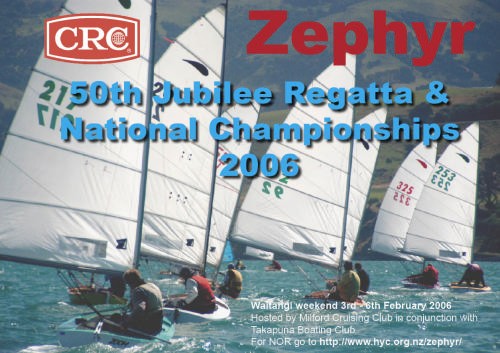
Zephyr 50th Jubilee Program cover Zephyr Owners Association
This weekend the Zephyr class celebrates its 50th Anniversary with the National Championship to be sailed at Milford Cruising Club.
The regatta has attracted 80 entries which will make it one of the largest national championships sailed in New Zealand, aside from the Optimist Nationals. Certainly for a New Zealand designed and developed class it is a remarkable achievement.
Class designer, Des Townson takes a typically laconic look at the class, in this introduction he wrote for the Anniversary programme:
‘When the 21st Anniversary of the Zephyr class was celebrated in 1977 by the French Bay Boating Club, it was quite an historic occasion, as the life expectancy of a dinghy in 1956 was about 10 years.
‘Most Zephyrs are constructed of untreated pinus radiata, the timber blamed by the building industry for the rotting homes problem. The glue used was heavily extended with walnut-shell, flour and water.
‘Much of the styling of the Zephyr is influenced by the traditional form of North Sea fishing boats, dating back to the mid 19th century.
‘So we have a class built of inferior timber, bonded (in effect) with a flour and water paste, and of antiquated styling. That the Zephyr has remained durable and popular for 50 years is good cause for further celebration.
‘I therefore welcome you to this significant regatta and trust you will have an enjoyable series.’
The following extract also comes from the Anniversary programme and outlines the history and development of the class:
‘This regatta marks the 50th anniversary of the Zephyr class. That the class has survived for so long is a tribute to the many people who have sailed the boats and contributed to the Owners’ Association.
‘Naturally, any review of the last fifty years has to start with the boat’s designer and builder, Des Townson. His decision to create the first one-design monotype in New Zealand began a lifetime of considerable personal achievement. His outstanding contribution to sailing in this country was recognised by Yachting New Zealand this year, on the nomination of Zephyr sailors.
‘Looking back, it is clear that a number of factors contributed to the success of the Zephyr. The first post-war decade saw the introduction of cold curing water-proof glues and a change to the way dinghies were constructed. New Zealand boat builders and designers quickly came to grips with the opportunities the new technologies presented, offering a range of craft to a receptive boat-buying public.
‘Des Townson was to become one of these builders. He left Auckland Grammar as Tanner Cup winner in 1950. He took up an apprenticeship as a motor body builder, but quit the business to begin building dinghies. He designed his first dinghy in 1953, - a 12-footer called Eagle, built by Ian Kelly. His first commercial design was the Q-class Nimble, commissioned by John Peet, a local sailing and family friend. Initially, he built many general purpose moulded dinghies as well as 12-footers.
‘Having seen all sorts of measurement arguments in the prevailing classes of the day (P, X, IA & Z), Townson determined there was a place in the market for an aesthetically pleasing, one-design monotype dinghy. He built a prototype, Atarangi, in 1956, as a development of his earlier 3.6 dinghies: Eagle, Mercury and, especially, Nimbus. Close friend John Peet persuaded Townson to exhibit Atarangi at the Tamaki Yacht Club Boat Show, which had been set up to promote the new one-design X Class. Atarangi stole the show - he came away from this show with 12 orders! The Tamaki Yacht Club sponsored the class and Bill Moyes bought the first production boat.
‘The class was immediately popular - by the 1956/57 season a fleet was established at Tamaki Yacht Club. The Zephyr made its first Auckland Anniversary Regatta appearance in 1957, in a mixed monotype class with the Moth class. A keen and at sometimes antagonistic rivalry ensued between these classes and continued for a number of seasons - both on the water and in the letters to the editor section of Sea Spray! A feature article on the Zephyr in the November 1957 issue of Sea Spray, with #6, Seafly, on the cover, gave the class a further boost.
‘To satisfy demand, Zephyrs had to be built economically and in sufficient numbers. The concept of a single manufacturer for a class went completely against the practise of the day, when yachtsmen expected to be able to build the class of boat they wanted to sail. Des’s determination to remain the sole builder did not endear him to a lot of yachtsmen who wanted to get into the class immediately.
‘By his own admission, Des was a focussed individual at that period in his life, not too concerned with the limited social opportunities the 50s provided. Surviving in the boat building business was the main goal! He proved adept at developing ‘production management techniques’. Zephyrs were built in batches of twelve or so - cold moulded in three layers of 1/10’ kahikatea or pinus radiata over a male mould. Individual planks for the first boat in the batch were shaped and twelve more prepared for later boats, number and stored. Subsequent boats in the batch thus became more of an assembly operation. The first side could be laid up in a few hours, covered with an electric blanket while the opposite side was laid up, by which time the first side was ready to have the staples removed in readiness for the second layer. A cleverly designed device for spreading glue on individual planks took further laborious work out of the process.
‘The purchase price of a Zephyr was 40 pounds at a time when take home pay was considerably less. Finish was generally to hull and deck beam stage, with owners installing centre cases and decking the boats. The quality of workmanship and finish was often superb. One example was #42, Frenesi whose extraordinary mahogany ply deck with intricate white wood inlays simply stopped the show wherever it appeared. Owners’ ‘love affair’ with their Zephyr (some even name them ‘Mistress’) has meant that some have remained in the same ownership for decades, with owners refusing to part with them even when they no longer actively sail.
‘Ultimately Des built 219 boats, the last being #225, now owned by Don Currie in Christchurch. The highest numbered Townson boat, #233, Lark, appears on a register c1966. It was built earlier and numbered for Otahuhu skipper Gary Linkhorn who had owned #33, Rocket, and #133, Whisper, so it seems practically all Townson Zephyrs were produced by around 1966. Production ceased when Des ‘moved on’ from dinghies - he was making Mistrals as well in a similar fashion, and his keel boats were becoming increasingly popular. The cold-moulded construction process for each boat was intensive and laborious. With 14,000 staples to insert and extract in each boat, one day he decided he never wanted to build another. So, according to John MacFarlane3, he calmly cut up the moulds and burnt them!
‘Amazingly, Zephyr prototype Atarangi survived. John Peet’s son, Brian, bought her two years ago and undertook a full restoration. Atarangi has sailed again and is now in the NZ National Maritime Museum in Auckland.
‘The class spread rapidly in the Auckland area, due in no small part to owners who sailed at every opportunity. Tamaki Yacht Club Saturday races were the main focus, but regular racing on Sundays took place at Tai o Tea (Browns Bay), Pt Chevalier, Manukau, Glendowie and Otahuhu. Otahuhu was also the venue for one of the classes most famous photographs - of long serving class secretary Barry Morley sailing #22, Gae, with only his knees showing as he stacked out in a fresh south westerly. As an indication of the Zephyr’s rapid growth, the first National Championship was won by #4, Why in 1956, (and again in 2004!) then by #168 Baloo, in 1964.
‘By 1960 the class had spread southwa
If you want to link to this article then please use this URL: www.sail-world.com/21513