Vestas Sailrocket 2 bouncing off the ceiling
by Paul Larsen on 2 Nov 2012
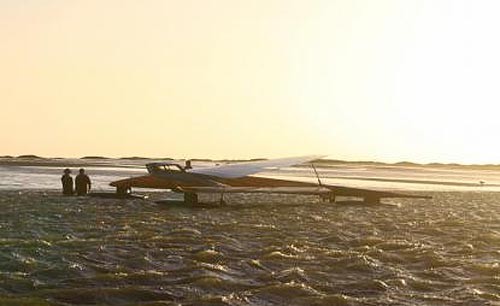
Vestas Sailrocket 2 Vestas Sailrocket - copyright
http://www.sailrocket.com
Paul Larsen, Vestas Sailrocket 2 project leader and pilot, discusses how the crew is bouncing off the ceiling due to the lack of sufficient wind.
The Walvis Bay wind machine seems to have broken down. The powers that be that make this one of the best and most consistent speed sailing venues in the world have taken a break and left no message as to when they are coming back. It has been 11 days since we have had enough wind just to get started in and the forecast doesn't indicate anything strong enough on the horizon. It's very unusual for this time of the year. In my four years on location here I haven't seen it this 'flat' before. It's weird. It's slightly depressing to be honest.
As mentioned in the previous blog, we have had to commit to booking a WSSRC ratified world record attempt without even knowing if we have the performance to achieve our goals. VSR2 is still very much being dialled in. We have only done five runs since we arrived, two of which we didn't even get going over 10 knots. The last run was pretty good in 'boat' terms... but pretty average in 'Outright' record terms.
As a team, both here and in the UK, we are all scratching our heads as to why we are hitting this 'glass ceiling' at around 52 knots. Consider the simple facts we have seen to date...
- Two different boats with seven wildly different foils have all hit this speed
- The boats have been sailed in winds from 22-34 knots and only twice just exceeded this speed. Remember that in theory a 30 knot wind has nearly 50% more power than a 25 knot wind.
- Both boats accelerate very hard up to this speed and then flat line.
- VSR2 is designed to sail at over 60 knots and is sheeted accordingly. If anything she is a little oversheeted at 50 knots. The tell tales are all flying and she accelerates from 40 knots up to 50 with the same sheeting angle. We have eased the wing out a few degrees to allow for the fact that we aren't achieving the polars.
- The foils are specifically designed not to cavitate until at least over 60 knots. They are base ventilated wedges and we have gone to great lengths to prove that the base is ventilated well down to tolerable/expected pressures throughout the run.
So, if it was simply a question of power... then we would go significantly faster in higher wind strengths. This hasn't proven to be the case. If the drag increase was gradual or even linear... then we would go faster in stronger wind strengths... we don't. The aerodynamic drag is only a small part of the overall drag picture. The front planing surface is the only thing in the water apart from the rudder and main foil at high speed. A simple V'd planing surface should have an almost flat drag curve as speed increases. The new rudder is smaller and more efficient than the last one in all dimensions. We are about to measure its base cavity pressures to make sure it isn't choking/cavitating... but am sure it isn't at speed (when the wind returns we will find out).
Thanks to all the sensors and the Cosworth data logger package we have a lot of very useful information from each run.
 Look at that acceleration on the yellow line. You can see how the acceleration levels off early as the wing is only partially sheeted until I bear away on to the course and sheet fully in to 10 degrees. The acceleration then shoots up again until we hit that glass ceiling at around 52 knots. It stays there despite sailing through gusts until I sheet out and bear away to slow down.
We are able to see how each aspect relates to the other. This graph above shows Boatspeed (yellow), rudder angle (red), rudder load (spiky purple... note it follows subtle steering inputs closely), Course over ground (lower grey), wing angle (playing up but still useful bottom dark blue), wind strength/angle (missing on this run), there are a couple of other load sensors in there.
We sit and stare at these graphs for ages, then we ponder them, lie awake in bed thinking about them... and come and check them out again. We question the accuracy of all the data and wonder how we can improve it. At moments like this when we don't have all the answers, we wonder if they aren't staring us right in the face. These light wind days give us time to ponder such things in depth.
So it comes down to this... if the nature of the drag was progressive or power dependent, sailing in significantly more wind would reward us with significantly higher speeds. We have simply hit 50-52 knots too many times now. This would suggest that the rapid rise in drag has been brought about by the foils in the water. Nothing else in the air or water could give such a rapid increase in drag. We know we are fully in the region where cavitation is likely. I can understand where the sub cavitation foils are failing as we are potentially near their limits, I can even understand where the first try at a ventilated/cav foil was failing (too big, too cambered)... but this new one is a hugely different foil in all aspects. It is specifically designed not to do the bad things that the first foil did. The new foil is the safe, reliable option and yet it simply hits the same glass ceiling as the last foil. That seems odd to me.
So we are all going over the boat, the data and having a fresh look at the basic principles. What are we missing? There is almost 100kg of thrust or drag not accounted for at our current speeds. It's a lot. Malcolm and Chris are meeting up at Aerotrope in Brighton tomorrow to discuss the problem in depth. I'll Skype in. If the wind was here we would be working progressively through the problem but it's not... so we have to work with what we already have.
There's a little bird outside that has become quite accustomed to us. It now hops into the container with one dodgy foot in search of crumbs. It hops right past me even as I type now. It has this weird problem where it is actually very territorial. When it catches sight of its reflection in the shiny underside of one of VSR2's pods it attacks it. It flies into its own reflection time and time again and we think it's silly. From its perspective it might be watching us going out time and time again smacking into our own glass ceiling. Neither of us will give in. It's not about the ceiling of course but rather the desire to own the territory on the other side of it.
Our ratified record attempt starts in a few days. No wind is forecast. Maybe it's a good thing. Maybe we are being afforded the time we need to work on the problem without distraction. I still have faith that there are great leaps and surges of speed waiting for us once we gain the understanding. I just hope that Mother Nature gives us a decent
Vestas Sailrocket website
If you want to link to this article then please use this URL: www.sail-world.com/103406