UK Sails Titanium - 'little black number'
by Guy Nowell on 8 May 2014
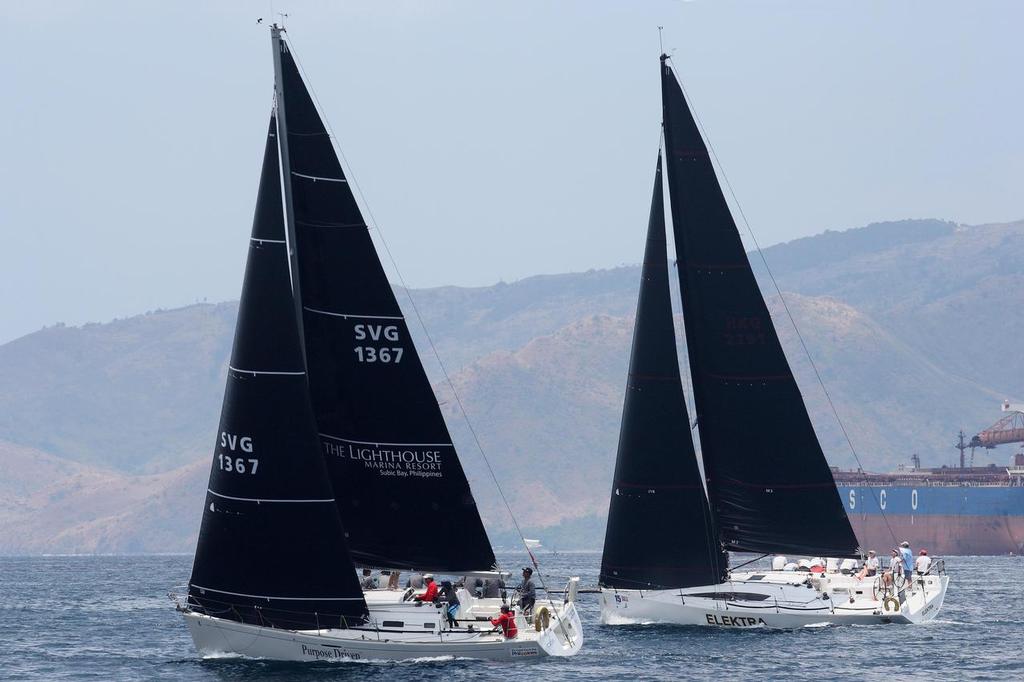
Selma Star and Elekta at the Commodore’s Cup 2014, Subic Bay, Philippines Bary Hayes
The dictionary defines 'Titanium' as a hard silver-grey metal used in strong, light, corrosion-resistant alloys. No wonder that UK Sailmakers' hottest item on the market bears the same name.
Say hello to UK's TITANIUM, a sail construction process that makes strong, light, hard-wearing sails that hold their shape through a wide range of wind strengths. This combination has long been every sailmaker's Holy Grail, and here is a winning construction that is already proving itself out on the racetrack.
UK’s Hong Kong production loft is tucked away in the north end of the territory, conveniently far away from any over-curious eyes. And now this phenomenally successful company that boasts almost 50 lofts and service centres around the world is rolling out a new generation of sails that encompass absolutely the most advanced design technologies and materials. They are very proud of what they do, but there are still places in the factory that are off-limits to visitors.
'It’s a lot of science, a good helping of art, and a pinch of black magic,' says UK Sailmakers’ Barry Hayes. 'As well as the input from the enormous UK team all around the world. Titanium sails are true one-piece sails that have continuous yarns running between the corners of the sail. They are the latest chapter in a story that began back in the 1980s with UK Tape Drive.' We all remember those, right? When, for the first time, someone thought of separating the load bearing and the air-impermeability functions of a sail, and came up with a unit that was strong in the right directions and right places only.
UK Titanium sails are composed of four layers: two PET films that are the outside faces of the construction, with the familiar pattern of load bearing carbon tapes and then panels of unidirectional carbon fibre cloth in the middle of the sandwich.
The exterior films are simultaneously the both the ‘finish’ and the glue that holds everything together. Shiny and weatherproof on the outside, the black PET copolymer skins are tacky on the inside, holding the whole layer cake together as it is constructed and also providing the resin that is going to melt down and through the interior elements, just like the cheese in a Reuben sandwich.
The carbon is extruded as a continuous fibre for added strength, measuring in at 2m wide and half of nothing in thickness. There’s not much introduction needed here - sailors all know about carbon fibre. This stuff looks like it came out of one of your old Barry Manilow cassettes, but is a lot stronger and less likely to be used as emergency tell tales. UK have been calculating load paths for long enough to know exactly what they are doing, so take it as read that all the angular sheet loads in this sail are now taken care of. Furthermore, the tapes are not coated in adhesive because there’s no need, and that makes for less weight aloft and less grunt required from the mast man.
The unidirectional carbon cloth is also massively strong and gossamer light, and its job is to provide rigidity to resist the twisting forces inherent in a sail that is being pulled three ways – from the head, the tack and the clew. Look at a Titanium sail and you may think that it is a panel construction because you can see the parallel panels of cloth. In fact, the seams are only in the film to shape the membrane, nothing more.
Hayes recalls that 'When we made our very first Titanium sail there was inevitably a certain amount of suck-it-and-see where the materials were concerned. We sandwiched three layers of unidirectional cloth into a No 3 jib built for Frank Pong’s RP76 Jelik. We knew the stuff was strong, but we didn’t expect the jib lead car to get ripped straight out of the deck. It’s strong – stronger than we realised. Jelik’s present No 3 only has one layer of unidirectional in the sandwich, and it’s just fine.'
The four layers are dropped into a custom-formed variable geometry form in which the sail is heat and UV-bonded into one piece. This is a concave form, and the ‘variable geometry’ part is very Secret Squirrel. (‘Don’t ask’ is safest, but we do know that it doesn’t involve trapeze artists and hovercraft). The PET copolymer resin melts and seeps around the carbon fibres and then down through the unidirectional weave cloth, and then all of a sudden the whole becomes substantially greater than the sum of its parts.
What’s happened here is that instead of applying the load path structural members to a pre-made sail membrane, the sail skin and load path structures have been fabricated as one integral product. Now you have a sail that is formed to exactly the right shape, as stiff as cross-grain plywood thanks to the unidirectional panels, as strong as the carbon load-bearing fibres can make it, and – here’s the bonus – not subject to UV degradation. Quite the opposite, in fact. Along with heat, ultraviolet light is part of the process that bonds everything together. Outdoors, UV merely serves to bond the sandwich together even more strongly.
UK maintain that their Titanium sails are their 'lightest, strongest and most high performance product ever'. They should know, after all, they have been building sails since 1946. The group has grown enormously since then, but UK are proud that the individual lofts that make up the group still retain the personal touch that sailors expect - all UK lofts are owned by local sailors who know the needs of their sailing communities. That's why each loft prides itself in providing quick, high-quality service along with well-designed, long lasting new sails.
Out on the race track, the most easily-spotted version of UK Titanium is probably the black-skinned sails on board Marcel Leidts’ GTS43, Electra. At the China Coast Regatta 2013, Electra rounded off the six-race series with three consecutive first places to take top honours in IRC 1. Leidts said afterwards, 'the sails took a little getting used to as they really are very, very stiff. But that didn’t take long, and the results speak for themselves.'
Frank Pong’s Reichel Pugh 76, Jelik, is also using UK Titanium sails, and made quite an impression at the Royal Langkawi International Regatta in January 2014. After a rocky start to the regatta – tactics, not equipment – Jelik chased hard, taking six first places in ten races, and finishing just two points off the trophy.
If you talk to the UK people for more than five minutes you quickly realise that the company celebrates ‘unity in diversity’. It’s been described 'a group of strong-minded independent operators with an enormous depth of specific talent spread through the whole group that any member of the group can call upon'. It’s that strength in depth that has come together to produce some of the finest racing sails in the world: UK Titanium – strong, light, stiff, practically bulletproof, and beautifully engineered.
If you want to link to this article then please use this URL: www.sail-world.com/121938