The American Tea Cup Regatta - where it all began
by Rob Kothe on 13 Jan 2011
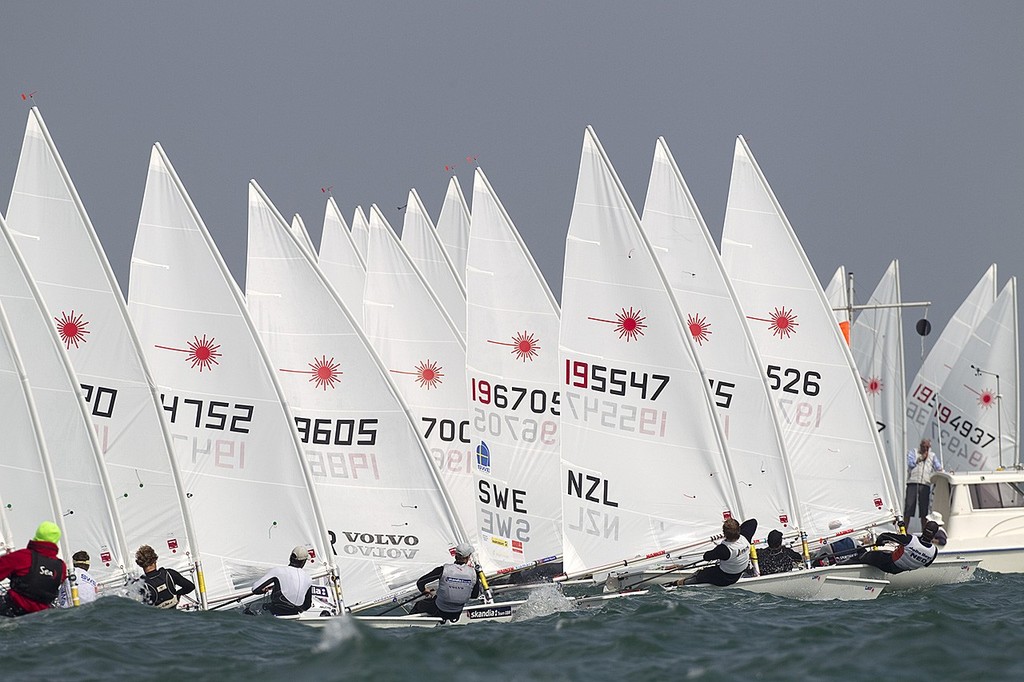
Start - Laser Worlds 2010, Hayling Island, UK Richard Langdon
http://www.oceanimages.co.uk
As sailing tries to broaden its base, the most desirable Olympic boats for the new and developing sailing nations are the single person boats, one-designs which are relatively inexpensive to build, the Laser and the windsurfer.
Almost 200,000 Lasers have now been built.
The boat's history began in 1969 when Canadian yachting journalist and boat designer Bruce Kirby was commissioned to design a dinghy small enough to be carried on a car roof rack. The design was for a camping equipment supplier, however that original design was never taken up.
The plans remained in Kirby's file until the following year when One Design and Offshore Yachtsman magazine, of which Kirby was the Editor, held a regatta for boats under $1000 at the Playboy Club at Lake Geneva in Wisconsin. It was called 'The America's Teacup Regatta'.
The first prototype, weighing in at 109 pounds, was named the 'Weekender' with sail number TGIF, the abbreviation for 'Thank God It's Friday'. (That was Hans Fogh's idea - he was another Canadian Finn sailor and the sailmaker and the first sailor to helm the dinghy.)
This week Kirby described the early days of the Laser.
‘There were two boats of note at the Teacup Regatta, one was the Weekender and the other one was the Windsurfer.
‘The Weekender was brand new, on that weekend. It had never been in the water before - literally, it had never been launched. In fact the hull and the masts arrived separately – but the windsurfer had been around for about three years.
‘The kid who sailed the windsurfer in the America’s Teacup Regatta was Matt Schweitzer, the 14 year old son of the inventor of the windsurfer Hoyle Schweitzer, who filed for a patent on the windsurfer in 1968.
‘It was really funny because young Matt had to a 720 in one race and of course he just spun the board with his feet and kept on going. It was the darndest thing. The middle of the boat never moved, just the ends of it spun around twice and he just kept on going.
'‘Our prototype boat in that America’s Teacup Regatta weighed only 109 pounds, it was 25 pounds under what turned out to be the proper weight. Hans explained that it had too much weather helm and so the builder Ian Bruce, built a second boat with a mast slot, so the mast could be moved back and forth while we played with the helm on the boat.
'In November of 1970 at the Royal St Lawrence Yacht Club, Ian asked a science student at McGill University ‘have you got any ideas for a name? We’ve got this boat ready to be produced and we don’t have a name for it yet.’
'Weekender was the only name we had and none of us really thought that was the right name.
'This young lad said ‘why don't you call it something scientific the young people will identify with?’
'And Ian said ‘do you mean something like Laser?’ And the kid said ‘yeah, that would be a great name.'
'Ian yelled down the table at me ‘how about Laser?’ And I said ‘that sounds pretty good.'
'And so it was the Laser...
'The first legal boat that weighed what we decided was within the range had the mast and everything in the right place, was built in December 1970, my boat was the boat from which all other Lasers has been copied. I sailed it for 18 years.
'We put a 100 on the sail, because of the two prototypes that had gone before. I eventually changed that to a zero because it didn’t make any sense to have a 100 on the sail and the builder had forgotten to put a number on the hull, which you have to do.
‘The number on a Laser used to be underneath the bow - the bow-eye on the old Lasers, the number used to be under that. Later the number had to be put on the transom, I think the US Coast Guard specified that.
'We sold 141 Lasers at the New York Boat Show in 1971 and on she took off from there.'
They certainly did take off and by the time of the Australian launch, one of the images used in the campaign was hull 6222 and one of the first boats sailed in Australia was 8000.
Kirby continues.
'In 1989 the Mystic Seaport regatta (at Mystic Connecticut) asked could they exhibit it (my boat) and its been there ever since.
'Mystic is a magnificent museum but it is nearly all old stuff – timber boats.
‘And among the exhibits is my good old Laser Zero. I think it was the first fiberglass boat in the museum.
'It was hand laid up and it was very nicely built, very stiff. It held its stiffness and quality for years and years. It was sailed hard - a lot. I think it is probably still a good boat. It started off Tangerine Yellow, but the sun took its toll and in its last few regattas the colour was listed as awful orange.'
Kirby concluded by saying ‘And now we are ticking to Laser number 200,000. But that is another story……’
Footnote: 81 year old Bruce Kirby is still an active sailor, although he no longer sails Lasers. He is off to his third Sonar World Championships in Scotland in 2011.
[Sorry, this content could not be displayed]
If you want to link to this article then please use this URL: www.sail-world.com/76372