Six minutes from cash to cutlery—Sailing in North America & beyond
by David Schmidt, Sail-World USA Editor on 19 Jun 2017
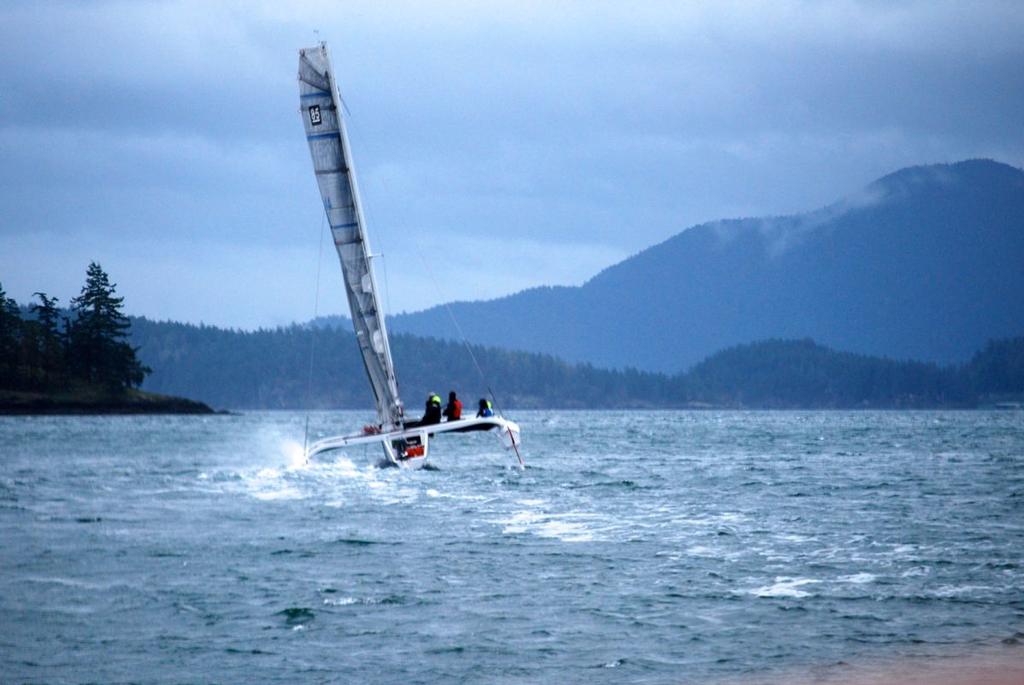
Team Pure and Wild/Freeburd in the 2017 Race to Alaska Pure and Wild / Freeburd
While the America’s Cup is offering viewers an amazing look at what happens when the world’s best sailors, designers and engineers conspire to create the world’s fastest multi-hulls, there’s something downright predictable about two teams meeting each other on flat waters and with enforced wind ranges. Of course, this makes sense in the context of the America’s Cup, where boats are fragile and all extra weight is stripped from the vessel in the design phase, but to remove a lot of the question marks that make sailing an adventure also removes some of the event’s magnetism. Place it in Bermuda, with its sky-high, exclusive pricing, then place it on hydrofoils that are driven by high-dollar airplane wings, and the event quickly becomes something that makes for a hell of a spectacle, but that is also well outside of the mainstream spectrum. Don’t be too surprised when eyes start glazing over.
Anyone who has read this newsletter for a while knows that I am a huge fan of the Race to Alaska (R2AK), a high-adventure, run-what-ya-brung affair that starts each year in Port Townsend, Washington, and crosses the Strait of Juan de Fuca (or, as it’s known locally on many of its rough-hewn days, the “Straight of Iwanna Puka”) to the charming city of Victoria, British Columbia, a distance of 40 nautical miles that serves as a qualifier leg to ensure that the brave-hearted are not in fact the foolhardy.
From Victoria, and following a two-day rest to repair boats and confidence levels (Victoria is home to many great pubs), the R2AK then punches 710 bold miles north to Ketchikan, Alaska, where the first boat in rings a bell and collects a $10,000 cash purse.
Sound easy? Be sure to factor-in the Johnstone Strait, where the wind seems to always blow hard from the north during R2AK windows; Seymour Narrows, where the tide can run 15-16 knots (literally forcing whales to time their passages; this has historically been a significant gatekeeper in this race); Queen Charlotte Sound, where the waves can be huge, and the water temperature, which perpetually hovers around 48 degrees Fahrenheit, and which doesn’t do wonders to the body’s core temperature over long hauls.
Oh, and don’t forget-no engines are allowed. Period.
Instead, teams can row, peddle or sail, and they can stop ashore for repairs or sustenance, but they are only allowed to use publically available resources (read: the chandlery or the local watering hole, not a team van), and any time spent ashore is time that their competitors can be making pure VMG towards Ketchikan.
Grizzly bears frequently patrol British Columbia beaches, glaciated peaks stand sentinel in the sky, and all traces of civilization largely linger south of Campbell River (or, as the libation-loving locals call it, “Scrambled Liver”), meaning that in the R2AK, sailors are striking-out on a real adventure, outcome unknown, survival anticipated-but-unknown, with no wind limits, no umpire boats and certainly no television cameras nearby (although the R2AK does employ a tracking system and offers fantastic updates on their website).
True, the wind machine can shut off for lengthy spells (welcome to the Pacific Northwest!), making the R2AK a human-powered endeavor rather than a pure sailboat race, but accounting for the light, sticky stuff is an important part of the pre-race experience. Get it right, as the past three winners have done, and the race seems marginally sane; get this choice wrong, as I experienced in the R2AK’s 2015 inaugural race, and those 40 miles from Port Townsend to Victoria can feel downright nautical, especially as you’re bailing like mad to keep your boat afloat.
While each edition of the R2AK has been unique, 2017 was one for the record books. Not only did the fleet experience near-biblical winds on the qualifier leg, but multiple boats made it through Seymour Narrows at the first reasonable tide window (rather than years past, when only one boat made it through and then enjoyed a private ride to Ketchikan), making the entire northern section of the course a serious fight. This culminated in two boats-Team Pure and Wild/Freeburd, an eight-meter customized trimaran sailed by the brothers Burd (Chris, Trevor and Tripp) from Marblehead, Massachusetts, and Team Big Broderna, from Anacortes, Washington, which included the brothers Strandberg (Nels and Lars), as well as Sean Huston and Marshall Lebron, aboard a Corsair F-31R-finishing within six minutes of each other.
After 710 miles of British Columbian and Alaskan coastlines, countless deadhead logs, likely a few bear and whale sightings, no wind limits (but plenty of air!) and full dry suites (mandatory).
(Full editorial disclosure, I’m proud to call the brothers Burd friends, so it’s possible that I was glued to the R2AK’s website for days, hitting refresh and-towards the end- praying that the wind machine would shut down and turn the race from a waterline contest to one that was determined by peddle and oar strokes, as there was simply no way that Team Big Broderna-with all due respect to a fantastic bunch of competitors-were going to touch the fitness level that the brothers Burd brought to the fight…and I speak from personal, ego-humbling experience here, as Chris Burd is a frequent hiking partner of mine, and one who has hiked me into the ground on many an occasion on Washington State’s glaciers and trails.)
In all, Team Pure and Wild/Freeburd covered 710 miles in four days, three hours and five minutes, slower than Team MAD Dog Racing’s 2016 record-setting time of three days, 20 hours and 13 minutes, but six critical minutes faster than I>Team Big Broderna, who is now the proud owner of a set of R2AK steak knives (no kidding) for their troubles.
“We finished in half the time as year one with twice as much work,” reported Tripp Burd after claiming the purse money. (N.B., Chris and Tripp Burd sailed a 22-foot, “vintage” beach cat in 2015’s inaugural race and finished in fourth place after nine days, seven hours and 24 minutes.)
As for Bermuda, yes, there’s an America’s Cup on, and the racing has been fantastic, with Emirates Team New Zealand (ETNZ) claiming the first two wins on Saturday, followed by another two back-to-back wins on Sunday, bringing the scoreboard to read three points ETNZ, zero point Oracle Team USA (yes, you read that right). Racing now pauses until Saturday, June 24, giving Oracle Team USA time to make their boat faster (we’ve seen this before, but there’s no denying that the Kiwis look fast this year).
While it will be fascinating to see if Oracle can conjure the same juggernaut magic that propelled them to one of the biggest comebacks in sports history during the 34th America’s Cup (2013), I personally will be spending these days between racing hitting refresh on the R2AK’s website, as there are plenty of great teams out there, and plenty of adrenaline left to vicariously enjoy.
May the four winds blow you safely home,
If you want to link to this article then please use this URL: www.sail-world.com/154735