Seven low visibility sailing tips for safety
by John Jamieson on 16 Sep 2011
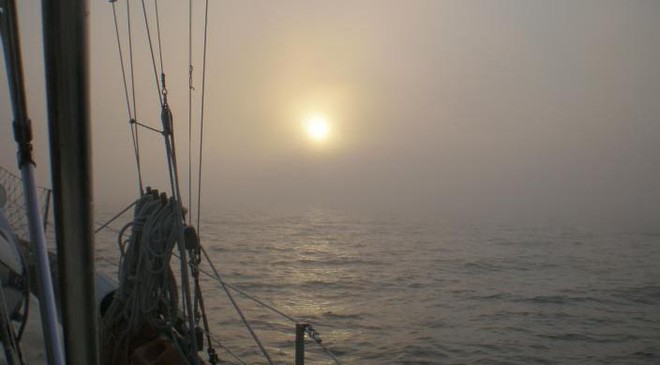
Could there be something in that fog? SW
Not many things cause as much tension underway as low visibility. You need to make sure that you are ready to deal with pea-soup fog or a blinding rain squall. John Jamieson (Captain John) shows short-handed crews the seven top sailing tips they need to know to meet this weather challenge with confidence--and peace-of-min:.
Know Where You Are:
Mark your position on both your nautical chart and chart plotter when in or near an area of reduced visibility. Energize and maintain a watch on radar and AIS (if installed). Maintain a plot of your position at frequent intervals. At all times--know where you are! Keep a record of your latitude and longitude in the logbook.
Plot the safest course to keep your vessel in safe water and clear of shipping lanes, areas frequented by commercial traffic (i.e. tugs, commercial fishing vessels), and dangerous shoals.
If in doubt of your position, pull off to the side of the channel and anchor. Make sure that you show the proper lights for a vessel of your size at anchor and that you sound the signals required by the Navigation Rules (see below).
Put on Personal Flotation Devices:
Make sure all hands put on inflatable vests or life-jackets. Fasten all straps and snaps. Attach flashlights and police-type whistles to each vest or life-jacket.
Stuff a wool or microfiber watch cap in your pocket. Your body loses close to 90% of its heat through your head. If you go into the water, this will help slow down the onset of hypothermia.
Jacklines provide an attachment point when moving between the cockpit and the bow. Run two lines or long lengths of flat webbing on each side of the boat. Attach the lines or webbing to the bow and stern cleats. Remove as much slack as possible so that they don't become tripping hazards for your sailing crew.
Wear a safety harness with two tethers (lines with snaps). Clip on to the windward side jackline. If you need to move around an obstruction, clip on with the free tether before releasing the other.
Strap a sharp knife in a sheath to your belt. If your safety harness gets tangled, you want to be able to cut yourself free in an instant.
Warn Others of Your Position and Status:
The Navigation rules require all vessels to show proper lights during darkness or periods of reduced visibility -- day or night. Sailboats show red and green side lights and a white stern light. If you have your engine on, turn on your masthead light.
Use a manual fog horn or air canister horn to warn other vessels of your position and actions when in or near areas of low visibility. Vessels under sail sound one prolonged blast (4-6 seconds) followed by two short blasts (a short blast lasts one second)--every two minutes.
If under power, sound one prolonged blast every two minutes. If under power but drifting, sound two prolonged blasts every two minutes.
Vessels at anchor are obligated to sound signals based on their length and whether they are anchored in International or Inland waters. In International waters, vessels 20 meters (65.6 feet) or longer must sound a signal of a rapid ringing of the bell for five seconds every minute.
If anchored in the Inland waters of the United States outside of a designated anchorage area on a vessel 12 meters (39.4 feet) or longer, you must sound this same bell signal every minute.
*Note--Some special vessels that are engaged in a specific type of work (i.e. commercial fishing, dredging, laying pipeline, tending aids to navigation--sound one prolonged blast-two short blasts in succession, every two minutes while at anchor. Stay well clear of these vessels to avoid extreme danger.
All other anchored vessels must sound some type of unique fog signal every two minutes to warn others of their anchored position. It has to be a fog signal that cannot be confused as one of those described earlier. So what fog signal could you sound?
The Navigation Rules suggest that you make a signal of one short blast-one prolonged blast-one short blast in succession, every two minutes. Mariners worldwide recognize this unique signal as that of a vessel at anchor.'
Other ways to attract attention:
Keep a powerful, one million candlepower, handheld spotlight in the cockpit. If a ship approaches, shine your spotlight in the direction of the vessel to get their attention. In addition, you could shine the light onto your sails.
Maintain a Lookout by 'All Means Available':
Send one crew forward to the bow away from the noise of the engine. Watch and listen. Hearing becomes the most important of your senses in fog or haze. If you hear or sight another vessel, slow down or stop. Figure out what the other vessel is doing before you proceed. If you have installed radar or Automatic Identification System (AIS), the navigation rules require that you use those tools along with visual scanning.
Hoist Two or More Radar Reflectors:
Purchase two radar reflectors. The best designs have three round panels that bisect one another at 90 degree angles. Hoist the reflector so that the top panels form a 'V'. This presents the best reflective surface when heeled over. Hoist the reflectors high up on your backstay and shrouds or mast.
Stop, Listen, and Look:
Heave-to often or stop the boat and listen for other vessels, voices, sound signals, or breaking surf. If under power, stop the engine and listen for several minutes. To find a sound equipped navigation buoy (bell, whistle, gong), make a tight circle to create a wake. Then, stop the boat and listen.
Get Your Anchors Ready:
Carry at least 300 feet of anchor rode (line) and two anchors. Make sure you can get your anchor over the side in a few seconds. If unsure of your position, anchor until you sort things out. If underway and you hear surf (breakers) ahead, lower the largest anchor aboard right away.
Captain John’s Sailing Tip: Shift the helm watch every 30 minutes in fog. Extensive research proves that attention spans plummet after this period. This applies to all sailors--novice and veteran alike!
Use these seven low-visibility sailing safety tips in less than ideal marine weather to keep out of harm's way. You and your sailing crew will arrive in port safe and sound--wherever in the world you choose to cruise.
John Jamieson (Captain John) with 25+ years of experience shows you the no-nonsense cruising skills they didn't teach you in sailing school. Visit his website for a free sailing tips newsletter. Become a member to get instant access to hundreds of sailing articles, videos, eBooks, and live discussion forums.
If you want to link to this article then please use this URL: www.sail-world.com/88478