Sail-World Boat Test- Flying the fabulous Weta
by Richard Gladwell on 15 May 2010
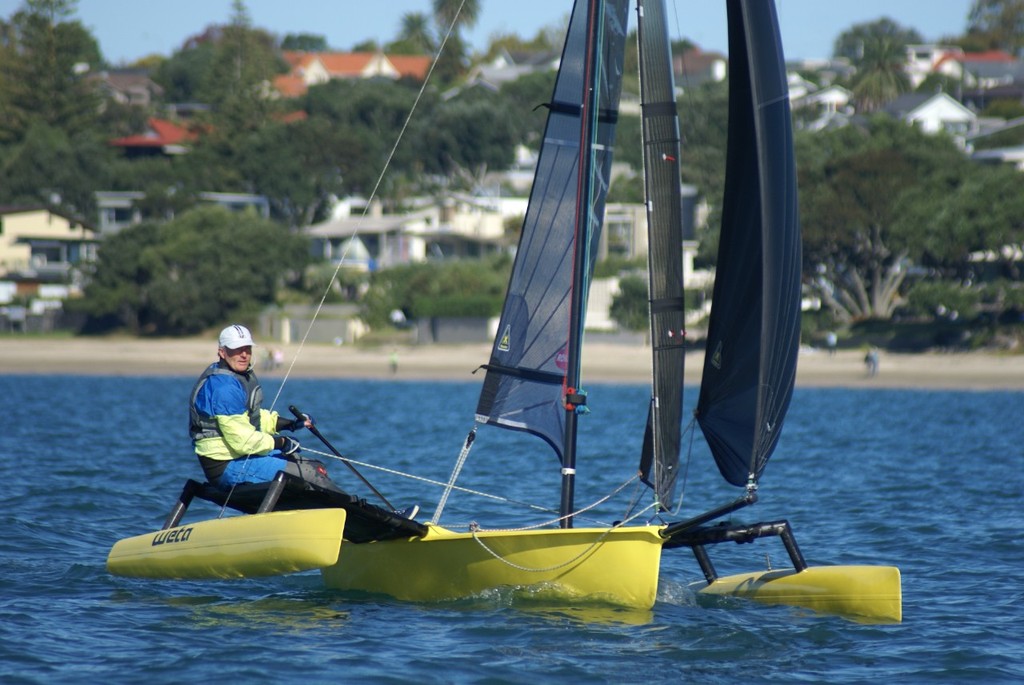
Venetian blinding in a Weta - she is remarkably close winded in this mode - Weta Boat test - May 2010 SW
Sail-World's Richard Gladwell test drives the Weta trimaran off Auckland's Takapuna Beach, and gives his impression of the boat which won the prestigious sailing World 'Dinghy of the Year' Award for 2010:
Over the past 30 or so years there have been several seminal boats and designs.
Bruce Kirby did it with the Laser, Hoyle Schwietzer with the Winsurfer, Hobie Alter with the Hobie 16, and Frank Bethwaite did it with the 29er.
And now, Roger and Chris Kitchen and the team at Wetamarine have done it with the Weta.
One way to judge a boat is by its uses. The Weta just oozes uses.
It was Frank Bethwaite who explained the 'uses' concept to us where a design appeals to a much wider group than just its target group, often because of a simple design feature that is very effective and appealing.
Take the Laser, the simple one design is everything from a beach sailer to an Olympic class, sailed by everyone from juniors to masters – all of whom think of the design as 'their' boat.
A simple question and answer sums up the situation. 'How many Wetas have you built, Roger?' 'About 400', he replies. 'How many on order?' 'About 200, in the next 12 months' he replies equally nonchalantly.
Clearly Wetamarine have a supply problem rather than a marketing problem. And, with those sort of numbers the Weta has certainly made an impact on a lot of sailors.
The conversation turns to who is sailing it and where it is sailed.
In San Francisco the Weta seems to be used as a single hander. In the Caribbean it is a resort boat, there are fleets in all the continents – Asia, Europe, Africa, Oceania, North and South America. 'There is quite a lot of destination sailing in France', says Roger, 'where fleets of Weta do three day camping hops down the coast. And of course there are more intrepid Weta sailors doing the 300km Everglades Challenge.'
Originally conceived by Roger and Chris Kitchen, the Weta was three years in protoype development.
Roger was previously a mathematics teacher who has been involved in small yachts as a pastime for many years, including a management role with Yachting NZ. He's always had a passion for small sailboats and has built a number of dinghies including a 3.7, Firebird, and a P-class. Like many Kiwis, fiddling around with boats comes very naturally to him.
Son, Chris was introduced to sailing at the age of 5 as a crew in Roger’s Firebird. As soon as he was big enough to sail an Optimist he started racing and has never looked back.
He progressed through the classes – Optimist, P-class, Starling, Laser competing in many international yachting regattas including winning a Silver Medal at the 2001 ISAF Youth Worlds as well as representing NZ in a number of world regattas. Currently Chris is sailing in the 18ft skiff class.
He picked up an engineering degree BE (with First Class honours) along the way, which shows in the Weta.
There is a diverse and interesting mix of thinking and experiences behind the Weta - perhaps explaining her appeal to a wide range of sailors.
'We came up with a multihull concept and commissioned several companies to design key components', explains Roger. 'They included TC Design, Graeme Robbins Sails, Fyfe Sails, C-Tech and our Chinese manufacturers Land & Ocean and Gaastra.'
'There are also a bunch of top Kiwi Olympic, America's Cup and world champion sailors who have given freely of their time and expertise to assist in the development of the Weta', adds Chris.
Originally designed as a safe yacht for school children to learn to sail in, the Weta is only just slipping into that use in New Zealand. Yachting New Zealand have purchased three for their 'Sailing - Have A Go' program, which each year gives hundreds of school children, their first sailing experience.
Back in the days when your humble scribe used to teach Learn to Sail, and Waterwise (a six lesson sailing experience program), we’d have killed to get our hands on the Weta.
It’s everything you need to get kids enthused about sailing – easy to rig, hot looks, goes fast, stable, no boom, plenty of sails – so there is something for everyone to do. Stable, and oh so forgiving.
Takes a load too. Chris tells us that 14 kids is the record. But three or four would be just fine – and a much better sailing experience for them than being in Optimists and chased around by a coach boat trying to instruct.
The Weta all quickly folds away into a space smaller than a car – so storage is no problem.
We picked a good day for our boat test (thanks to PredictWind). A nice warm autumn day with a light sea breeze pushing onto Takapuna Beach.
Roger and Chris Kitchen rigged the boat, detaching the floats from their position on the trailer, slotting the cross beams into sockets in the centre hull, a bit of quick lashing and the whole 'platform' was together.
The two piece carbon mast was quickly together, and in place with three stays.
Every part on the boat is manufactured in a single factory China, except the sails – which are from Gaastra – also in China.
Rigging is even simpler than the platform assembly, the only trick being to make sure the screecher is furled tight.
Weighing in at 125kgs all up, the Weta is easily launched off the trailer
We’ve got the screecher setting within the first 20 metres, and start looking for a bit of kick in the breeze, which is still only around six knots.
Even so the Weta seems to get along all right.
Soon the breeze picks up to eight knots or so and we are away. Out on the edge of the platform, hanging over the windward float and feeling like we have a bit of pace.
Sailing the Weta with three sheets and just two hands is no problem. With the jib and main cleated off, it is a simple matter to run the screecher sheet in one hand and the tiller in the other.
As we mentioned earlier the Weta is a very forgiving boat, if you need a second hand – it’s no problem to drop the tiller for a few seconds and fix the sheets or whatever.
With the screecher drawing the Weta sails at a surprisingly high angle – not close hauled but well above a beam reach. Tacking and gybing, with three sails set, is not a problem – and the Weta is very forgiving of slow crew work.
With the breeze building to about 8-10 knots we get our best sail of the day on a tight reach, with the Weta reasonably pressed. There is no tendency to trip over the leeward hull. They’re wave piercing and everything just loads up nicely. The centre hull lifts nicely. With the screecher pulling hard there is a little leeward helm, but no more than you’d expect, and certainly no tendency to bear off and cause serious grief.
Upwind the Weta feels reasonably close winded. The sails are very well cut and the rig really works well. It is easier to sail off the jib tell tales than the feel of the helm, which is very neutral – but maybe that is a multihull thing.
Ashore Roger and Chris unrig, while the questions flow.
Priced at a little more than a Laser, Roger Kitchen explains that the need to keep costs under control was behind the move to manufacture in China. And as demand has increased it has become more cost-effective to manufacture in their own factory – down to spinning their own carbon tube and making even the smallest of fittings.
He points to a small guide at the entrance to the sail track on the mast. 'When we imported those – the price was $15 each. When we made them ourselves the cost dropped to 15c'
That philosophy has allowed Chris and Roger Kitchen to use a lot of carbon in the Weta. But they readily admit the Weta could be 20kgs lighter. 'We did the prototypes at that weight, 'Roger explains. 'And then we put in more material to beef up the boat.'
They’ve certainly done that, with a centre girder running the length of the main hull to maintain stiffness. The floats have deck to keel tubes set into them, into which the platform tubes are inserted, so there is no chance of leaks, or the platform working.
When sailing the structure all feels very stiff and tight. Exceptional when you consider that is this is the demonstration boat which has been hammered for 12 months or more – yet still feels like new.
But all good things have to come to an end, and as the judges in the prestigious US sailing magazine, Sailing World, noted when awarding the Weta their 'Dinghy of the Year' award for 2010: 'In fact, nothing about the Weta disappointed, except, of course, having to hand it back.'
We couldn’t agree more.
For more information on the Weta see the website www.wetamarine.com
To read what others are saying about the Weta http://www.wetamarine.com/endorsements/!click_here
If you want to link to this article then please use this URL: www.sail-world.com/69469