Ridding Sails of Mildew - the Four Easy Steps
by Andrew Dove, Area Manager, North Sails Caribbean on 9 Mar 2008
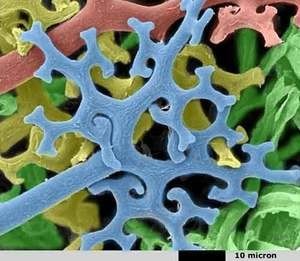
Not so pretty on the sails SW
Mildew is an integral part of our ecosystem. But where the keen gardener will apply copper sulphate to limit the destructive affect of mold on his precious plants, sails are an expensive purchase and their aspect a clear part of a boat’s image. Certainly mildew stains on sails are a serious problem.
Often the stains will appear after a period of stockage which will be the case for many sails during any length of time that the boat is not used. For the sail maker this can be quite a nightmare; though arguably, it is a stain like the tar that scrapes off of pilings or the blood from the spinnaker pole accident, somehow mildew is unique. Most cloths have antifungal agents added and these are fairly efficient if the conditions that create mildew are limited.
Laminated sails due to the mylar film sandwiched within the cloth are often an ideal support for mildew development. Contrary to what we may think, the growth is more on the surface of the fibres than deep within them. Though small patches may disappear with a few days sailing, the development continues if untreated as soon as the conditions are united.
Moisture, heat, and shade are the obvious factors. Rain water is generally far more dangerous than sea water. A colleague of mine in Auckland often drops new sails in clean sea water to protect them for fungus growth. We have very good results with the Mclube treatment which should be considered if you are purchasing any laminated sails. This product can also be reapplied. A number of customers have purchased grey cruising sails. The colour obviously does not avoid fungal growth but, in addition to being a popular modern look, it hides minor mildew. Obviously the prevention of mildew, short of planetary biological twilight, remains elusive, but we have a few techniques to at least partially remove it after the fact.
The following procedure should NOT be used with Kevlar or nylon sails.
INSTRUCTIONS.
1. Fill a tub or tank with water. It should be large enough that the sail you intend to wash can be fully immersed.
2. Add Clorox or other chlorine bleach to the water, in a ratio of approximately 30 to one. 'Clorox' is sodium hypochlorite in a 5.25% solution, so the resultant wash solution is slightly weaker than 0.2% (two parts per 1000) of sodium hypochlorite in water. The exact solution does not matter, however. We suspect that one part per 1000 is adequate, and we know that five parts per 1000 (10 to one Clorox in water) will not cause any damage.
3. Place the sail in the bath for at least 48 hours (and cover the tank since the chlorine likes to evaporate). Longer is probably better, for stubborn and very serious cases. Make sure the sail is fully submerged. Stack rocks or bricks on it if necessary, to keep it from floating. Force out as many air pockets as possible and make sure the sail is fully wet out. You might want to stir it every now and then, or shift it around.
4. Take the sail out of the sodium hypochlorite solution and check it. If it is not sufficiently clean, put it back in the bath for another day. When done, rinse it thoroughly with fresh water. Hang it to dry.
At the end of this, the sail should be almost completely clean and any remaining mildew will be absolutely dead, so lingering stains should fade fairly quickly when the sail is used. Exceptions will likely be under corner patches, under insignia cloth, and maybe inside a seam, though these spots should be greatly improved. More time in the solution will improve them.
This is not a new idea. Tent cleaners have said for years that prolonged soaking will remove mildew, and there have been extensive anecdotal reports from North Sails New Zealand, to rename one source, that stains have been rectified by soaking the sails over the side in clean salt water for a day or so.
The cleaning agent may vary but the indispensable element is time. The mildew is microscopic and the longer it lives on a sail, the deeper it gets into the yarns and fibre bundles. It prospers in all sorts of wretched conditions so it is capable of withstanding quick but intense cleanings, even with fairly hot water and mild detergents. If the wash kills it, it does not have time to remove the dead bodies. No amount of scrubbing will reach a stain, without first peeling off the top of every yarn and a good part of the sail.
So be prepared to wait and, importantly, be sure to air and dry your sails whenever possible and do not stock when damp.
If you want to link to this article then please use this URL: www.sail-world.com/42491