Ice detection with thermal imaging cameras
by FLIR on 29 May 2014
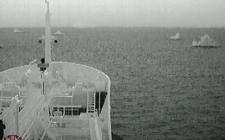
Traversing the Arctic waters becomes much safer with the help of a thermal imaging camera. FLIR
http://www.flir.com/cvs/apac/en/maritime/
The earth's Polar Regions are considered by many seafarers to be among the most challenging environments in the world.
The combination of extremely long nights, harsh weather and icebergs can make a trip through Arctic and Antarctic waters dangerous. Nowadays these trips can be made safer by using a thermal imaging camera from FLIR Systems. Thermal imaging can help seafarers to find the safest path through the ice.
Glacier ice is difficult to track by marine radar as the radar signal is scattered by air bubbles and other imperfections in the ice. Many experienced seafarers can attest to the difficulty of detecting ice with radar. Even the radar signal returns from large icebergs are much lower than from ship targets because of the lower radar reflectivity of ice (and especially snow) if compared with steel. Detection of ice targets is therefore rather difficult, especially if they have low or smooth profiles.
Pieces of ice also break off from icebergs. The larger pieces are known as bergy bits, and the smaller pieces are known as growlers. These smaller pieces are even harder to detect by radar. This is particularly true in heavy sea conditions where the radar returns from ice floes may be lost in the so-called 'sea clutter', which means that the waves show up on the radar image, making it difficult to distinguish between ice and the waves.
During the daylight hours the inability of radar to detect ice in certain conditions can be compensated by visual inspection. This requires good visibility. However, in the long polar nights this task becomes very difficult due to the lack of light and even during those scarce hours of daylight the visibility might be restricted by fog or snow.
Fog is common in the Arctic during the open water period and during the winter snowstorms regularly occur. In the nighttime the combination of darkness and fog or snow can limit the capability of regular eyesight to detect ice hazards even further.
The solution to this problem can be found in using a thermal imaging camera. Thermal imaging cameras record the intensity of electromagnetic radiation in the infrared spectrum. All matter emits infrared radiation, even objects we think of as cold, such as ice, emit infrared radiation. In a thermal imaging camera the infrared radiation is focused by a lens onto the detector. The intensity of the recorded infrared radiation is translated into a visual image.
Because thermal imaging cameras rely on thermal contrast instead of color contrast they do not need lighting to produce crisp images during the night. They provide a good overview of the situation giving a much better idea of the surroundings than the narrow beam of a searchlight. Also, searchlights are of limited use in snow and fog. Its light beam does not reach far in such conditions. When fog or snow impedes vision thermal imaging cameras can also help the ship's captain and navigators to see farther.
FLIR Systems set out to determine how its maritime cameras perform in the field. For this field test two versions of the FLIR M-Series thermal imaging camera were mounted on a tripod next to the bridge of an ice strengthened vessel traversing Greenland's ice filled waters to deliver fuel to its remote settlements. In this extreme environment, arguably one of the most dangerous maritime areas in the world with its floating chunks of years old dense glacier ice, FLIR's thermal imaging cameras were put to the test. They passed the field test with flying colors.
The test clearly showed that thermal imaging cameras are capable of detecting ice in total darkness and even during snowfall. In total darkness, the visual light of a search beam is reflected by the snowflakes, impeding vision. Thermal imaging cameras perform much better under these circumstances, as the test clearly showed, maintaining a good range performance despite the snowfall.
During the test thermal imaging cameras were successfully used to detect pieces of ice of different sizes and shapes. These are generally divided into three categories: icebergs, bergy bits and growlers. Icebergs are floating chunks of ice with more than five meters of its height exposed above sea level. Bergy bits are pieces of icebergs showing one to five meters above sea level. Growlers are pieces of icebergs showing less than one meter above sea level. With the thermal imaging camera all of those three categories were detected.
Due to their size icebergs are usually relatively easy to detect by radar. In most occasions using radar should suffice in detecting them. The bergy bits are smaller than full-grown icebergs, making them harder to detect, both by radar and visually. Even the large bergy bits can be difficult to detect using marine radar, due to their shape. The sides of bergy bits are often oriented in such a way that radar energy is deflected away from the antennae. Combined with sea clutter this bergy bit characteristic can make it really difficult to spot them on the radar. During the test many bergy bits were observed with the thermal imaging camera, they showed up very clearly in the thermal image.
Growlers, being the smallest category, are the most difficult form of ice to detect both visually and on radar. Though small, growlers can still pose a serious threat even for ice strengthened vessels. Growlers made out of ice less than one year old should not be able to cause much damage to such vessels, if they maintain a safe speed. Due to its pressurized environment ice from glaciers and multi-year sea ice can have a much higher density, so growlers made of multi-year ice can be a lot heavier than those made out of the less dense 'younger' ice.
Even the hull of ice strengthened vessels can be damaged in case of a collision with a multi-year ice growler. Also the fuel consumption of a vessel is higher if it is slowed down due to the impact of such collisions. It is therefore much safer and more efficient to avoid all growlers and bergy bits. Growlers can easily be obscured by the sea clutter on the radar screen, especially if they have a smooth relief that deflects radar energy away from the antennae. In clear conditions it may be possible to detect growlers visually, but at night and in bad weather that becomes increasingly difficult.
Governmental authorities warn seafarers that traverse Arctic waters not to trust on radar alone to detect icebergs, bergy bits and growlers in fog and darkness. Given the fact that the force of impact in case of collision varies as the square of the speed the authorities advise to lower the speed of the vessel. The prudent speed in a given ice condition is a result of the visibility, the ice type and concentration, the ice class, and the maneuvering characteristics of the ship.
With a thermal imaging camera on the prow you can not only avoid collisions with icebergs, bergy bits and growlers, using a thermal imaging camera can also help increase the speed at which the vessel can safely move through waters where ice collision hazards are suspected. Since thermal imaging cameras help increase the visibility drastically, the speed at which the ship can safely move through ice filled waters is much higher. This increases the overall efficiency of the vessel.
Thermal imaging cameras can be used to detect ice because the ice is generally much colder than the surrounding ocean. Not only do the temperatures of the ice and the seawater differ, in most cases there is also a difference in emissivity. Emissivity can be described as the ability of a material to emit energy by radiation, more specifically the ability to emit thermal radiation. Two objects at the same temperature but with different emissivity will present different levels thermal radiance to the thermal imaging camera.
Most of the ice in the sea surrounding Greenland originates from glaciers and therefore mostly consists of fresh water. The exact emissivity differs slightly depending on the circumstances, but generally speaking fresh water has a higher emissivity than the salty sea water. This means that even if the temperature of the ice and the seawater are the same temperature, there will still be a contrast between the two in the thermal image. Another factor is the movement of the surface. The surface of the seawater is ever moving, rippling and churning, while the surface of the ice is solid, still. Even when the amount of thermal radiation emitted to the thermal imaging camera is more or less the same, which means that the ice and the water have more or less the same color in the thermal image, the ice will stand out in the thermal image due to this difference.
The FLIR M-Series thermal imaging camera is available with a variety of sensors and resolutions to meet a wide range of maritime needs. For the ice detection test the models M-612L and M-625L were used. Both of these models include a thermal imaging camera with an uncooled Vanadium Oxide (VOx) microbolometer detector that produces thermal images at a resolution of 640x480 pixels and a 100 ?lx Lowlight CCD camera, mounted in a rugged waterproof housing capable of 360° pan and +/-90° tilt that is waterproof and contains internal heating to ensure its performance even in such cold environments as the Arctic. The difference between the two is the optics and resulting field of view. The lens of the M-625L gives it a field of view of 25° × 20°. Although this gives an excellent situational awareness, the range performance is better with a narrower field of view. The M-612L has a field of view of 12° x 10°, which is narrower, allowing for a better range performance.
In average conditions the thermal imaging camera incorporated in the M-625L is capable of detecting a small vessel (2.3 m × 2.3 m) at a distance of over two kilometers (over one nautical mile). The M-612L's thermal imaging camera can be used to detect the same size target at a distance of over three kilometers (over 1.7 nautical miles). The test conclusively showed that thermal imaging cameras are able to detect bergy bits of similar size in real life situations from roughly equivalent distances, despite snowfall reducing their range performance. This makes FLIR thermal imaging cameras an ideal addition to conventional ice detection tools, filling in the gaps where radar and searchlight underperform.
In the crisp high contrast thermal images the smallest of details are shown, regardless of lighting. This not only allows these thermal imaging cameras to aid the captain and navigators with ice detection, it can also prove invaluable in man overboard situations. In these cold waters hypothermia can prove to be deadly within minutes, so if a man overboard situation does arise then finding the fallen crewmember swiftly is of paramount importance. Thermal imaging cameras have shown their value in such search and rescue operations all over the world, but in the cold waters and long dark nights of the Arctic using thermal imaging can make an even bigger difference. The large temperature contrast between the cold water and the warm person allows the camera operator to swiftly locate the waterborne person regardless of lighting. Due to the freezing temperatures in the Arctic waters the time saved by using a thermal imaging camera can easily make the difference between life and death.
Installing a FLIR thermal imaging camera on vessels traversing Arctic waters will help avoid collisions, increase efficiency and help safeguard the safety of the crew in case of man overboard situations regardless of lighting conditions and in all types of FLIR website
If you want to link to this article then please use this URL: www.sail-world.com/122745