Gladwell's Line- Riding shotgun on Emirates Team NZ's AC72 at 43.6kts
by Richard Gladwell on 15 Nov 2012
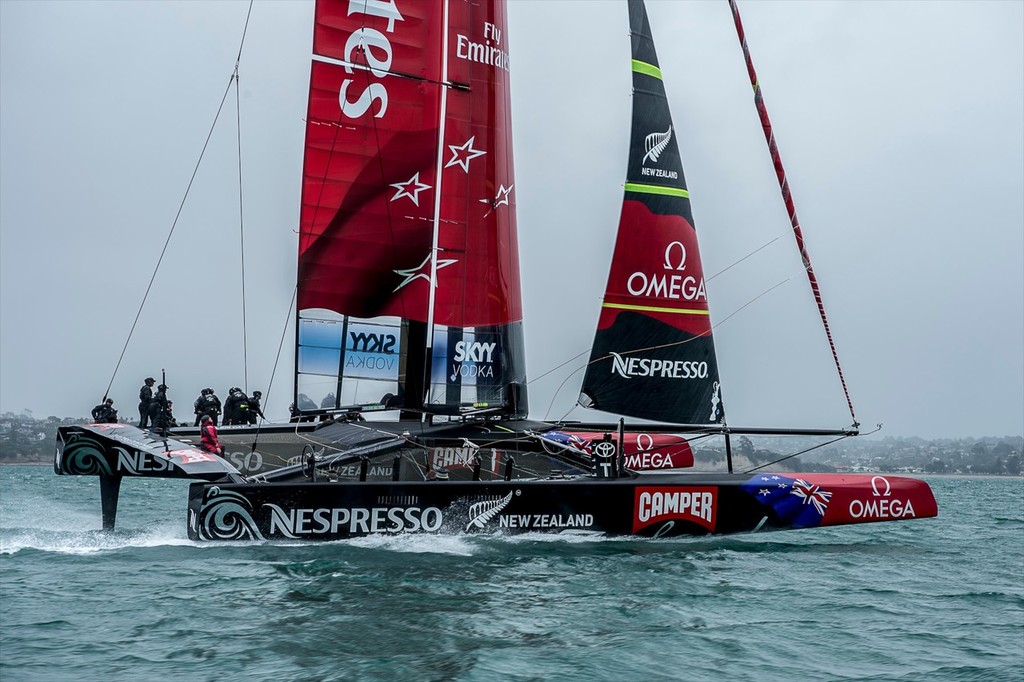
Sail-World’s Richard Gladwell (red wet weather gear) , checks out the wingsail twist as Emirates Team New Zealand’s AC72 rips across the Hauraki Gulf at speeds of over 40kts Chris Cameron/ETNZ
http://www.chriscameron.co.nz
Sail-World.com's NZ and America's Cup Editor, Richard Gladwell, spent three hours perched on the after beam of Emirates Team NZ's AC72 for a training session on the Hauraki Gulf. Sailing in winds of up to 25kts, the AC72 hit an amazing 43.6kts and didn't even feel like she was breaking into a sweat. He reports on Wednesday's race and test session.
Imagine you are standing on top of an Emirates jet on that final mad charge down the runway before takeoff.
The engines are screaming and every imperfection in the runway is magnified into the jolting that reverberates through the plane just before it leaves the ground.
Next, take that mental snapshot and overlay it on to a boat the dimensions of a tennis court (well three metres wider), flying down the harbour, a couple of metres above the sea, travelling at a speed of more than 40kts.
This is the surreal world of the AC72 catamaran and the 34th America’s Cup.
Today Emirates Team New Zealand’s skipper Dean Barker is putting his crew through a seven-hour programme of race practice and testing on Auckland's Hauraki Gulf, venue for the 2000 and 2003 America's Cups.
The AC72 is a boat like you’ve never seen or experienced before.
New Zealand has just emerged from her hangar, where she has been modified to incorporate changes from her first 16 days of trialling. The America’s Cup rules allow just 30 days of test sailing before January 31, 2013
We came across the black hulled, red bowed catamaran flying upwind in a stiff 15kt offshore breeze, as she finished her race practice session. She’s setting a very short hoist jib, the smallest in her inventory. The 40metre tall wingsail, longer than an Emirates A380 wing, is doing all the work.
The first impression is of a very stiff platform (multihull-speak for the combination of hulls, beams, deck and supporting truss underneath the 40metre tall wingsail). There was no twisting. The whole boat is a single locked unit, as she charges into the moderate sea.
Next take is the body language of the crew, almost motionless in the boat, only occasionally moving the pump (winch) handles to adjust the sheet on the wingsail, or pressure up the hydraulics. Dean Barker guides rather than steers with minimal wheel movement. The AC72 sails smooth and fast – like the flying machine she is.
The crew have been on the water since just after 8am.
This is the tail end of the day’s racing phase where Emirates Team NZ simulates an America’s Cup course, complete with marks, and run through a race scenario complete with pre-start, fast reach and then the beats to windward and downwind legs, all within the constraints of the America’s Cup course boundaries. 'It’s a test of crew-work,' explains team boss Grant Dalton, as we clamber aboard. 'It went very well this morning.'
Aboard, our roller coaster phobia kicks in. We don’t like roller coasters – too much of the hang on, trust it knows where it is going, and won’t fly off the rails. The AC72 initially that feels like that. Does man control the machine, or will the machine control man?
We’ll soon find out.
[Sorry, this content could not be displayed]
Sitting still in the water in the AC72 means you are sailing at about eight knots. Full blast, as we were to soon find out, is about 43.6kts. But at that speed who is counting?.
The acceleration is enough to knock you flat, so you sit down and hang on to something solid or it’s over the back you go.
Today’s breeze is 20-25kts, a mix of rain squalls and sunshine. A typical Auckland southwesterly, offshore breeze.
A flick of the wheel and we are off. First on a short reach and then the gennaker is broken out and we begin the first screaming, shuddering charge downwind, climbing on to the leeward foil with consummate ease.
It’s a wild ride, but a good one.
The screaming sound is coming from the tail fin on the windward rudder. The faster you go the higher pitched the scream from the rudder. Then as it breaks free of the surface there is a blissful nanosecond of silence, giving a silent awesome flight, as though you are riding on the back of a giant mythical seabird swooping over the ocean.
Aside from the rudder scream, there’s no other noise on board. No creaking or groaning. No shouts between the crew. That takes a bit of getting used to as well.
The AC72 is wet and dry. Our position in the centre of the boat is dry. To windward the crew is in the firing line for water flying into the air as the tip of the windward foil kisses the water, throwing back a massive shower of spray, Southern Ocean style. Full wet weather gear is required.
The mad runners
Suddenly one crew-member leaves his station and races over to the leeward hull, running a springing, moon-walking, step across the trampoline netting.
Another follows and then another, and you realise something is up.
The mad runners’ only problem is stopping when they reach the leeward side and are running downhill. The tall grinders, with their high centre of gravity are the worst, almost falling over the side. There’s no fence, just a mad grab for a pump handle to check themselves. This is definitely a boat for shorties.
A gybe is coming.
The lack of crew talk seems very weird until you realise they all talk through a networked on-board radio system in their helmets - which have little cigarette packet sized radios laminated into the helmet back. Outwardly the crew appears to communicate by mental telepathy. Reality is that communication is very clear – until someone has an audio failure in their helmet.
Mid-gybe we actually drop off the foils as the speed plummets to 20kts, then turn complete, we’re off on another wild ride hitting speeds in the high 30’s early 40kts.
Our roller coaster phobia has eased - replaced by technical curiosity.
Are we going to nosedive? Not even close. Lying down on the deck peering through the netting at the leeward bow, it’s well clear of the water, and stays that way.
About 10nm offshore the fast, hard ride ends, the gennaker is furled and dropped. It is time to head upwind. There is a bit of a discussion in the back of the boat about an approaching squall. A few calls ashore reveal the wind will increase by only five knots or so.
Time to sheet on and go again.
Upwind there is no foiling, the AC72 just sails like a catamaran at speeds of about 20kts plus. That gives an apparent windspeed of about 46kts according to the number crunchers at the back – we’d guessed at 50kts - based on the wind in our face. The speed and motion of the boat, combined with the storm strength apparent wind requires you to keep a low profile, or risk being blown over.
The foils do have some effect, lifting the leeward hull – visually lowering the waterline, but she still sails with part of the hull immersed.
The degree of twist in the wingsail leech is just jaw-dropping.
There are over a thousand customised components in the wingsail which consists of two elements. The degree of control is such that the wingsail can be twisted in both the front and back elements, and individual sections, so the sail is almost like a soft mainsail – allowing the rig to be powered and depowered quickly, or just set for a particular windstrength.
Everything seems to be working incredibly well, and we start wondering what these guys are going to do for the next eight months.
That line of thinking is about to come to a sudden end.
Foiling upwind?
We’re lying down admiring at this 40 metre structure working, almost breathing, in the breeze, when out of the corner of our eye we see the AC72 has climbed on to the leeward foil. Upwind foiling? Wow!
Quickly Dean Barker reigns in his frisky mare, dropping her on to the stern and stopping the boat. From the startled look on his face you can see that this feature wasn’t in the Owner’s Manual.
Another quick discussion, and it seems that the new fairing on the main beam has worked a little too well, making the AC72 literally take off, as it generates lift in the Force 10 apparent wind.
We set off again, powering up the rest of the leg at a more pedestrian 18kts. Again the AC72 takes flight in a rain squall, before once again being dropped back on her haunches.
At the top of the course, the decision is made to remove the fairing behind the main beam, which has been designed in an aerofoil shape, like a plane wing. But it has worked too well, taking the AC72 from sailing, into foiling and then into the realm of full flight.
While the fairing is cut away, it’s time for a look around and a bit of a chat.
First this AC72 is an incredibly simple boat. She has been designed that way because of the reduced crew numbers. There are just 11 crew instead of the 17 on the monohulls used in the previous editions of the America’s Cup.
The jib is on a self tacker – one less adjustment to make in a tack. The mainsheet is just a single sheet leading from the winch to the end of the wingsail.
The truss below the platform deck is what gives the AC72 her rigidity. There is carbon cable under there that is almost as thick as your arm.
There are no running backstays. The backstays are almost fixed, but are eased slightly downwind.
With the fairing removed, from the starboard side only, it’s time for another run and a beat.
We look through the decking at the leeward bow as we sail through the Zone of Death accelerating from 10kts to close to 40kts. (Typically as any high performance yacht or catamaran bears away from the wind and rapidly accelerates the bow dips, sometimes submerging, and very occasionally turning into a full nosedive as so often seen in the smaller AC45’s).
There’s none of this submarining with the AC72. The knuckle of the bow is clear. The foils do their job and we’re up, up and away again.
Ten miles out we turn again – having hit between 41 and almost 44kts depending on whether you believe the analyst’s computer or the crew readouts. Oddly enough New Zealand doesn’t feel that pressed - about three-quarter pace - and gives the impression that there was still more untapped speed potential.
The crew look remarkably relaxed, and there’s no edginess or talk of being even close to the limit – wherever that might be.
We turn upwind again. Has the removal of the fairing done the trick?
That’s what months and months of development testing and incremental gain are all about. The sum of those little things uncovered in testing will add up to a significant edge, come the Louis Vuitton and America’s Cup regattas. Time is the scarce commodity. More testing time should give more speed refinements.
Upwind in 50kts apparent
The AC72 starts another run upwind. You can feel the crew applying the pressure now. She’s more loaded, but with no sign of the dreaded lift off. The design and engineering magnificence of this AC72 comes to the fore as she hurls herself up the course into an approaching rain squall, in 50kts of apparent wind.
Five minutes up the track there’s a crack from the lower wingsail.
Barker stops instinctively. The crew all turn to the source of the noise, and then to a man, all look skywards. Nothing is descending from the Heavens. The relief is palpable.
The bang is the sound of a wing rib fracturing. A consequence of some of the changes made while the AC72 was in the shed. Loads have shifted.
After another discussion, the decision is made to sail some more on the other tack, at reduced load and take the pressure off the broken rib.
'It’s not big deal,' reports Dalton back to Barker, after a close look and a chat. 'We should have picked up that it could happen. We need to look at a few other things too,' he adds.
'It’s a three hour repair,' Dalton says later of the broken rib. 'We could have fixed it overnight and gone sailing tomorrow, but won’t because there’s supposed to be another front coming through.'
Five minutes later, and we are a lot closer to Auckland. New Zealand picks up a tow line from the chase boat and heads for home at 25kts. Session over, but there’s now plenty on the work and learning list.
Shoe-horning the AC72 into her berth in Auckland’s Viaduct harbour is not easy. 'We’ve never done it before in this strength and direction of breeze,' confides Dalton on the way up the Waitemata harbour.
The tow is dropped off Prince’s Wharf and we experience the power and pace of the AC72 for one last time as Barker lines New Zealand up for an incredibly small gap in the sea wall.
The two 'tugs' – specially designed inflatables with central rotating Yamaha outboards are hitched up and do all the sideways work. The main chase boat is lashed alongside too. Her four 300hp Yamahas at the ready if the AC72 gets caught in a gust and takes charge.
The berthing operation goes smoothly, including two sideways shunts though the hole in the seawall and then under the Viaduct Bridge.
The sun comes out. The wind has dropped in the shelter of the harbour. A mass of chase boat, design and shore crew swarm aboard and the debriefings start. It’s a happy excited group.
This has been a very good day, an unbelievable experience. But there’s a long way to go before this team’s America’s Cup campaign is signed off.
If you want to link to this article then please use this URL: www.sail-world.com/103801