Gladwell's Line- Oracle's options to get back into the Game
by Richard Gladwell on 28 Oct 2012
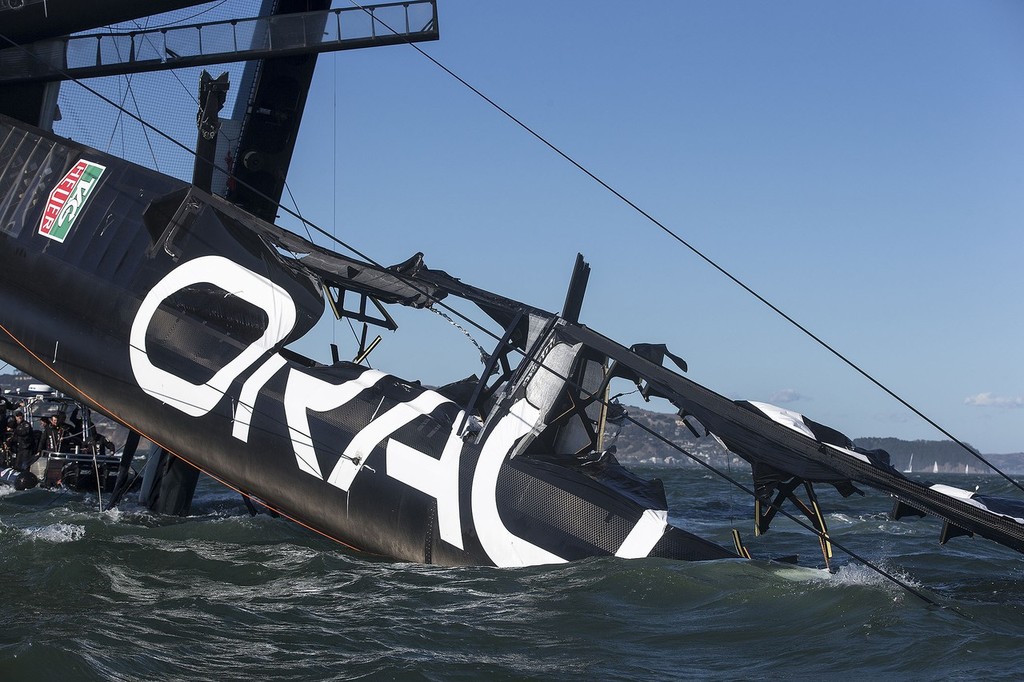
Oracle Team USA AC 72 capsizes during training in San Francisco Bay Guilain Grenier Oracle Team USA
http://www.oracleteamusamedia.com/
With just ten months left to the Defence of the 34th America’s Cup, Oracle Team USA's current situation is not ideal. But it certainly isn't terminal either.
After her capsize and subsequent retrieval from San Francisco Bay on October 16, there has been little by the way of comment from the team as to the state of the damage to their first launched AC72. The team's longer term plans were confirmed by Grant Simmer as being focused on getting the second AC boat (believed to be in the early stages of construction) launched on time for February 1, 2013.
'We have started the repair process on our first AC72 – our shore team is progressing with this work.' Simmer said in a media release two days ago. 'A new wing was already under construction at Core Builder Composites in New Zealand – it is expected to arrive and be ready to use in the repaired boat early next year. We’re also planning the construction of a third wing for use on the second boat.'
Certainly a trip to the Measurement Committee, and probably International Jury, would seem likely to clarify exactly what Oracle are and are not allowed to repair or alter on USA-17.
In a perfect world it may have been a serious option to discard USA-17 and start building a third boat, identical to the second they now have under construction, and get that launched February/March 2013.
A team can only build two of the 72ft catamarans (or use surrogate boats) in a single Cup cycle, and the decision to ditch USA-17 completely, and not attempt a rebuild is highly unlikely.
Certainly from what has been seen from photos posted on the interweb, the hulls and beams do not seem to be damaged, and the basic platform is intact. (The Platform being multihull-speak to describe the combination of two joined hulls and the attached crossbeams.)
There are significant implications for Oracle Team USA from the International Jury decision earlier on October 6, that the daggerboards do not need to be measured in the lowered condition for the hull displacement measurement calculation.
The decision on the obtuse rule, was not well received by the US team. It meant that larger foils were permitted. Oracle had made a different assumption on the labyrinthine rule and then designed a boat around that.
A photo comparison of Emirates Team NZ and Oracle Team USA's catamarans clearly indicates that the former is able to get hydrofoiling much, much more readily, can stay flying for sustained periods and at lower windspeeds than the US boat.
That is largely a function of the use of higher volume (read larger) daggerboards, which double as foils, and which makes New Zealand boat a lot more forgiving to sail.
The key advantages of the use of hydrofoils in the AC72 context means that there is less drag, which results in greater true boat speed. Plus the boats are able to sail much deeper angles downwind, which means that the Velocity Made Good (VMG) towards the mark is greatly improved because of (a) the faster boatspeed and (b) the reduced distance to sail because of the direct angle. It is a massive downwind gain to be able to foil with the ease enjoyed by Emirates Team NZ.
Even if Oracle Team USA's USA-17 had not capsized on Tuesday, the team would have needed to seriously considered their options in modifying USA-17 to take the larger volume, or bigger foils used by the New Zealanders.
Putting new foils/daggerboards into an AC72 is not a simple task and would have required a substantial rebuild, both in fitting the foiling mechanism, making the daggerboard cavity bigger, fitting a 'V' foil similar to the NZers, and ensuring that the platform was structurally strong enough to handle the new foil system.
That all sounds like an enormous amount of effort, however to box on with the current boat and her foibles (ignoring the capsize implications) would have meant that come February 1, 2013, Oracle Team USA-17 would have been testing a small foil boat against a large foil boat. There seems to be little doubt that the latter is better, by virtue of being more forgiving, and therefore able to be driven faster with less boat handling issues and better downwind VMG.
The ease with which Emirates Team NZ can foil, up and downwind is apparent to most on the water observers. Due to the reduction in hull drag achieved by foiling, it is unlikely to be slower in any condition in which flight can be achieved, and the ability to have and early and sustained foiling capability, will be a must have for any America’s Cup team.
On a hiding to nowhere
Continuing with USA-17 in its original configuration could have left Oracle Team USA, come February 2013, with program consisting of two disparate boats. That is not ideal for an America’s Cup defence – where a matched two-boat test program is essential.
It is likely that substantial modifications were on the cards anyway for USA-17 - highlighted by the decision earlier not to shift base to Hawaii for a period of training outside the North American winter.
An addition to that modification list may be the slim bows of USA-17.
It is clear from comments made by Dirk Kramer, highly respected design team member that USA-17 was designed to do the bear-away move (which led to her demise), while riding on foils, not with the bows immersed.
'The foils actually help you,' he told CupInfo.com before the incident. 'Our hull is quite small, much smaller than Team New Zealand’s, so we are reliant on the foils to keep it from pitchpoling in a bearaway.'
From video taken just before the incident, USA-17 does seem to be foil borne but still very close to the water, and certainly not to the height and stability achieved easily by Emirates Team NZ, which has to be the benchmark.
That is something that the design team are going to have to revisit, both from the perspective of what they have seen and know from watching Emirates Team NZ, now larger foils are allowed. Another question for the design team will be whether adding more bow volume (even by way of the addition of a stepped chine, similar to that used by Artemis Racing), is required, even as a reserve measure.
The woes of Twist
The other design issue needed to be addressed in USA-17 is the platform twisting.
Luna Rossa skipper Max Sirena confirmed on Thursday what many others had suspected that the extreme twisting so apparent on USA-17 is not conducive to foiling, with the potential for the winglet on one rudder to be at a markedly different angle to the other, and for the two to work against each other until one prevails.
Clearly for USA-17 to be able to achieve the foiling benchmark set by Emirates Team NZ, two things need to be done – the foils have to be increased in size, and the hull twisting has to be eliminated.
Having worked up the alteration list for USA-17, and talked with the design team about their work schedule, Oracle will have to get a good and definitive understanding of what is allowed by way of repair and modification.
Ironically the Jury ruling on the use of larger foils may work their way.
A key part of that decision, overruling an interpretation by the Measurement Committee, was that the words in the Class Rule or Protocol are to be read literally, and they mean what they mean.
Speaking in general terms the rules allow 50% of a wingsail surface to be rebuilt, and 50% of the hull surface error may be altered. 29.6 (c) reads: 'a Wing Spar section shall be deemed to be new if more than 50% of its mass is replaced.'
Protocol 29.8 (b) (Hull Modification Limits) allows the Hulls to be modified up to a maximum of the Original Hull Surface. 'Competitors may modify the Hulls of their AC72 Yachts to a maximum of 50% of the Original Hull Surface of the yacht.' There are a number of exclusions to the definition of a Hull (being the canoe body) which all work Oracle's way.
Rule 29.10(c) makes it clear that 'A repair is not a modification provided the Measurement Committee is satisfied that the damaged part has been repaired, or the extent possible, to its original condition.' Most would interpret that as meaning that provide original strength and shape are replicated the 50% limitation does not apply to the hull.
If Oracle Team USA, or their builders Core Builders Composites, had made extensive use of female moulds in the construction of USA-17, and had kept these moulds, then making replacements that mirror the original should be relatively easy as the external finished shape will be identical to the original. If male moulds have to be used then the task is more fraught in terms of compliance.
Time is the scare commodity
Our assumption is that the hulls and platform basics of USA-17 are largely undamaged. Certainly the paraphernalia inherent in the platform deck is completely destroyed and will have to be replaced. But this area is outside the scope of the rule and can be repaired or altered at will. The only constraint is time.
Similarly the constructed in country rules don’t apply anymore to USA-17, as she has already been constructed in USA. If required, the boat could be shipped elsewhere, even outside USA for repair and alteration.
The new target for Oracle Team USA has to be to get two boats (one repaired and the other new) in the water and by February 1.
The team has lost the 22 days of training time allowed between now and 31st January 2013. That cannot be recovered or carried over. They get 45 days in the next training cycle from February 1, 2013 to May 31, 2013
Oracle have also lost one of their three permitted wingsails – so are now down to one wingsail per boat, or four sections.
Oracle have also gone through maybe as much as four of their permitted ten foils. Certainly that is the case if one looks at foils in terms of pairs.
On the positive side they have more time than the Challengers in that as Defender, Oracle Team USA don’t have to be racing until September, unlike the Challengers which have to be on the startline for the Louis Vuitton Cup on July 4, 2013.
In terms of timing, the capsize and destruction of USA-17 could not have come at a worse juncture. They were just eight days into work-up. While they had lost some of the program with the breaking of a foil on Day 2, just before the fateful October 16 session, they had put in three days of good work on the water.
From the video released of the capsize incident, the conditions were very willing, and had they survived the session most observers should have been very impressed with the progress made by the Oracle Team USA who were clearly back on track at that point.
That gain is now frozen, until a new boat is in the water. From Grant Simmer’s comments it would seem that the team has put the priority on getting the second boat running ahead of the revamped USA-17.
A very challenging worklist
The work list ahead of the building team is substantial.
First, in terms of the second boat, the design team has to look at the implications of the bigger foils ruling and determine whether they wish to go down that path. If they have not done so already, they have to look at the bow volume issue and decide whether they want to retain the USA-17 style bow, or go for something with more volume. They have to make a similar call with the hull twisting issue. And of course, they have to consider how the three issues work together in terms of structural strength and weight.
Second for USA-17, the design and sailing teams have to do a full analysis. It was a little surprising to hear sailing team member, Murray Jones say in an interview last Monday (NZT) that the full debrief had not yet taken place with the sailing crew.
The design issues with USA-17 are much the same as for their second AC72. The question is how the alterations and repairs required can be accommodated within the requirements of the governing rules for the Class and Protocol.
Certainly repairing a wingsail from the collected bits, and staying within the limitation of being able to replace to 50% of its mass, would seem to be out of the question.
The hull alterations should be able to be achieved within the similar but different 50% limitation imposed by the rule.
Thirdly the limited repairs and alterations to USA-17 have to be aligned with the design of the second boat, so that when the program is re-launched, Oracle Team USA have two evenly matched trial horses, not two disparate boats – which are useless for the evaluation of development changes.
There is little point in conducting a formal Defence Trial series between two mis-matched boats.
It proves nothing, as the team’s second boat should always win, no matter if she is driven by James Spithill or Ben Ainslie – the only question to be answered is delta, or losing margin. The option of turbo-charging a slower older boat to bring it up to the newer model is not an option in the AC72. They are already turbo-charged to the max.
Two programs in two countries
In terms of the building programs the task is a formidable one for Core Builders Composites.
At this point, they should have been starting the build program for the second AC72, while sailing and some boat development continued with USA-17. If the model for USA-17 were to be followed, the new AC72 build program consists of the hulls built in San Francisco, and the wingsail and other components to be done in Auckland.
In addition to the second hull build, the San Francisco based team also have to do the repairs and alterations to USA-17 in the San Francisco facility, unless the boat is air-freighted to Auckland.
In Auckland, or rather Warkworth, Core Builders will have to build two wingsails, or four wingsail sections (maybe identical which will save some time). But certainly that activity requires substantial manhours (said to be four months elapsed time), plus shipping to the USA.
(The first wingsail went by ship, but because of the current time constraint air-freight of the 20 metre sections is a probability).
Then add to the Warkworth worklist the construction of the other components for not one boat, but for two. That means main beams and the full paraphernalia for the new boat and the replacement components for USA-17 (assuming that replacement main beams are not required to resolve the twisting issue, or were not damaged in the incident).
Fortunately, Oracle Team USA, do have the facilities to undertake such a formidable challenge within the stipulated timeframe. Unlike the other teams they do have a full in-house building team, and facilities in two countries. There is no question of getting yard space.
Oracle Team USA/Core Builders Composites have two excellent people leading the build programs in Warkworth and San Francisco in the form of Mark 'Tugboat' Turner and Tim Smythe. Much if not all the required building infrastructure is in place, save for what are expected to be substantial additions to the building team.
The building program associated with the construction of 12 or so AC45’s gave Core Builders Composites the infrastructure to carry over in the AC72 program, and will serve them in good stead for the very challenging design build and logistical task ahead.
Effectively they have to push the reset button on the program that has been running prior to October 16, and set up for a final sailing and development program beginning February 1, 2013.
The sailing operation of Oracle Team USA will continue in the team's fleet of AC45's which include their two development AC45's their two ACWS AC45's and the AC45 pf Ben Ainslie Racing. That would nominally allow Oracle to get their sailing team on the water at one time, but again it is not ideal.
But there can be no more setbacks, capsizes or delays. Oracle Team USA have to hunker down, get focused on the big challenge ahead and achieve some very ambitious milestones – all while watching their competitors sailing on the Hauraki Gulf and in San Francisco.
For a competitive team that is a very big ask.
The other teams will certainly have learned from the Oracle experience, in terms of buttoning off any extreme sailing until they have second boats commissioned. They have to curb their enthusiasm and listen to their weather teams.
The 34th America’s Cup will be a war of attrition as much as boat speed. Oracle Team USA were the first major casualty.
If Core Builders Composites and Oracle Team USA can pull off the impossible, this will be remembered as the first America's Cup to have been won by the building teams not the sailors.
If you want to link to this article then please use this URL: www.sail-world.com/103265