Flag Etiquette on a sailing boat today
by Des Ryan on 30 Sep 2012
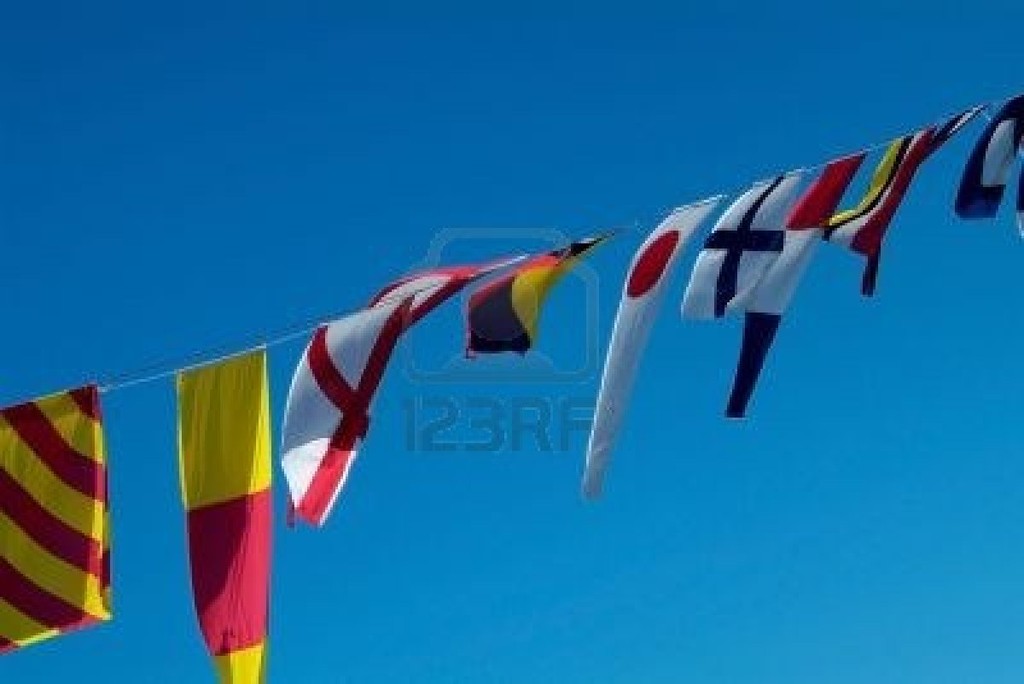
Never fly a flag which can be mistaken for a signal letter SW
Flag etiquette on a sailing boat is a tradition that has been handed down to us by generations of sailors and other mariners. Although often not appropriately respected, if you want to be considered a seasoned sailor, you will do well to observe and perpetuate the pride in old traditions.
Flags are signals and each one says something specific about your boat. They can signal nationality, maneuvering situations, club affiliation, office held or other situations. For the benefit of the sailors who would like to observe the correct etiquette, following are some of the rules. It does well to remember that the rules originated in Britain and have been slightly changed by other English-speaking countries. Remember that flags are 'worn' by a yacht and 'flown' by the owner.
Apart from the ensign, flags commonly worn by a yacht comprise a burgee, a house flag(Private Signal), a courtesy flag when in another country and (if racing) a racing flag.
Before getting to the ensign, here are some general conventions for the minor flags:
House Flags or Private Signal:
House flags are flown at the port spreaders and serve to indicate membership of associations such as a yacht club, or they are a small, custom-designed and custom-made flag that carries symbols standing for the owner, so it can basically be anything. The signal may be flown day or night, but is not displayed when another sailor is in command. (The rule is: the private signal and burgee follow the sailor, not the boat.)
House flags may be flown on the same halyard in which case they should be flown in order of seniority. Never fly a flag which is the same or could be confused for one of the letters of the alphabet.
On a multi-masted boat, the house flag or private signal is flown at the head of the aftermost mast. On a sloop, the private signal may be flown from the starboard rigging, either below the burgee or alone.
Courtesy Flags:
As a matter of courtesy, it is appropriate to fly the flag of a foreign nation on your boat when you enter and operate on its waters. There are only a limited number of positions from which flags may be displayed. Therefore, when a flag of another nation is flown, it usually must displace one of the flags displayed in home waters. However, it is hoisted only after the appropriate authorities have granted clearance. Until clearance is obtained, a boat must fly the yellow'Q' flag. Often cruising sailors fly both the courtesy flag and the quarantine flag (Q flag below) on entering a foreign port.
The courtesy flag is flown at the boat's starboard spreader, whether the ensign is at the stern staff, or flown from the leech. If there is more than one mast, the courtesy flag is flown from the starboard spreader of the forward mast.
It is considered disrespectful and rude to fly a courtesy flag that is old, tattered or raggy. Make sure that you replace flags that do not do justice to the country you are visiting
Lastly, it is also a common courtesy to fly the national flag(s) of your guest(s) on board, if they have a different nationality than the ensign is showing.
Courtesy flags are normally the maritime flag of the country which in most cases will be that same as the National Flag (e.g. France, USA, Netherlands) others may be the National Flag defaced with a device (e.g. Italy, Finland, Morocco) and others may be a totally different flag (e.g. UK, Australia, New Zealand). If you are planning to visit
a foreign country, find out the correct maritime flag from some of the sources shown at the end of this article. Most quality specialist flag shops will have the information.
Flags' Dimensions:
Flags come in standardized sizes, but there are guidelines about selecting the proper size for your boat.
The size of a nautical flag is determined by the size of the boat that flies it. Flags are more often too small than too large. So in the rules below, round upward to the nearestlarger standard size.
The flag at the stern of your boat: The ensign or national flag should be about one inch for each foot of overall length. For example, on a 40ft. boat, the ensign should be 40 in. i.e. about 3.5ft.
Other flags, such as club burgees, private signals and courtesy flags used on sailboats should be approximately 1/2 inch for each foot of the highest mast above the water. For example, on a 30ft. boat, with 50ft. between the masthead and the water, the burgee should be about 25 in. The shape and proportions of pennants and burgees will be prescribed by the organization which they relate to.
British Conventions:
The ensign is the principal flag on board, for British yachts it is the Red Ensign and is worn at the most senior position which is as close to the stern of the vessel as possible.
A 'privileged ensign' may be flown if the holder of a warrant to fly one is on board in which case the corresponding burgee must also be flown. Privileged ensigns are usually blue and may be defaced or 'emblazoned' with a heraldic device. They are granted to certain Clubs by the Secretary of State for Defence on behalf of H. M. The Queen.
Red Ensigns are less common – examples likely to be seen around the Solent include the Royal Victoria Yacht Club and the Royal Lymington Yacht Club.
White ensigns may only be flown by Members of the Royal Yacht Squadron.
Any privileged ensign may only be worn when the owner is on board or in the vicinity and the warrant must also be carried on board.
Only one burgee may be flown on the yacht which must match the privileged ensign. It is now common practice to fly the burgee at the starboard spreaders; however, you must be aware that you may not fly any flag above your burgee at the same halyard.
Note: if the burgee is flown at the starboard spreaders and you are entering the territorial waters of another country, you have a dilemma. The starboard spreaders are used for signalling purposes so this is where both the country’s national courtesy flag and the Q flag should be flown. You may not fly any other flag above a national courtesy flag on the same halyard. If your masthead is cluttered with a VHF aerial, wind indicator, trilight and other modern gadgets, the best way round this is to rig a second signal halyard at the starboard spreaders and avoid the conflict.
However, it is common practice among cruising sailors today to fly the courtesy flag on the starboard spreader with the yellow quarantine flag below it. Any burgee or house flag is then carried on the port spreader.
If racing, the ensign should be hauled down and replaced by the racing flag after the five-minute signal and hoisted on finishing or when retiring from the race.
Yachts should salute all Royal Yachts and all warships of any nationality. A salute is made by dipping the ensign to a position two-thirds the way down the halyard from the close-up position. The vessel saluted responds by dipping her ensign then rehoisting it. The saluting yacht then re-hoists her ensign. It is also customary for a Flag Officer to be saluted by a yacht flying the burgee of that club – once per day is usually sufficient!
The Union Flag often called the Union Jack should never be displayed from a yacht. It is the proper flag for any UK Citizen to fly on shore but with the exception of its use as a Jack in the Royal Navy, it is not a sea flag.
The Pilot Jack may be flown by those who wish to 'show the flag' on a British registered yacht. It consists of the Union
Flag surrounded by a white rectangular border and is used as follows:-
· as a stem-head jack in the bows
· an additional dressing-ship flag to be hung on a weighted line from the bowsprit
· as a signal for a pilot when hoisted at the fore
It must not be worn underway unless the yacht is dressed 'over-all'. In harbour, it is hoisted and hauled down with the colours. It is never dipped in salute but may be half-masted together with the ensign on occasions of national mourning.
Yachts may 'Dress Overall' in the UK on the following dates or on other special occasions such as Trafalgar Day, Navy Days, or in the presence of a Royal Standard or Flag of the Head of State or a foreign Sovereign.
6th February Accession Day
2nd Monday in March Commonwealth Day
21st April HM the Queen’s Actual Birthday
Saturday in June (ICW DCI's) HM the Queen’s Official Birthday
2nd June Coronation Day
10th June The Duke of Edinburgh's Birthday The order of the full set of 40 flags (from
stem to stern) is as follows:
E, Q, p3, G, p8, Z, p4, W, p6, P, p1,
1Code, T, Y ,B, X, first Sub, H, third Sub,
D, F, second Sub, U, A, O, M, R, p2, J, p0,
N, p9, K, p7, V, p5, L, C, S.
USA Conventions:
A code was devised by the U.S. Coast Guard, U.S. Coast Guard Auxiliary, U.S. Power Squadrons and other yachting authorities for the proper flying of flags aboard recreational boats.
There are points of honor where flags are flown and it should only be flown at the highest point of honor it is entitled. In descending order they are: gaff, flagstaff at the stern, bow staff, starboard yardarm (halyard), truck of mast, port yardarm (halyard).
The highest point of honor on your boat should be reserved for the national ensign. The U.S Ensign is usually flown from the stern of a small boat. A yacht ensign instead of the national ensign may be flown from the stern.
The size of a flag is important. The national ensign should be an inch on the fly for each foot of the overall length of the vessel. All other flags should be 5/8-inch on the fly for each foot of overall length.
Australian conventions:
Flag and Yacht Etiquette are derived from Britain, so British rules should be followed, with the following comments:
All Australian ships are entitled to wear the Australian Red Ensign.
However, yachts may wear the defaced Blue Ensign provided that:
The owner has an admiralty warrant to fly the Blue Ensign
The warrant is aboard the yacht at the time
The owner is on board or in effective control of the yacht (eg. ashore in the vicinity)
Burgees and Ensigns must not be worn when racing and a racing flag should be flown from the backstay. Yachts having retired should still wear the burgee and ensign, but should quickly remove the racing flag.
Finally,
Raising and Lowering Flags:
Ensigns are hoisted in harbour when colours are 'made' – normally at 08:00 or at 09:00 between 1 November and 14 February or as soon after that time as people come aboard. The Ensign is lowered at sunset or at 21:00 local time if earlier or before that time if the crew is leaving the yacht. At sea and under way, ensigns may be worn between sunrise and sunset when there is sufficient light to distinguish the flag. It must be worn when meeting other vessels,
when entering or leaving foreign harbours by day or by night, or when approaching forts, signal stations or Coastguard stations.
To prevent wear and tear, the flag may not be flown when out of sight of other vessels or when nobody is aboard. For purists: In the morning, the ensign is hoisted rapidly before other flags. In the evening, it is lowered slowly and with ceremony after other flags come down.
Always handle the National Ensign with dignity. Don’t let it touch the deck. When your flag is tattered, torn or faded deliver it to the appropriate entity such as a veteran's association for disposal. Gag flags such as those depicting a martini glass, bunnies, etc., are unseamanship like and unbecoming.
As you may have noticed while reading the information above, there is some discrepancy between written conventions and what is generally the world-wide convention of most cruising boats on the water today. For further information here are some other references:
· RYA publication Flag Etiquette & Visual Signal
· Flag Etiquette for the New Millennium by Richard Yeowood
· British Flags and Emblems by Graham Bartram
· Flags of the World website at: www.crwflags.com/fotw/flags/
Did you enjoy this article? You can subscribe to Sail-World and receive your sailing news regularly by clicking http://www.sail-world.com/Cruising/international/newsletter_subscribe.cfm!here
If you want to link to this article then please use this URL: www.sail-world.com/102443