Exit interview with Josh Adams, US Sailing's Olympic boss, Part Two
by David Schmidt, Sail-World USA Editor on 1 Nov 2016
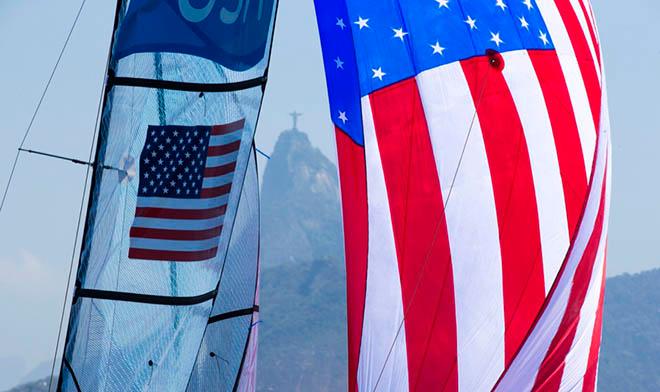
Team USA training on Guanabara Bay in Rio on Sunday - 2016 Rio Paralympic Games Richard Langdon / World Sailing
Historically, the USA has been one of the most decorated nations in Olympic sailing, with a total of 60 medals (19 gold medals, 23 silver medals and 18 bronze medals) earned since 1896. In fact, only the UK outranks the United States when it comes to Olympic sailing medals, and they hold a total of 58, with 28 being the most precious of Olympic metals. While this sounds fantastic, any student of Olympic sailing history can tell you that the USA's halcyon days of Olympic glory ended after the 2000 Games, when the American-flagged team brought home four medals, one gold, two silver and one bronze.
The team brought home just a single gold and a single silver from both the 2004 and 2008 Games, but the wheels really abandoned the bus at the 2012 London Olympics, when the USA suffered their first medal-ceremony shutout since the 1936 Berlin Olympics, despite strong showings at the 2011 ISAF (now World Sailing) World Championships just eight months before the Games. Clearly, something had to be done, and quickly.
Following the London Games, a long-planned leadership change at US Sailing brought former
SAIL magazine publisher Josh Adams to the Olympic helm, after eight years in the capable hands of Dean Brenner, as Managing Director of U.S. Olympic Sailing. (Full disclosure: I worked for Adams as
SAIL’s senior editor for much of his tenure as the magazine’s publisher, and I am proud to call him a mentor and a friend.)
Adams immediately set to work trying to solve a number of issues, including fundraising, elite-level coaching and building a clear understanding of the racecourse challenges (wind, waves, currents, water pollution), that would be facing U.S. sailors on Guanabara Bay at the 2016 Rio Olympics.
These changes were big and ambitious, and the adage certainly applies that large ships don’t exactly turn on dimes. While Team USA realized some success in the Men’s Finn class in the form of a proud bronze medal that was earned by Caleb Paine, as well as some strong medal-race performances and other personal Olympic bests, it was obvious that, while the young team is talented, it needs more Olympic experience and maturity to reach the podium’s top steps.
The good news is that the basic ingredients are now assembled for the 2020 Tokyo Olympics and the 2024 Games (where Team USA will likely truly shine again). The bad news for Adams, however, is that the job of Managing Director of U.S. Olympic Sailing requires constant travel and time away from home, which doesn’t mix well with the job responsibilities of being a dad to two strapping young lads (America’s Cup teams, pay attention), ages seven and nine. As a result, Adams made the decision to step down from US Sailing and take the helm of their family business, starting in December.
Now, US Sailing finds itself in the midst of a leadership search, with the Sailing World Cup Miami (January 22-28, 2017) less than three months away and planning for the next Olympic quadrennial at a critical stage. While Adams has promised a smooth transfer of leadership, important grains of sand are now falling through the metaphorical hourglass.
I caught up with Adams for an extended phone interview, which we presented in two parts (this week and last week), about the team, its headwinds and tailwinds, and the longer-term corrections that are needed to return Team USA to its former sailing-powerhouse status.
What are your reasons for stepping down from your position?
It’s a difficult decision for me to move on from this role and this mission, because I’m proud of what we’ve built up here. It’s strictly a decision that’s all about my family. I have two young sons who are seven and nine, [and] my wife and I feel that the best thing for us to do as parents right now is to focus more on them. And so as hard of a decision it is to make, we know it’s right for our family. When I’m done helping US Sailing leadership and the Olympic staff with the transition this fall, I’ll be diving into a family business.
Do you have a time frame of when this all will be happening?
I gave US Sailing about two-months time to make this transition in a full-time basis. Then I’ll be diving into the new business at the end of the year. I’m always going to be available to help out the team and US Sailing leadership, especially in the early going here while they identify my replacement.
Do you think you might see these reasons differently if the U.S. Olympic squad had brought back some gold and silver medals?
Totally unrelated. With the benefit of hindsight, the decision probably would’ve been no different. This is what is right for our family right now. I’ll just add to that I’m intensely proud of what our team accomplished in Rio. Their performance was-as a team-a positive result. There certainly were some disappointments balanced with several peak performances. But I’m intensely proud of what we’ve accomplished as a program and a team. The decision to move on was really just about our family.
What advice would you give to your successor?
Great question. My advice would be do everything in your power to keep the focus on performance, build strong and lasting relationships that support the team both short and long term, and always remember it’s all about the athletes.
Do you have any legacy initiatives that you’re trying to get across the finishing line before finishing up?
[One of our priorities] this Olympic quad to establish a youth-development system, [and] to put in place a program that that would develop youth sailors at a high level. Two years ago we launched the Olympic Development Program with substantial backing from the AmericaOne Foundation and several private donors. Those individuals who are working on [this initiative], participating in it, and funding it in are going to [make] a lasting impact on Olympic Sailing. We’re really proud of the Olympic Development Program and excited for its future. I think that down the road, folks will look back at the Olympic Development Program being established in this quad as an important milestone for the sustainable success of [U.S.] Olympic sailors.
I know we talked about this a little bit, but the official timeline for your replacement sounds like it will be the first of the year, thereabouts?
Well the search has just begun, [it’s] hard to put a timeline on it, [but it will happen] as soon as possible. It’s a priority, to hire for the role [and] I’m actively supporting that search. I’m confident we will get someone in place as soon as possible.
Jumping topics, I note that in the last two Olympic/Paralympic quadrennials-based solely on medal count and quality-it seems as if Paralympic sailors are doing better than their Olympic counterparts. What’s causing this strength in American Paralympic sailing that I’m not seeing in U.S. Olympic sailing right now?
I’ll point out that in terms of sheer podium results we had the same outcome on the Olympic and Paralympic team [in Rio], with one medal each. [Editor’s Note: Caleb Paine took home a bronze medal in the Finn from the 2016 Rio Olympics, while Rick Doerr, Hugh Freund and Brad Kendell earned a silver medal at the 2016 Rio Paralympics.]
We’ve got talented American sailors in Paralympic Sailing as well as Olympic Sailing. Paralympic Sailing has been a real strength for the U.S. Since [Paralympic sailing’s] inception as a demonstration sport in 1996, the U.S. has medalled at every [Games].
It’s truly a shame and a short-sited decision to kick sailing out of the Paralympics. And I’d like to see a really well-organized campaign to reinstate sailing in the [Paralympic] Games in 2024, [but] I think we have a long way to go to get that effort on track. [Sailing] should be a core sport in the Paralympic Games.
Meanwhile disabled sailors in the U.S. will stay active. They’ll remain inspired by the performances of Rick Doerr, Brad Kendell, Hugh Feund and their silver medal, as well as their teammates in the 2.4mR and the SCUD18 [classes], those were all Top Five performances. [Our Paralympic sailors] did a great job down there!
So what are your thoughts on the campaign to reinstate sailing into the Paralympic Games?
[In] my personal opinion, [this effort] really needs to focus on two things: One is [to] demonstrate high-quality competition at established international events, and Sailing World Cup Miami is the prime example. I think Miami will provide an excellent platform to demonstrate the strengths of Paralympic Sailing.
The second area of focus needs to be on the equipment. It’s really important to not try and be all things to all people and go after multiple types of equipment right now. It’s more important to show high-quality competition. So pick one or two classes that help get strong numbers, total numbers of competitors, and also number of countries, and go do it really well. Demonstrate how strong the sport can be, and then, once reinstated, we can grow it from there.
Anything else that you’d like to add, for the record?
I think it’s really important to recognize the 15 [U.S. Olympic] athletes in Rio, the 42 athletes on the US Sailing team, and the dedicated professionals who support them on and off the water.
When you look back at Rio, we got the challenge that we expected, we saw that ultimately Rio was going to test the complete sailor. Our team showed up ready to race and submitted a competitive performance. We’re also proud of Caleb [Paine] getting the job done in the Finn class, his bronze medal that put USA back on the podium in sailing is really a thrilling achievement and we’re really happy for him.
We’re proud of the whole team [because of] the way they represented the USA. Also [some of these] athletes finished [in the] Top Ten in six classes. Some of those results were personal bests in which the sailors really [stepped] up. And some would be disappointments because we had other sailors who wanted to finish on the podium.
As a team we experienced the highs and lows of Olympic sport. And we left really proud of our team in Rio. The Olympic program is an organization that supports athletes, and [we’ve] got a great group of athletes in this country right now. I’m really excited for them going forward.
Many thanks to Josh Adams and to US Sailing for their time and consideration with this extended, two-part interview.
If you want to link to this article then please use this URL: www.sail-world.com/149342