Dhows, a thing of the past - and the future.
by Sail-World Cruising on 24 Jun 2012
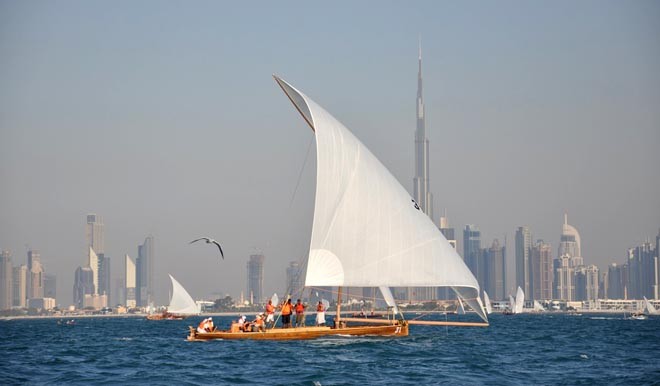
Modern dhow sailing in Dubai SW
The dhow has been fixed in the Western imagination as a romantic Arabian seacraft of the past, but, apart from the fact that they are still used for the transport of goods even today, they are also undergoing a dramatic revival, among sailors in the UAE who don't want to lose their traditional past.
The dhow typically has lateen sails, one or two masts, with a elegantly long thin hull design. Traditionally they were not small vessels, typically weighing between 300 to 500 tons, and had crews from twelve to thirty.
Dhows equipped with sails and heavy oars were central to the pearling industry which once thrived in the Gulf’s warm, shallow waters; some 4,500 boats and as many as 74,000 men operated at the Gulf industry’s peak in the early 1900s.
But dhow sailing was almost forgotten during decades of breakneck, oil-fuelled modernisation after World War Two in the UAE.
It is now catching a fresh wind among Emiratis, many from old pearling and fishing families. They want to get away from the glass and concrete of the UAE’s wealthy cities, while rising incomes have given them the time and money needed to develop an interest in some of their ancestors’ traditions.
'It’s a change, like an escape,' Ali Salem Al Falasi, a dhow navigator, who has been sailing on traditional boats since the late 1980s, told local news outlet http://www.khaleejtimes.com!Khaleej_Times.
Apparently nationals coming from other than seafaring families find it harder to learn how to sail a dhow. He learned the skill in the sailing team of Mohammed Rashid Al Rumaithi, owner of Al Fattan shipyards. The team builds four or five dhows for its own use each year.
Rashed Al Humairi, who spends his working hours in the steel and concrete jungle that the Emirates has grown recently, has been teaching children how to sail to promote the tradition.
'Around half of the people we see on all other boats today have been taught by us since the 1980s. They started sailing, and then they built their own boats,' he told Khaleej Times.
'Some 16 dhow races in 22-, 43- and 60-foot (7-, 13- and 18-metre) classes are held in Abu Dhabi and Dubai between September and May. Only Emiratis and other Gulf nationals may take part.'
In 1991, 53 boats of different sizes and varying states of repair competed in the inaugural race, which commemorates the homecoming of boats from pearling expeditions.
Omanis form around half of the UAE dhow crews as it is still hard to find enough Emirati sailors. But the government hopes that youngsters competing in the 22-foot class will help fill the gap eventually and keep the heritage alive.
'There was a time where you could not see a single sail on the sea. People only talked about it,' said Ahmad Mohammad Binthani, chairman of the Dubai International Marine Club, who comes from a fishing and pearl diving family.
'We could hear a story about the name of that boat, how many pearls they got, the name of the captain, names of the crew, but we did not practise it,' said Binthani.
Compared to heavy old pearling boats, modern racing dhows, many built from Meranti wood brought from Indonesia due to a teak shortage, are about two-thirds lighter and much faster. 'During the pearl hunt in old times, dhows used to compete over who was faster reaching the pearl hunting areas,' said Mohammed Hareb, a former dhow racer.
'Our dhows are very fast ... we exceed the speed of the wind by five, six, seven knots. I achieved a speed of 20, 22 knots but I broke my mast.'
Some dhows carry as many as 150 sand bags as well as water barrels as stabilisers, because they do not have keels like modern racing yachts.
A racing dhow, which may last five to seven years, does not come cheap. A fully equipped boat may cost up to Dh370,000 ($100,000) with tens of thousands of dirhams spent on repairs and modifications; locals still build them at home with skills passed from father to son, and their designs are a closely guarded secret.
'These boats take about three to four weeks to build from zero,' says Al Falasi, checking a route on his electronic global positioning system while his shipmates tighten ropes on their dhow’s deck. 'The building has not changed but materials, yes.'
Lamination has replaced shark liver oil and epoxy is used instead of cotton, while masts and booms are made of carbon fibre. Sails are also much lighter then they used to be, and radio and satellite navigation are permitted. But that is as far as many of the dhow sailors want modernisation to go.
Khalid bin Dasmal, a jury member at Dubai International Marine Club, had the last word. 'We are modernising but the dhow must stay. We cannot afford to live without it,'
If you want to link to this article then please use this URL: www.sail-world.com/98861