Austal prepares for launch of Next Gen Trimaran
by Austal on 11 May 2010
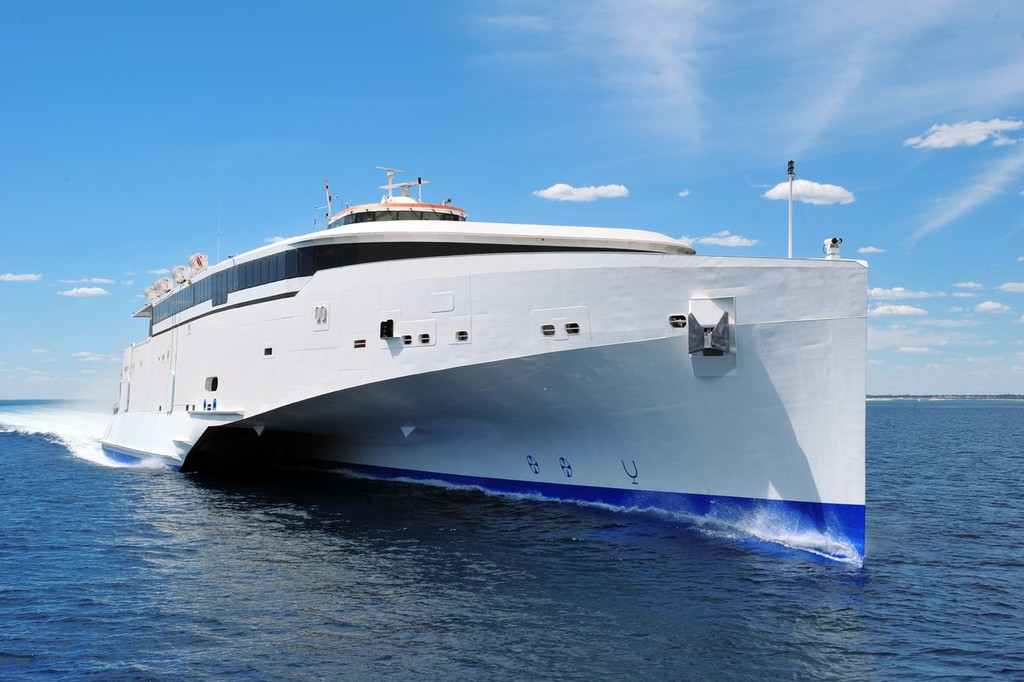
102m trimaran vehicle-passenger ferry currently under construction and available for purchase. Austal Ships
http://www.austal.com/
The approaching completion of Austal’s next generation 102 metre high speed trimaran ferry heralds a new era in maritime transportation.
Set to introduce unprecedented levels of passenger comfort compared to regular high speed craft, particularly in adverse weather conditions, the vehicle-passenger ferry proves a fitting debut for Austal’s second-generation trimaran hull form.
By incorporating lessons learnt from the success of Austal’s inaugural 2005 trimaran “Benchijigua Express” and the Austal designed and built Littoral Combat Ship “USS Independence”, recently delivered to the US Navy, the company’s latest trimaran delivers innovation without risk.
Austal Technical Manager James Bennett said improving on a product as successful as “Benchijigua Express” was an exciting challenge.
“One of the most outstanding features of “Benchijigua Express” has been her ability to deliver passengers to their destination in comfort no matter the weather conditions.”
“We wanted the second generation trimaran to not only take passenger comfort to new levels but also to optimise performance, sea keeping, fuel efficiency and payload.”
Before proceeding with a successor to the company’s inaugural trimaran, Austal conducted a complete review of “Benchijigua Express” to establish where improvements could be made. This was followed by a detailed market study on the commercial ferry industry looking at the size and capacity of existing fleets.
Based on the data collected from this study, it was determined that 102 metres, 1165 passengers, 254 cars were the approximate specifications most applicable to the existing market.
Because the vessel was being built on speculation, the design of the vessel’s interior and vehicle deck has been pitched at a level that permits the eventual owner to easily modify the vessel to suit their particular market.
The final design achieved a number of key improvements over its predecessor including:
• Refined waterlines to improve sea keeping, passenger comfort and reduce resistance
• A new and simplified ride control arrangement and operating system to deliver improved control over the vessel’s motions and handling characteristics
• Simplified, three engine power train
• New series water jets with improved cavitation margins
Trimaran Technology – The Competitive Advantage
The vessel’s unique trimaran hull form combines the softer roll of monohulls with the low resistance, stability and carrying capacity of catamarans to deliver proven advantages over conventional designs.
These advantages include greater speed for the same installed power, an ability to operate in higher wave heights and maintain higher speeds in waves, greater resistance to damage and reduced wake which reduces impact on the environment.
Most importantly, the trimaran’s lower roll speed means lower accelerations experienced by passengers, significantly reducing passenger sea sickness.
Studies show that motion sickness on the trimaran will be approximately 56 per cent lower than on a 100 metre catamaran operating in head seas. Even larger benefits are realised in other headings.
For operators, this means higher passenger satisfaction, greater customer loyalty and positive word of mouth marketing.
It also means higher revenue from onboard sales resulting from the ease of movement onboard and reduced sickness. Improved revenue potential from the trimaran’s ability to sail in a larger range of sea conditions (fewer cancellations) is another significant advantage.
Increased comfort also provides operators with a competitive marketing advantage compared with other high speed craft. Greater customer satisfaction due to fewer cancellations equals more repeat business and improved revenue potential from a more viable roster.
Effectively, the trimaran becomes the “preferred alternative” in a competitive market situation.
For more details and specs visit http://austal.com
If you want to link to this article then please use this URL: www.sail-world.com/69382