An interview with Rainer Muller about the International 6 Metre Worlds
by David Schmidt, Sail-World USA Editor on 18 Sep 2017
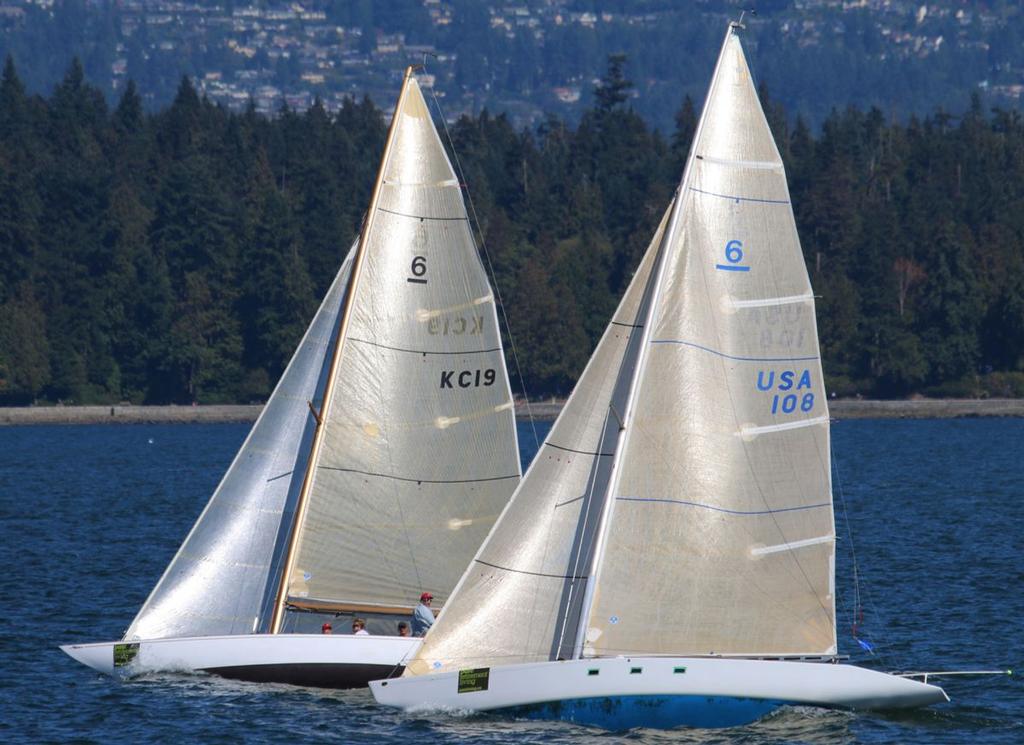
Six Metre racing off of Stanley Park in Vancouver, B.C. Dana E. Olsen
When it comes to classically pleasing lines, the International 6 Metre Class is a tough act to follow, as these graceful beauties share a similar aesthetic to the world-famous 12 metre class but in a smaller, more easily managed package. The International 6 Metre class, or “6mR”, was an Olympic class from 1908 to 1952, and for decades the boat offered some of the highest levels of international competition afloat. Also, much like the bigger 12 Metre Class, the 6mR draws its distinctive moniker from the measurement data that’s derived from several key components of its box-rule design, rather than its LOA, which is usually between 33 and 39 feet. 6mR yachts are raced with crews of five sailors, and while the wooden-hulled gems are deemed to be “classics”, fiberglass boats are allowed to compete in the newer “open” class.
It’s been estimated that more than 1,200 boats have been built to the international 6mR class rules since its inception in 1907, with some 400 boats still afloat and roughly 300 still in racing condition.
Not only are the yachts a sight that’s sure to crack a smile of appreciation on the face of any old salt, but the class’ biennial world-championships consistently draws big-name sailors from around the world. A glance at the registration list for this year’s 6mR Worlds reveals that former America’s Cup-winning skipper Dennis Conner and his May Be VII crew from the San Diego Yacht Club, will be competing in the classic-boat class; noted yacht designer Ron Holland and his Nuvolari crew will be flying the burgee of the Royal New Zealand Yacht Squadron from their open 6mR; former Snipe and Star world champion Lars Grael and his Saskia crew will be representing the Rio De Janeiro Yacht Club aboard their classic 6mR, and Spain’s former king, Juan Carlos I, will be competing in the classic-boat class with his Gallant crew.
Additional well-known names on this year’s entry list include (but aren’t limited to) Andy Beadsworth (UK), Annie Haeger (USA), Craig Healy (USA) and Russ Sylvertri (USA), meaning that the starting lines will have plenty of sharp, sharp blades contending for the favored position and the winner’s podium will be a who’s-who of the international sailing world.
The 2017 6mR Worlds are set to unfurl on the waters of English Bay, off of Vancouver, Canada, from September 17-21 and will be hosted by the Royal Vancouver Yacht Club (RVanYC). Given that this is the first time that this world-championship title will be contested on Canadian waters, I caught up with Rainer Muller, event vice-chair (and an active 6 Metre sailor who will be competing in this year’s Worlds aboard the Swiss-flagged Finnegan) via email, to learn more about this exciting biennial regatta that’s expected to draw 45-50 boats from eleven different nations.
The West Coast and the Pacific Northwest in particular, seems to have a nice, stable fleet of Six Metres—how much of factor did this play in Vancouver being chosen to host the 2017 Worlds?
Teams from Puget Sound and Vancouver have been competing in Six Metre Worlds and European Championships since 2009. They won five championships and made the podium five times.
In recent years, we have had three or four teams from our region competing at these major events. This was certainly critical for the choice of Vancouver.
What kinds of course shapes will competitors likely see? Mostly Windward-Leewards, or will the Race Committee get creative?
The International Six Meter Association has published guidelines for their championship events. The boats sail to weather very well, especially in a breeze, so there is a preference for long windward-leeward courses without too many mark roundings.
Windward-leeward courses provide the maximum number of passing opportunities, both upwind and down so expect to see that format for the world championship.
How many boats are you expecting and how many will be from the greater Vancouver area?
There should be 21 boats in the Classic Division and 24 boats in the Open Division. We will have ten boats with teams from Vancouver and 17 teams from the West Coast/Seattle area, San Diego and San Francisco. In total, there will be sailors from eleven different nations and four continents competing.
How much of a factor do you think local knowledge will play?
In Vancouver, the current is always an important factor but, because it is fairly unpredictable, it doesn't necessarily favor the local boats. Sometimes a fresh set of eyes can bring big gains on the local fleet. The boats sail quite evenly, so speed, crew work and boathandling might be a bigger factor.
Looking at the entry list, do you have any pre-racing favorites?
In the Classic division, there is certainly Gallant. She will be sailed by His Majesty Juan Carlos I from Spain. The boat was restored once by Eric Jespersen of Sydney, British Columbia, and will have Olympic silver medalist Ross MacDonald onboard. But Peter Astrand’s Fridolin from Finland and Eric Jesperson’s famous Sparkman & Stephens-designed Goose, which is sailing for the Port Madison Yacht Club, are strong contenders as well.
And of course, Dennis Conner will be sailing his May Be VII, which is another very fast Sparkman & Stephens design .
In the Open division, we will have Phillippe Durr’s Swiss-flagged Junior, which was the 2015 World Champion, as well Ben Mumford’s local boat New Sweden, from the Royal Vancouver Yacht Club. But watch for Hugo Stenbeck’s Sophie II from Switzerland and Steve Kinsey’s Blade, which is another local boat from the Royal Vancouver Yacht Club. These teams have been on the podium as well.
And for the boats built in the 1970s Ron Holland, the well-know naval architect, might win the Nelson trophy with his Nuvolari team from New Zealand that will feature Chris Dickson, the veteran America’s Cup skipper, onboard.
Any advice to visiting sailors who have not yet to experience Vancouver’s conditions?
Watch the current!
Can you tell me about the kinds of steps that the ISMA World Championship took to reduce its environmental footprint and/or to green-up the regatta?
First of all, the boats are not powered, except by sails and occasionally by paddles when entering and leaving the marina, unlike most boats of their size. That provides a nice starting place for a green regatta.
These races will be organized very close to shore so towing the raceboats and miles driven by coach and spectator boats will be reduced.
The host club has been working on reducing disposables for the last several years. For example, we don’t use purchased water in plastic bottles. For this event, we are providing an event water bottle for each competitor, for those who don't already have one. As much as possible, we are reducing paper use by only publishing the results, and by using webpages for all our regatta postings and notices.
Anything else that you’d like to add, for the record?
I would like to thank the amazing team of volunteers and the Royal Vancouver Yacht Club for organizing this world-championship regatta. Over 50 volunteers are involved in bringing the event into being.
Also, it’s very important to me to point-out that this championship will be held on the traditional territory of the Musqueam and the Squamish First Nations. They will be an integral part of this Championship. I’ll note that one of our skippers is Peter Wealick, a First Nations sailor from North Vancouver, who will be sailing his Max’Inux, which is a very fast boat that was once owned by the famous Rothschild family in Geneva.
If you want to link to this article then please use this URL: www.sail-world.com/156845