America's Cup - Race Director hits back on Semi Final racing questions
by Richard Gladwell, Sail-World.com on 7 Jun 2017
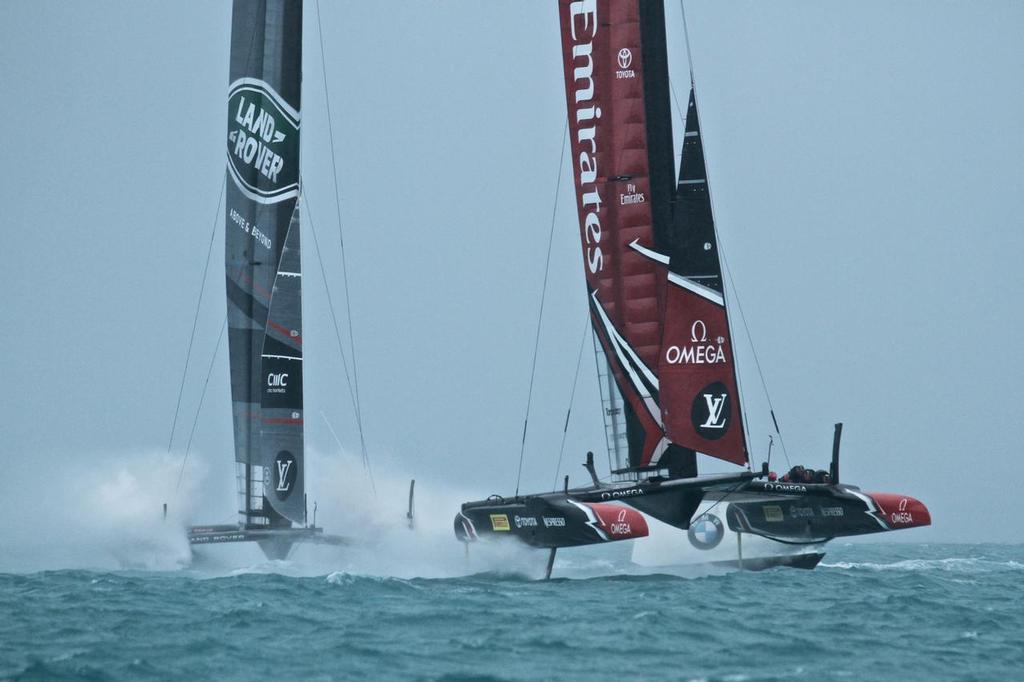
Emirates Team New Zealand leads Land Rover BAR - Semi-Final, Day 11 - 35th America’’s Cup - Bermuda June 6, 2017 Richard Gladwell
www.photosport.co.nz
Iain Murray, Race Director for the Louis Vuitton America's Cup Regatta, came out firing live bullets over claims that racing should not have been staged in yesterday's Louis Vuitton Cup Semi-Final.
After running through the standard presentation of expected wind conditions, pairings for the Semi-Final, course layouts and locations and Race start times, the floor was thrown open to questions from the 30 or so media gathered.
Second question in the session came from RNZ's Todd Niall asking in hindsight whether it was safe to race the AC50's in yesterday's winds of just under the limit?
Murray responded with a prepared salvo of slides showing wind strengths for the start in which Emirates Team New Zealand nosedived; relevant points from the Protocol; and Racing Rules.
Murray's key message was that he could only work within the parameters set and agreed by the teams.
Of particular note was a change to the Protocol made just two weeks before the start of the Regatta when an amendment was made both reducing the upper wind limit of 25 knots and the way in which it was measured.
Murray's line was that for some time he had been advocating a reduction in wind strength from 25kts to 24kts, and a change to the way in which it was measured. However his advice was only acted upon by the competitors two weeks before the start of the Challenger Selection Series. Murray was quick to point out that it was changed by the unanimous agreement of all competitors.
The wording of Article 32.1 of the Protocol gives the discretion not to race 'unless the Regatta Director considers the conditions too rough'. The interpretation placed on 'rough' is that it refers to sea-state only, and not 'rough weather'. Whether that is an interpretation made by Murray, or if it was an interpretation made by the teams was not clear. It is assumed that it came from the teams.
It was made clear that if the wind strength passed the codified test in the Protocol then racing would start.
Murray then rattled through the extracts of various relevant documents several of which apply in yacht racing generally.
His final slide was of wind readings 10 seconds before Emirates Team New Zealand's pitchpole which showed winds of 21.7kts for the period.
Although he did not make the point the Race Management function of this regatta - covering all aspects of on the water racing and measurement and adjudication is completely independent of the Defender, San Francisco's Golden Gate Yacht Club and is independently funded by a levy on the participating teams.
A battle for selection or war of attrition?
The dichotomy with the Challenger Selection Series is that its primary purpose has been to select the best possible Challenger to go up against the Defender in the America's Cup Match.
In fact, the Louis Vuitton Cup was established to create for the Challengers a similar selection process as took place for the Defenders in the 132-year tenure of the New York Yacht Club.
In the Defender series when it was contested in 12 Metres (1956-1983), racing was conducted by a selection committee - which excused yachts from further competition until they had one remaining who was selected as the Defender for that Match.
The Louis Vuitton Cup has always been conducted on a points basis with a Round Robin and knockout phases similar to the sport of match- racing.
The risk with a keenly fought series, particularly one conducted at the top end of the wind range, is that the selected Challenger, battered and still bleeding, is handed over to the fresh and well-practiced Defender to compete for in the America's Cup.
The most notable example was the 2000 Louis Vuitton Cup battle between Luna Rossa and America One, which went right down to the wire. Luna Rossa went on to be defeated 5-0 by then Team New Zealand. The feeling was that the Challenger had done their best sailing in the Louis Vuitton Trophy and that even a rest period of a week was not sufficient to recover.
This America's Cup Challenger Series being fought by four very good teams, and in what looks like being a moderate to heavy air series, when the expectation that the America's Cup Match which begins on June 17 will be sailed in lighter winds.
Murray says he has no discretion in the matter.
'I have campaigned, in discussions with all teams, for the last two years to lower the wind limit. I have to be governed by black and white rules. I wasn't prepared to go into this competition with the chatter, that took place in AC34 (San Francisco, 2013) with racing being called off because of light winds, or heavy winds and me being accused of ruining peoples' Cups.
'So for me, it has to be a black or white decision. It is right, or it's wrong.'
'Unfortunately we are in a sailing regatta. This week we have had possibly to much wind. That is the luck of the draw.'
'At the end of the day, the best sailors will win, whether it is light or heavy.'
The way in which the Protocol can be changed in the America's Cup competition is contrary to the way sailing is conducted under the auspices of the international body that governs the sport. At Olympic and World Championship level there is no voting by competitors on the rules and conditions governing the way the series will be conducted. Standard rules and processes are used and set in a transparent way, independent of the competitors.
In the America's Cup, the rules governing the conduct of racing, contained in the Protocol, can be changed by a majority vote of the competitors, with the Defender, Oracle Team USA having both a vote and right of approval of any change made to the Protocol. America's Cup Class rule changes can only be made by the unanimous vote of the teams. The process is further clouded by a secret agreement signed by five of the six teams covering the basis of conduct of the 36th and 37th America's Cups. Emirates Team New Zealand is not a signatory and sits in this regatta as the so-called 'Lone Wolf'.
When asked if this process of rules by consensus, was really a case of the lunatics running the asylum, Murray answered 'by any normal standard such as an Olympic sailing regatta, 24knots is not a lot of wind.' (The standard at the 2016 Olympics was 25kts).
'The boats are high performers. As you have read the teams have many, many smart people who have told me since the inauguration of this class that they will be able to handle sailing in these conditions. It is their responsibility to bring boats and crews to the competition who can handle the wind strengths that they have nominated.'
Murray was then asked, team views aside, what he believed the maximum wind limits should be.
'I reckon 24kts,' was his response. 'The big change from what I recommended was that we went from a 60second average to a 30-second average (in the measurement of wind strength using the so-called 'rolling (box car)' average.'
Emirates Team NZ deny breaking Race Wing
Murray recapped the circumstances of yesterday's semi-final racing, in regards to Emirates Team New Zealand and their actions and decisions.
'Emirates Team New Zealand damaged the lower section of their wingsail,' he said (before racing got underway).
'They returned to the dock doing 44kts.They changed their wingsail from their Reserve Wing to their Race Wing, which they had been preserving for the America's Cup, to expedite their return to the race course to race two more races. It was a decision made by Team New Zealand to take their best wing to the race course.'
(Emirates Team New Zealand subsequently denied this assertion and told Sail-World that both their wingsails were 'identical in every way'.)
Murray noted that Artemis Racing also suffered some damage and elected to withdraw from Race 1 and conserve their energy to compete in Race 2. Other competitors suffered damage to fairings caused by frequent high-speed dives into the Great Sound.
Responding to a question on the shape of the courses used yesterday, Murray said that he didn't think the width of the course was an issue yesterday, but that sailing three laps was too much for the AC50's in yesterday's conditions.
He added that geographical parameters (overlaid with wind direction) governed the length and laps to be sailed (given there is an informal target for the races to be under 20 minutes) but that whenever possible they would set two lap courses.
Looking forward, Murray said that he was not anticipating sailing today, Wednesday, because of strong winds. He would be looking to race six races on Thursday's forecast 'which may or may not conclude the series'. He noted that Friday's forecast has improved substantially overnight.
'There is some hope that we will be able to complete the full program.'
A subsequent announcement advised that racing would not take place on Wednesday, but would do so on Thursday. There is a possibility that three semi-finals could be sailed. Two of the teams - Emirates Team New Zealand and Softbank Team Japan are on three points in the first to five series.
If you want to link to this article then please use this URL: www.sail-world.com/154410