America's Cup - AC50 construction uncovered - Part 2 - Wings and Costs
by Richard Gladwell, Sail-World.com on 5 Jun 2016
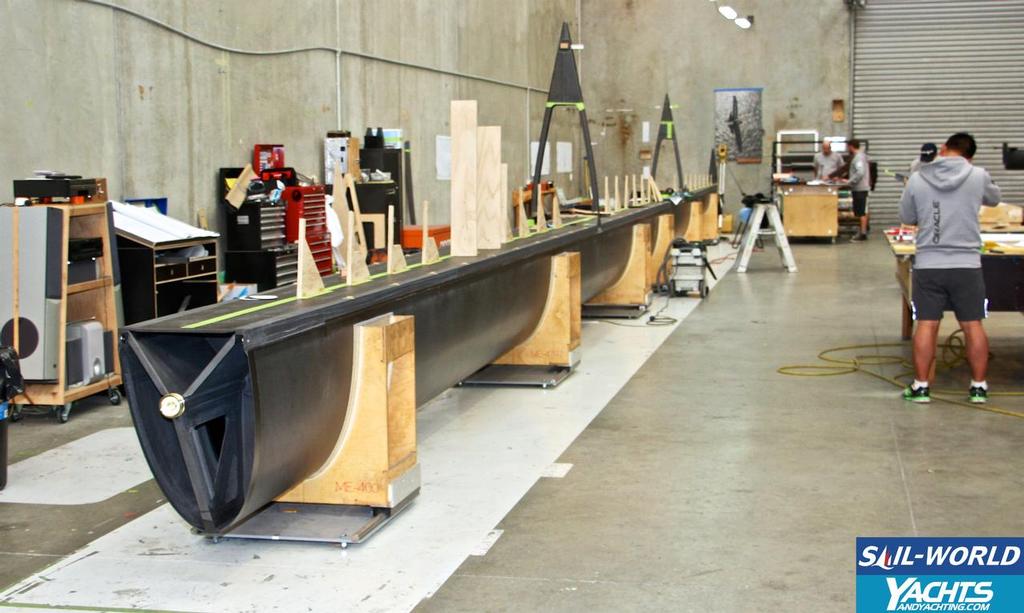
Wingsail construction - AC50 construction May 2016 Richard Gladwell
www.photosport.co.nz
Second part of a two-part series looking at the construction progress at Core Builders Composites, and features of the AC50 class which will be used in the 35th America's Cup in Bermuda. Tim Smyth takes us on a tour of the CBC facility in Warkworth, and hour's drive north of Auckland. Where several AC50's, components and wingsails are under construction or have already been shipped to the teams.
For Part 1
click here
One of the odd aspects of seeing the AC50's under construction is that they don't look like a 50ft boat.
There is still 10ft of the hull to be added to bring what we see up to full the full 50ft. (An AC50 is actually 15metres long which converts to 49ft 2.55 inches for the technical pedants.)
Under the Protocol governing the conduct of the 35th America’s Cup, the Constructed in Country requirement has been modified so that only a 10ft section of the bow is required to be built in the country of the Challenging or Defending Club.
'We built the tools and sent them to USA and Japan for laminating,' Core Builders Composites' principal Tim Smyth told Sail-World.com
'They only need one or two guys to build them and will be coming back here for fitting, or maybe they may even go straight to Bermuda. They are bolt-ons after all so they can be readily replaced in the event of a collision.'
That 10ft section of the bow is bolted to the 40ft after-section of the hull, bringing the total length out to the full size for the AC50. It also means that the boat is easily broken down for shipping into the two containers, and in the case of damage, a bolt on bow section could be carried by the teams in their spare component kit.
Not all of the Boat is one design. The daggerboards, the foil motion system, and the area it occupies remains open to innovative solutions. There is as much design work involved in these one design boats as there was in previous editions of the America's Cup.
'The builders have been challenged to the limits of their materials and current technology to produce a strong enough all carbon daggerboard which is the lightest way to build them,' explains Smyth.
'One day when the complexity of the systems and loads with which we are working are revealed, people will be amazed both as to the load size and stresses and the variety of different approaches the competing teams have taken to solve them,' he adds.
Wingsail both Open and One Design
The hulls, crossbeams and pods are assembled to form what is known in multihull parlance as 'The Platform.' Those basic platform elements are all one-design.
The 23metre high wingsail is part one design in its profile, but open design in other key areas.
'The wingsail consists of a common geometry main element and common structural design along with overall area limits,' Smyth explains.
' Team designers are allowed to develop their own three-flap element twist control system and the structural solutions to build those components.'
'Flap control systems are incredibly elaborate pieces of technology with beautifully engineered systems, carbon fibre, alloy honeycombs, three D printed nylons and titanium, milled alloys and exotic thermoplastics, chains, sprockets, cables, hydraulic pumps, electrical actuators, sheaves and ceramic bearings, endless strops and dead end dog bones, “ says Smyth rattling off a list of design options that are beyond the ken of most sailing fans.
'These are all items employed by the teams building their own ‘particular’ twist control system,' he adds. 'Most people who get a look at these systems would struggle to understand how it works.'
'For sure the lessons learned and the technology developed by these privately funded teams would be the envy of any equally funded Government sponsored research and development project. And we get all this and the sporting entertainment, too,' he quips.
'In these two development areas alone, for those involved in building these boats, there has been more exciting development in the America's Cup, in the past few years than all of the IAAC monohull development, in which we were involved. And it keeps getting better.'
Significant cost reduction
Cost reduction has been at the heart of any discussion about the future of the America's Cup in recent years.
Many believe that cost reduction leads to more new teams being able to afford the entry level for a first campaign.
Other more cynical Cup players believe that an America's Cup costs what it costs, and it doesn't matter what is done with cost reduction teams will always find ways to spend money.
The reality is that the constant changing of the America's Cup boat for each Defence kills the second hand or recycling of boats. And without the hand-me-downs new teams can't buy a used boat and go sailing to get their campaign underway and attract sponsor interest for a minimal upfront investment.
The AC50 One Design is an attempt to approach the issue from two angles - cost reduction and second-hand market creation. But the latter benefit will only eventuate if there is class continuity between Cups.
Smyth is a little reluctant to be drawn on cost comparisons between the AC72 and AC50 and the older IACC V5 monohulls last used in the 2007 America’s Cup.
(Yes, by the time of the next America’s Cup it will have been a decade since sailing’s oldest trophy was sailed in monohulls.)
“The AC50 will be as fast as the AC72 and will have similar foil loadings,” says Smyth. “But they are a lot cheaper. It is simplistic just to look at a boat like an AC72 or a V5 monohull and talk about the cost of a sail-away AC boat. An America's Cup build program is not like that. You have to factor in all the logistics of a particular build location, the development work, all the design blind alleys, the failures and the replacements around it – which you have to add onto what you actually spent.'
“There is so much noise around all the design, development and building cost that it was hard to put a building cost on the previous Cup boats.”
“Our costs for the AC72 were confused by the capsize, for instance.”
“But I would put the costs of a one design AC50 Yacht at 50-75% of the cost of an open design AC72,” he says.
Cost comparisons with a monohull are more difficult again as with the AC50 there is just a single wingsail and a jib in the sail plan, while with a monohull there is a myriad of sails, albeit limited by the class rule.
But even so Smyth says the costs of a pair of IACC hulls was $5million. “The rig budget was about the same and the sails about three times that. So you are looking at well over $20million.'
By comparison, he says an AC50 is about $4-5million. That cost includes a complete wingsail (at an approximate cost of $1.8million) and one set of appendages, but not a sophisticated electronics and hydraulics package.
Spare parts reduction
Another mantra in the previous Cups has been the issue of spare parts. “I come back to these people who want to avoid risk and take caution. But that all costs money and needs careful judgement. For instance, you see teams carry massive amounts of spare parts, and thousands of dollars of spares just go in the bin at the end of each Cup when the boat or the system changes and they can’t be re-used.”
The AC 50 One Design elements approach should reduce this waste, and again lowering entry cost for new teams and in theory increasing participation - which means an expanded game in terms of the profile of the America's Cup.
Reducing spare parts inventories are another are of cost reduction and have also been a focus of the Volvo Ocean Race organisers.
In the 35th America’s Cup Smyth doesn’t expect teams to go to the extreme of building spare hulls, but concedes that a spare hull would have been most useful for Oracle Team USA last time around.
However, he does expect teams to build spare bows, and most will have a spare wingsail, plus a spare steering wheel or two.
Significant daggerboard issue
Smyth believes there is a glaring omission in the current Cup over the limitation on daggerboards to just four that will be insufficient in the case of breakage.
He notes that teams are likely to build two sets of daggerboards – one optimised for light winds and more displacement sailing – which will be lower drag, and the second set-orientated around high winds, foiling, and speed.
Break one board in that four (and almost every team except Team NZ broke at least one daggerboard in the last Cup), and it is not possible to build a replacement in the time left in the regatta. Any repair is likely to be very involved if indeed it is possible to obtain the required structural strength.
Normally an America's Cup daggerboard takes eight weeks from design to build completion, and a replacement using the same tooling, up to six weeks.
“Limiting the boards to just four will be dangerous. The teams can’t even build an identical spare without sacrificing a ‘card’– they are supposed to repair them when they are broken. I think it is a glaring anomaly,” Smyth explains.
Final assembly before shipping
After Core Builders Composites have completed the build of the hulls, platform, and wingsail components, the AC50’s will be assembled at Warkworth (but not fully rigged). They will then be broken down into their components, and shipped to the teams ready for final assembly, electronic and control systems fit-out and rigging and launch in early 2017
The wingsails are also being fully assembled and bend tested at Warkworth before shipping.
“Most teams have their hydraulic, rig and electronics guys at their home base, so they may send a team to do that fit-out, or they may ship the boat and do it at their base.'
The containers containing the AC50's and wingsails will not be shipped en masse, but as required by the teams so they can be sailing by January 1, 2017. They are expected to arrive at least two months before the earliest sail-by date.
CBC moves into composite construction outside AC
Beyond the America’s Cup, Core Builders Composite is keen to continue to build its business on composite construction and providing tooling for other builders inside and outside the marine industry.
'Foiling winged Multihulls have driven us to develop engineering, CNC machining and composites manufacture processing solutions which really advance the sport of sailing and the desire to go fast,' says Smyth. 'And it won't stop there, the building of highly loaded foils, for example, have given us insights into building underwater marine turbine blades which will play a big role in future energy production given the size of the marine power resource.'
'The foil motion control systems the Cup teams are developing will feed directly into foiling craft of all styles in the future with the promise of less energy consumption and a more comfortable and speedier ride.'
Core Builders Composites seem to be blessed with a sprawl of large concrete block construction factories, allowing the facility to expand or contract as required. Even better it is all on flat land, making the movement of components between facilities and easy task.
The construction facilities are enhanced and in the next six months, CBC will install a new 2.5m x 9m autoclave from a leading US manufacturer alongside the main AC50 building area.
“Our America's Cup work can be a bit spasmodic, so we endeavour to fill the gaps with other tooling work and composite projects,' Smyth explains. 'We have ring-fenced a team to work with the CNC milling machines which are dedicated to other client work.”
“We have had a lot of projects outside the America's Cup, but one of the downsides is that often we can’t talk about those projects – it might be a movie job or a tool for a boat that is going to be launched which the builder wants to talk about themselves.'
The non-AC projects include high-end architectural work, industrial projects, non-civilian aerospace parts and alternative energy generation components.
'Infrastructure, which will be huge for composites in the near future, also beckons but we aim to remain at the pinnacle of high end Racing Yacht construction, and we continue to invest to keep ourselves at that forefront.'
In the meantime, the AC50 production line is more than enough to keep the Core Builders Composites team occupied.
If you want to link to this article then please use this URL: www.sail-world.com/145270