Indonesian sandeq sets sail for France
by Jakarta Globe on 9 Apr 2012
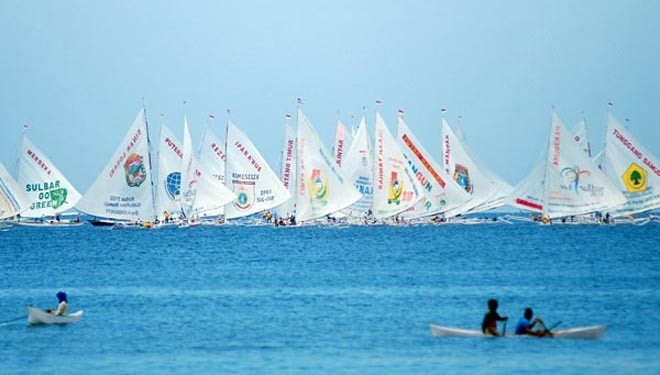
Sandeqs under sail photo by Muhammad Ridwan SW
As the largest archipelagic country in the world, encompassing some 5.8 million square kilometers of maritime territory, Indonesia is rich in seafaring traditions and time-honored craft developed by a variety of tribes across the centuries.
But modern technology and demands have led to the obsolescence of many of these vessels. Recognizing the unique and precious offerings of Indonesia’s maritime heritage, several foreigners have taken steps to preserve and celebrate iconic Indonesian boats — especially the elegant sandeq.
Between 7 meters and 11 meters long, the sandeq is the traditional fishing vessel of the Mandar people, although variations of the boat’s design can be found in several tribes. The word 'sandeq' means pointed, referring to the sharp, sweeping bow of the boat, which enables it to slice through heavy seas and places it among the fastest traditional vessels in the world. The hull, which is typically painted bright white, is roughly a meter wide and is flanked by narrow pontoons, or outriggers, on each side to supports its bulky — and often colorful — triangular sail.
In early 2009, Francois Cuillandre, the mayor of Brest, a city in France’s northwestern region of Brittany, was on an official visit to Indonesia when he first heard about the Mandar tribe in West Sulawesi and its traditional sandeqs.
Cuillandre was eager to have the Mandar share their boats with the rest of the world at the Brest 2012 International Maritime Festival of the Sea in July. At the mayor’s invitation, three sandeq boats and 16 passandeqs — Mandar mariners from Majene and Polewali in West Sulawesi — will participate.
A model Indonesian village will also be built and staffed near Brest’s marina.
'Indonesia is the second Asian country to become the guest of honor of this festival,' event spokeswoman Paskal Chelet-Roux said.
Chelet-Roux said the quadrennial festival, which attracts up to 650,000 visitors and is held as a tribute to French maritime culture, regularly invited countries from other parts of the world to honor their maritime traditions and exhibit their boats. This year, its guests also include Morocco, Russia, Norway and Mexico.
The participating Indonesian boats — the Saqbe Mandar, Cahaya Assad and Sinar Losari — were dismantled last September and shipped to France, where they will be reassembled in July.
West Sulawesi native Muhammad Ridwan Alimuddin, better known as Iwan, said it would be the second time the sandeq was introduced to the French public. In 1997, a sandeq was on display for a maritime exhibition at the National Museum of Natural History in Paris.
Iwan, who has been researching Mandar maritime heritage, said recent efforts to preserve sandeq boat-building techniques were in large part thanks to a 300 nautical mile race from Majene to Makassar, the capital of South Sulawesi.
The Sandeq Race, billed as the world’s fastest, longest and most difficult race for traditional fishing vessels, was started by German anthropologist Horst Liebner in 1995. After studying the Mandar tribe’s maritime construction techniques, Liebner found that fishermen were trading the sandeq for motor-powered boats, putting the traditional craft in danger of extinction. Despite its exceptional speed, the sandeq could not sail fast enough to bring in the freshest and most profitable fish.
Iwan echoed Liebner’s observations, saying the decreasing need for sandeqs in fishing and interisland trade resulted in the boats remaining idle on the shores of West Sulawesi, where they were eventually sold or left to deteriorate.
Liebner suggested a race as a way to encourage the Mandar people to keep their traditional boat-building alive. Since then, the Sandeq Race has been held 11 times.
'If there was no such race, there would be no demand to build the sandeq boats and no opportunity to pass on the boat-building techniques to the younger generation,' Iwan said, adding that a sandeq, which is made of wood with traditional tools, could easily be sold for up to Rp 30 million ($3,300).
Iwan describes the sandeq as tremendously seaworthy and built for long distances, capable of handling steep ocean swells and heavy winds. The high-speed design is the product of input from centuries of maritime communities that have navigated Austronesian seas.
This fact, Iwan said, makes it difficult to claim any legal rights to the traditional knowledge of sandeq construction, because it cannot be traced back to any single inventor or tribal community.
'The process of determining and designing the boat’s parts has been passed down from one generation to another for hundreds of years,' he said, adding that the sandeq’s individual parts were also used to build other types of traditional boats.
'Instead of wasting time coming up with sandeq patent rights, what we — including the government, scientists and other stakeholders — should focus on is promoting the sandeq as part of the Mandar maritime heritage,' he said.
Iwan believes that conducting research and scientific documentation, developing a sandeq Web site and the Sandeq Race have helped disseminate knowledge about the swift boats to younger generations and aided in preservation efforts.
'The more messages that get out to societies outside the Mandar community results in global acknowledgement,' he said. 'Such recognition surely dismisses other parties or regions laying cultural claim over the sandeq.'
Iwan also hopes the regional government of Sulawesi will get involved in a serious and comprehensive effort to preserve sandeq traditions, which he hopes will do more than just commercialize them.
'There are more substantive ways to preserve the heritage,' he said. 'Most importantly, the preservation efforts should not keep the sandeq craftsmen and seafarers sidelined.'
Iwan will lead the Mandar delegation to Brest. The group will include the boats’ crews as well as a sandeq craftsman who will demonstrate the boat-building process inside the replica village.
Chelet-Roux said the village would be built to imitate a typical Indonesian kampung, with a showcase of local arts and crafts. It will be manned by up to 85 people, including 60 who will travel from Indonesia, as well as a small number of Indonesians living in Brest. The village will consist of the Mandar contingent, a troupe of gamelan orchestra performers from Semarang, dancers and craftsmen from Kalimantan’s Dayak and Kutai tribes, and batik artisans.
There will also be traditional kite-making and drawing sessions by Ludovic Petit, a Frenchman and expert on Indonesian kites, followed by kite flying demonstrations and a workshop on using Indonesian spices for cooking.
The village will also be decorated with 20 contemporary paintings depicting the Nyai Roro Kidul, the mythical Javanese Queen of the South Sea, which were produced by 20 young Yogyakartan artists.
'It will be a good opportunity for the French and European public to learn and appreciate the Indonesian culture and experience the Indonesian people’s warmth and hospitality,' Chelet-Roux said.
If you want to link to this article then please use this URL: www.sail-world.com/95857