Newport Bermuda - The thrash to the Onion Patch
by John Rousmaniere on 22 Mar 2012
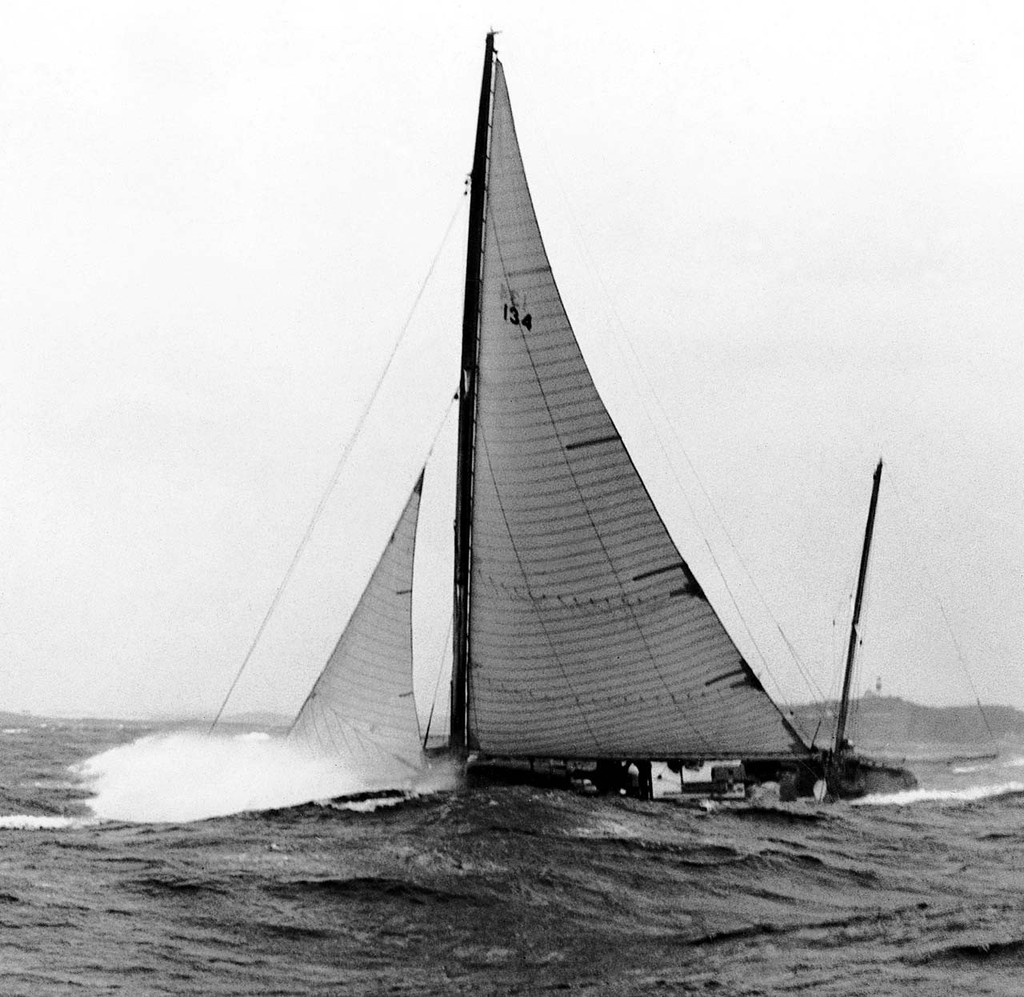
Bolero blasting toward the finish line at St. David’s Lighthouse in the 1956 Newport Bermuda Race. Courtesy of Bermuda News Bureau
There’s a good reason why the Bermuda Race’s nickname is 'The Thrash to the Onion Patch.' Many good reasons, in fact. On the 40th anniversary of the toughest Bermuda Race in history, in 1972, when the tail of a hurricane lashed the big fleet, let’s remember that rough weather and the Newport Bermuda Race are hardly strangers.
Consider, for example, the 2002 race. Early on, a cold northeaster pushed the 182 boats at high speeds into the Gulf Stream, which proceeded to fulfill its reputation as a dangerous weather-maker by churning up black squalls punctuated by waterspouts. Then things really got nasty when the northeast wind gave way to a force 6-7 southwesterly blowing right into the teeth of a long, powerful southbound eddy reaching almost to Bermuda.
The impossible seaway was reminiscent of a description of the Stream by a great sailor of a past generation, Erroll Bruce, who called it 'a mass of separate steep crests, each moving independently, and breaking haphazardly.' Fred Detwiler’s 70-footer Trader stuck her bow into one of these waves and lost her mast.
One of the many boats that were nursed through this chaos was the 75-foot turbomaxi Pyewacket, a Transpac Race record holder that Roy Disney had brought east. In the worst going she jogged along at a mere eight knots under deeply reefed mainsail and no headsail. She suffered no damage, but there was great discomfort among the crew, who had fought not only the bone-shaking conditions but also a contagion of the flu.
'You would not have wanted to be on the boat,' Disney said somberly after the finish. Still, Pyewacket was first to finish. Averaging 11.8 knots, she shattered the elapsed time record by almost four hours, at 53 hours, 39 minutes.
Except for the flu, this was hardly a new chapter in the long history of the Bermuda Race. The tone was set in the first race, in 1906, when a gale in the Stream stopped one of the entries in her tracks and forced her back to North America. Recalled a sailor in another boat, 'By 6 a.m. we were clear of the Gulf Stream, which place, I am under the impression, might be improved upon. I really enjoyed it, only I thought it would be kind of nice to be dry again for a change.
' After another rough race three decades later, a sailor recalled the entrancing sight of the sea in turmoil: 'The phosphorus was beautiful and would light up the whole deck.' But, he added, 'When phosphorus goes down your neck it is nothing more than plain sea water.'
Forty-four boats started the 1936 race, and after days of beating into an unwavering southeast gale, only 35 finished. The 20 percent dropout rate is one of the worst in the race’s history. Twenty years later, in 1956, it was blowing so hard when the 73-foot maxis of that era neared Bermuda that the leader, Venturer, couldn’t tie a reef into her heavy cotton mainsail and had to make do under jib and mizzen.
Overtaking her, Bolero couldn’t reef, either. She blew out two jibs, and then when the headstay turnbuckle broke, the crew quickly doused the headsail, ran jib halyards out to the bow, and set a small forestaysail. Bursting out of the fog at 11 knots, Bolero set a new elapsed time race record.
In 1960 an 80-degree wind shift caught Henry Morgan’s 62-foot sloop Djinn aback. 'The boat went right over on her port side,' Morgan recalled. 'I know how far over because we found weed in the top of the three sets of spreaders while checking the rig in Bermuda.'
When she came back upright, Morgan, at the wheel, realized he was the only person on deck. 'I could see that there wasn't a soul, whereas I knew there had been seven others when we tacked. That was a bit of a thrill, but very shortly people started appearing over the rail, swarming up their safety harness tethers. This was the best lesson in the merits of everybody hooked on I've ever seen.'
The wind devils were back at work again in 1970. As the fleet was hammered by thunderstorms sweeping in from the west with hurricane-strength gusts, Harvey Loomis, sailing in John Page’s Pageant, noticed 'a particularly heavy cloud that we wishfully hoped was not doing what it appeared to be doing: moving against the wind, toward us. The leading edge was blacker and sharper than any squall I’d ever seen.
Reminded me of the thin black mustache on the upper lip of the villainous landlord in the old melodramas. And low. And spitting straight down out of it were occasional blasts of lightning. Altogether a very much more than ordinarily imposing piece of nature’s work.' The crew doused all sail. Pageant went on to win her class.
All this could not compare with the 1972 race, when 178 boats pounded through a southeast gale spun off from an early-season hurricane. 'It was like driving a truck into a stone wall three times a minute for two days,' a sailor said afterwards. On board Bob Bavier’s 40-footer Witch, somebody noted in the log, 'The watchword for today is survival.'
The overall winner was Noryema, an English Swan 48 and the first and (as of 2010) only non-U.S. winner of a Newport Bermuda Race. The crew credited their success in large part to a diving mask the helmsmen wore so they could see through the salt spray.
In another English boat, Crusade, recalled Scott Osler, 'We were surfing in the mid-teens with a storm jib and a storm trysail. The wave troughs were deeper than our spreaders were high.' Domestic life, meanwhile, became unhinged, along with the door to the galley oven, where some leftover chicken was stored.
'I was off watch during a pretty terrific fall into a wave trough which broke the oven gimbals and door,' Oster explained. 'All of the chicken carcasses flew out and several of them climbed into our foul weather gear on the floor. As we were asleep, we didn't realize this until we tried to put them on. '
Things were even stranger on board Australian Alan Bond’s Apollo. 'The breeze got quite strong and we ended up beating to windward with a fully reefed mainsail and storm jib,' Ron Packer recalled.
'By late afternoon the wind appeared to be moderating slightly and Trygve Halvorsen in his very low key style said to us, ‘Boys, if we were really trying we would have the number 4 jib up.’' Four brave souls obediently ventured forward with the number 4.
'On one occasion as the bow slammed into the next wave, John Longley put his hand down to cushion the landing and found a flying fish in his hand. Not wanting to miss an opportunity, he merely pushed it into his oilskin pocket and continued with the sail change. We eventually got the number 4 up and the storm jib back into the main cabin via the cockpit. Doc Phillips turned to the rest of the crew and said, ‘Wow, that was pretty hairy,’ to which John Longley replied, ‘What do you mean? I had time for a spot of fishing!’ and produced the flying fish out of his pocket.'
The big test was the landfall, which was always a challenge in the pre-electronics era of navigation, when the sextant was king. The anxiety of a shaky landfall has been described this way by an experienced Bermuda Race navigator, Nick Nicholson: 'All the self-doubts about what you had done for the last three or four days piled up at once. Were my sights accurate? Do I really have a clue?
The first time Bermuda popped up in front of the boat approximately when and where it was supposed to be, it was a divine revelation. There was meaning to the universe. The celestial clock was still God’s timepiece, and it still ran with eternal perfection.'
That clock never seemed more remote than it did in June 1972, when, after three days without sextant sights, a fleet of yachts tried to find Bermuda without running up on the island’s coral reefs. The poor navigator searching for this tiny, low fishhook-shaped archipelago knew what Shakespeare meant when he wrote of 'the still-vexed Bermoothes.'
I was sailing in the Swan 55 yawl Dyna. The cloud cover briefly opened up at dawn to allow us to get a compass bearing on Gibbs Hill light. Our depth sounder and other electronics having shorted out during the wet ride, our skipper and navigator, Clayton Ewing and Dick McCurdy, decided to feel our way around the reef. We sailed toward it until the waves shortened and steepened.
This sign of shoal water encouraged us to tack very quickly and hold out until the seas lengthened again, a signal to make another probe. After an hour or two of this, we were still feeling lost when a burly Aussie fisherman named Sid Brown stuck his head out of the companionway, looked around, and, pointing abeam at a buoy, announced, 'There it is.' It was Northeast Breaker, and from there our path to the finish was relatively straightforward.
Other boats weren’t so fortunate. Eleven boats were dismasted or otherwise disabled, but no boat ran aground (that’s happened in only one of the 47 races) or suffered a serious injury (the only death in the race’s long history was in a fire in 1932).
Still, there were many close calls near Bermuda in 1972. When 1970 winner Carina’s radio direction finder bizarrely showed danger on one tack and safety on the other, Dick and Richard Nye hove to, as did other crews. When the next race came around in 1974, the Cruising Club of America and Royal Bermuda Yacht Club for the first time permitted state of the art electronic navigation, though only within 50 miles of Newport or Bermuda. By the 1980 race, boats were allowed to use Loran-C from start to finish.
Another consequence of the harsh 1972 thrash was widespread respect for the race’s onerous focus on safety, with its required inspections, many regulations, and demanding entry requirements. After the catastrophic 1979 Fastnet Race in England, Richard Nye would point out that almost all the losses of life and serious damage occurred in boats smaller than 38 feet, approximately the Bermuda’s Race’s de facto minimum size.
Applications for Entry into this invitational adventure are being taken under on the race website. The classic 635-mile race offers racing in five divisions— The St. David’s Lighthouse (amateur) Division, The Cruiser (amateur) Division, the Double Handed Division, the Gibbs Hill (professional) Division and the Open (professional) division. There is great competition for all levels of commitment and experience.
About 40 of the two Lighthouse Division entries are expected to sail the Onion Patch series, a tough triathlon of offshore racing. Boats compete in the New York Yacht Club Annual Regatta in Newport, then race to Bermuda, and finally sail in the Royal Bermuda Yacht Club Anniversary Regatta. Information is online here.
If you want to link to this article then please use this URL: www.sail-world.com/95147