Short-Handed Man-Overboard Maneuver - the 'Williamson Turn'
by John Jamieson on 24 Feb 2012
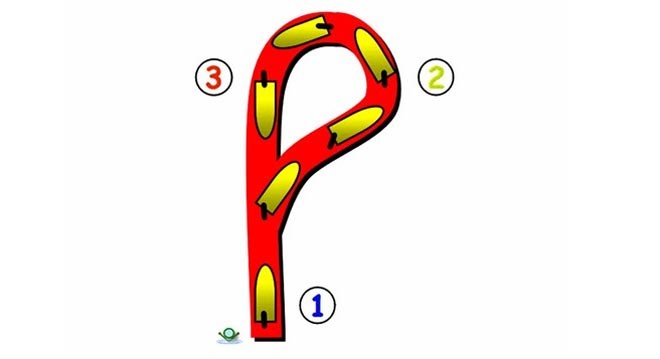
Turn your rudder hard over (position 1). Shift your rudder hard over to the opposite side when you reach 60 degrees from your sailing course (position 2). Continue around until you are sailing on your reciprocal sailing course (position 3). SW
Sailing short-handed has its own beauty and its own challenges. Here John Jamieson (Captain John) paints a picture that is quoted as a nightmare for many short-handed sailors, which includes a majority of the cruising sailors of the world:
Howling wind, black night--not a star alight. Your buddy relieves you after a long watch and you stumble below. Exhausted, you crawl into your berth and are soon sound asleep. And then...you awake with a start! You glance at your watch. You're an hour late. Did the off-going watch wake you up? This couldn't have happened! You pull on your sea boots, grab your foul weather jacket and sailing harness, and dash up the companionway ladder...
You glance aft. You see the autopilot, rock-steady as it steers the boat. But where's the watch stander? You glance forward-- and see no one. You dash back below and check forward, aft, everywhere. No sign of your friend. And then a sickening sense of dread hits you. You're are all alone! What now, skipper?
Not many things at sea can jar the nerves as much as a man overboard emergency. And it doesn't always happen when you're around. You may know of the overboard approach turns under sail or power that form a figure-8 or tight circle.
But there's one little-known method you'll want to know in case you don't see a person fall over the side. This technique - called the 'Williamson Turn' - can be used when you need to:
* Locate a person that fell overboard at an unknown time(no one saw this happen).
* Sail down the exact same track to keep the search area close to the original sailing course.
* Make a tight turn that puts you back into your wake trail (critical at night, in fog, or in rough seas).
* Recover objects that fell over the side (hats, hand-held radio, fenders).
Used by ships and power vessels for years, you can also add this to your list of 'need to know' maneuvers when your are under sail alone, motor-sailing, or motoring only.
Skippertips member and retired Coast Guard commander Charles 'Mac' McFadden contributed this article on how to make a perfect Williamson Turn to recover a person or a common object like a floating hand-held VHF radio
Suppose you drop your portable VHF radio overboard. It will very quickly be lost to sight astern (presuming it floats). Without a visual reference, simply turning around to retrieve it is not likely to work. A Williamson Turn offers a much greater chance of success.
Note your course and immediately throw the helm hard over (say to starboard). Continue the turn through about 60 degrees, and then shift the helm too hard over port. Steady up on the reciprocal of your course. Slow down and search back over your track.
For example: You are on course 000 (due north) when your VHF goes overboard. Turn hard right (illustration, step 1). Watch the compass. When your heading reaches about 060 (000 + 60), turn hard left (illustration, step 2). Steady up on 180, the reciprocal of your original course (000) (illustration, step 3).
The Williamson Turn can be employed anytime you want to retrace your steps. It can be useful in a man overboard situation in reduced visibility conditions, or when some period of time elapses before the loss becomes known.
You can also make a Williamson Turn in the opposite direction--or to the left in the above example. Just subtract 60 degrees from the sailing course. In the example, you would turn left to 300; then turn the rudder hard right and steady up on 180, the reciprocal of your original course (000).
Mac also points out a super simple way to determine your reciprocal on oddball sailing courses. Here's his super sailing tip: The math to add 180 to (or subtract 180 from) the course or bearing might seem pretty uncomplicated. But sometimes distractions like noise, darkness, or anxiety, can ruin your arithmetic skills. Instead of doing the math with 180 degrees, use a combination of 200 degrees and 20 degrees as shown. Here are two examples that show you how to accomplish this fast and easy:
Example 1:
Add 200 and subtract 20 to find a reciprocal. Here's an example: 137 (course) + 200 = 337; 337 - 20 = 317 reciprocal course.
Example 2:
Subtract 200 and add 20 to find a reciprocal (use for courses over 200). 252 (course) - 200 = 052; 052 + 20 = 072 reciprocal course
Add these sailing safety overboard recovery secrets to your skipper skills treasure-chest today. You will be prepared to meet any challenge that crosses your path--wherever in the world you choose to go sailing!
John Jamieson (Captain John) shows you the no-nonsense cruising skills you need beyond sailing school at www.skippertips.com . Sign up for a free sailing tip-of-the-week or join for hundreds of sailing tips articles, newsletters, eBooks, and live discussion forums.
If you want to link to this article then please use this URL: www.sail-world.com/94234