Rolex Sydney Hobart Yacht Race - First TP52 ever built to compete
by Jim Gale on 24 Dec 2011
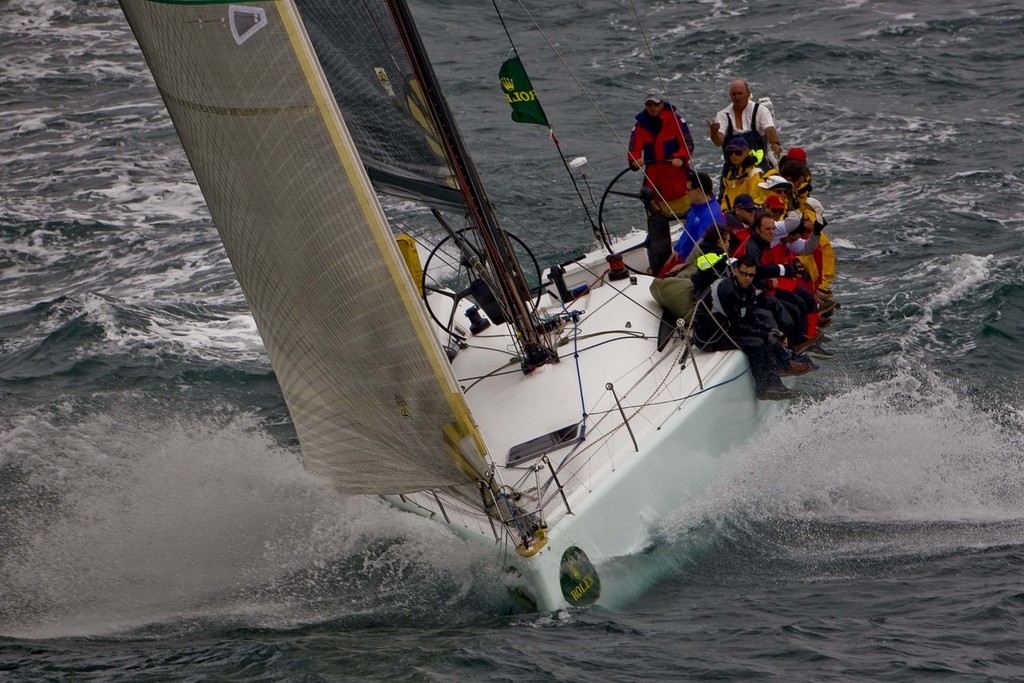
Geoff Hills Strewth - Rolex Sydney Hobart Yacht Race 2011 Rolex / Carlo Borlenghi
http://www.carloborlenghi.net
Rolex Sydney Hobart Yacht Race starts on Sydney Harbour at 1pm on 26th December and finishes on the Derwent River.
In the history of ocean racing there have been signature boats, designs and events that have reverberated through the sport. Think of Windward Passage II, the first carbon fibre maxi that in one season rendered aluminium maxis obsolete and led directly to today’s high tech supermaxis. The 79 Fastnet and the 98 Hobart. Or when New Zealand designer Bruce Farr first burst onto the IOR scene.
In recent years, one of the biggest game changers has been the TP52. In just on a decade these simple, exciting, immensely demanding boats have become the weapon of choice for many of the world’s top ocean-racing sailors.
Recent Rolex Sydney Hobart races have featured a growing phalanx of these yachts - there are eight competing this year - all high on the bookies’ lists of boats most likely to take out the coveted Tattersall’s Cup.
And this year Ffreefire 52, the very first TP52 ever built, is among them.
TP52s are one off yachts designed to a ‘box rule’, that is, each boat has to fit into the dimensions of a box, as it were. Length, displacement, draft and sail area are defined, but hull shape, construction, deck and interior layout are at the designer’s whim.
It’s a kind of halfway house between one design and traditional handicap racing. TP52 owners can have their own unique boat, competing against all the other boats in the fleet on handicap, yet still enjoy boat-on-boat racing in real time.
It is a formula that has taken off. These are big, expensive boats to build and campaign. Yet since Ffreefire 52 was launched in 2001, a further 65 have been built and a 67th is currently under construction.
Anthony Day, who has chartered Ffreefire 52 for the Rolex Sydney Hobart, first sailed a TP52 in 2005.
'The first time I saw a TP52 I thought wow, all the things you can do with this. The TP52 has changed things so quickly. It just lights up everyone who sails on one.
'They are extremely fast, you get a more exhilarating ride, and they are very responsive.' They are, really, giant ocean going skiffs, able to reach incredible speeds and demanding exactly the same focus and skill a good skiff requires.
'We just love sailing them,' Ffreefire 52’s sailing master Russ Parker chimes in. 'You just always come off feeling good.'
And just like a skiff, you have to sail them well. TP52s don’t suffer fools lightly. On a TP52 the groove, when the boat is sailing at its full potential, is very narrow. A moment’s inattention and you can suddenly be going very slow, and because they are unforgiving, Day says, TP52s have had a profound impact on the culture and style of modern ocean racing.
'These are hard boats to sail. A bunch of guys can’t just thrash about on a TP52 and achieve anything. You have to bring a level of commitment and professionalism that you don’t need to have on a cruising boat or even the older style of racing boats. You have to up your game.
'That’s reinforced the level of professionalism and commitment both on the water and in the organisation behind yacht racing.'
Over the decade the focus of TP52 racing has shifted from America to the Mediterranean, and that has changed the focus of the box rule.
'When these original ones were built, they were focused on offshore racing, so the hulls are a bit heavier and a bit more solid,' says Russ Parker. 'The more modern boats are more performance orientated for windward/leeward, round the buoys racing, with lighter hulls and everything. The more modern ones, like the new Hooligan, are inshore racing yachts.
Day and Parker have bought Ffreefire 52 down from Hong Kong for the Rolex Sydney Hobart. All her crew live or have lived in Hong Kong or Singapore.
'There is a very thriving sailing community in Hong Kong,' says Day. 'Hong Kong is, after all a maritime city, a port, and you only really understand the place when you look back at it from the water.
'The Hong Kong sailing scene is great. The standard of the competition just gets better and better. The youth programs are growing year by year and that’s starting to flow through to the bigger boat programs.
'Living in Hong Kong, racing is a perfect antidote to what is a very claustrophobic city.'
Day says that one of the great developments at the Royal Hong Kong Yacht Club is the growth in Chinese sailing.
'There is absolutely no distinction between the Chinese and expats. I don’t know if there was a conscious attempt at some point to boost Chinese involvement in the club, but if there was it is certainly no longer necessary.'
While Ffreefire 52’s crew have logged up thousands of racing miles in the China Sea, the 2011 Rolex Sydney Hobart, starting at 1pm next Monday from Sydney Harbour, is a new challenge for most of them.
'This is my first Hobart so I am very excited. I mean, if you like messing around offshore this is what you do, isn’t it? I have done the TransTasman two-handed race so I know what to expect.
'With so many TP52s it makes for a very interesting race within a race. We’ll all be keeping an eye on each Rolex Sydney Hobart Yacht Race website
If you want to link to this article then please use this URL: www.sail-world.com/92171