Volvo Ocean Race - Telefónica snatches lead from Puma's Mar Mostro
by Volvo Ocean Race on 15 Nov 2011
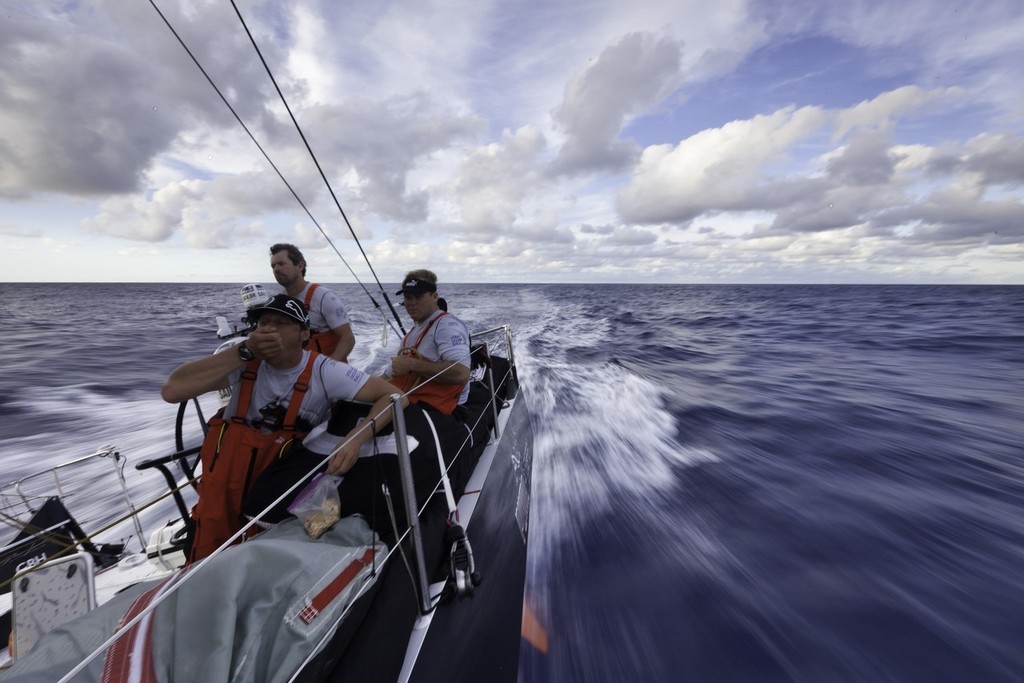
Kelvin Harrap driving PUMA Ocean Racing powered by BERG’s "Mar Mostro" in fast conditions during leg 1 of the Volvo Ocean Race 2011-12 Amory Ross/Puma Ocean Racing/Volvo Ocean Race
http://www.puma.com/sailing
Volvo Ocean Race Team Telefónica have grabbed first place from Puma’s Mar Mostro this afternoon, just as the fleet prepared to enter the Doldrums and trust to luck. Anything could happen at this crucial stage of leg one as the boats charge towards the infamous area just north of the Equator where weather systems converge.
'Crossing the Doldrums is done always with nervousness,' said Ken Read, skipper of Puma Ocean Racing powered by Berg, who were passed by Team Telefónica at the 1300 UTC position report. 'It’s always a bit of a crapshoot. You can do all your homework and enter where you think the right path through is and still get it very wrong.'
The Doldrums, officially known as the intertropical convergence zone, is a dynamic area of low pressure characterised by light winds but notorious for sudden squalls. Constantly changing shape, the Doldrums make up one of the trickiest areas of the planet to navigate and one that has caused the reshuffle of many an ocean race leaderboard.
'How you do in the Doldrums has a lot to do with luck,' explained Volvo Ocean Race CEO Knut Frostad, a four-time veteran of the race. 'The Doldrums can give you cards to play with or no cards at all. It is crucial point in the race. It’s scary for the teams because it’s one of the only times they have absolutely no control.'
It’s an especially tough time for the navigators. Weather conditions are localised so they can’t be accurately predicted using computer software. Instead, the crews will have to rely on eyesight alone to deal with whatever Mother Nature decides to throw at them.
'You can forget about weather data or routing,' Frostad added. 'You have to go on what you can see outside. It’s a very tense time.'
Telefónica, skippered by Spanish Olympic gold medallist Iker Martínez, reeled in Puma in 12 hours on Monday morning and were less than a nautical mile in front at 1300 UTC, with around 250 nautical miles to sail to reach the Doldrums. The Volvo Ocean Race’s chief meteorologist Gonzalo Infante said he expected the first teams to be reaching the Doldrums by 0000 UTC on Tuesday.
'Once the first boats hit the Doldrums the fleet will compress as the leaders slow down in the light winds,' he said. 'Depending on where the boats cross the Doldrums it could take them around 24 hours to pass through. Once out they will be into the southeast trades sailing fast towards Fernando de Noronha. The elastic band effect will be reversed and the distances between the boats will expand again.'
Speaking to Race Control this morning Puma skipper Read said his crew were frustrated by Telefónica’s gains.
'Telefónica have a little better angle coming in right now,' he said. 'Over the last few days they have eaten away at our lead and I wouldn’t be surprised if they were actually first into the Doldrums. We’re a little frustrated because we really liked our line and Telefónica’s line is proving to be a little better right now. Every three hours you get a report and it really sets the mood on the boat. There’s a tad of frustration that the wind gods haven’t played it exactly as we had planned but that’s life and we’ll get through it.'
Chris Nicholson’s Camper with Emirates Team New Zealand, around 70 miles to the west of Puma, continued to see their hold on the leaders’ coat tails slip, with another nine miles lost between 1000 and 1300 UTC.
In the east Groupama continued to pay the price for taking a risky course close to the coast of Africa during the first phase of the 6,500 nautical mile leg to Cape Town. At the 1300 report they were 327nm behind the leaders doing 18 knots compared to Telefónica’s 20 knots.
Groupama helmsman Charles Caudrelier said their course would see them cross the Doldrums at its widest point – currently around 200 nm – but that could pay dividends in the sprint to Fernando de Noronha, the leg one turning mark off the coast of Brazil.
'To cross the Doldrums well you need some knowledge but also some luck,' he said. 'The further east you go the higher the risk is, but at the same time the angle when you're out is more interesting for Fernando. It's never an easy choice. You need to pick your entry point and cross your fingers.'
Positions on 14/11/2011 at 13:00:54 UTC
| |
|
DTL
|
DTLC
|
BS
|
DTF
|
|
1
|
TELE
|
0.00
|
3.0
|
20.7
|
4204.5
|
|
2
|
PUMA
|
0.70
|
1.0
|
19.9
|
4205.2
|
|
3
|
CMPR
|
152.10
|
9.0
|
17.3
|
4356.6
|
|
4
|
GPMA
|
327.50
|
4.0
|
17.8
|
4532.0
|
|
-
|
ADOR
|
Retired from Leg 1
|
|
-
|
SNYA
|
Retired from Leg 1
|
Volvo Ocean Race website
If you want to link to this article then please use this URL: www.sail-world.com/90723