Changing guidelines for transiting Somali pirate waters
by Nancy Knudsen on 4 Dec 2010
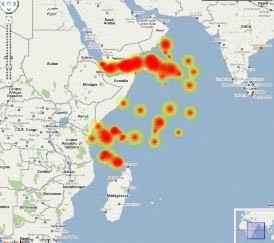
Recent piracy activity according to security firm Drum Cussac SW
The season for transiting the pirate infested Gulf of Aden for sailing boats is fast approaching, a route that saves the much longer route to the Mediterranean via Africa. But how does a yacht crew decide between the shorter journey, the longer route or simply, but expensively, having your boat transported by ship?
Last year, according to a spokesman for the Oasis Club in Salalah, Oman, in spite of recommendations against it by the International Sailing Federation (ISAF), approximately 200 yachts transited the Gulf of Aden in convoys, and none were attacked.
ISAF, the Maritime Security Centre - Horn of Africa (MSCHOA), and the UK Foreign and Commonwealth Office (UK FCO) are all still recommending against yachts transiting the area.
Depending on who you believe, ISAF or security firm Drum Cussac, attacks on merchant ships have increased between 45% and 65% in the past year. The success rate, however, has fallen, owing to an increased presence by up to 28 international warships, and this has driven the pirates to spread their activities to a much wider area.
The waters of Kenya, Tanzania and Mozambique are now not considered safe, and it is significant that the only two kidnappings of cruising sailors in the last year have occurred in Kenya and Tanzania waters (Lynn Rival, in the SW of
the Seychelles archipelago whose crew, Rachel and Paul Chandler were held for over a year before a ransom was paid for their release in early November, and Choizil, reportedly pirated on the border between Tanzania and Mozambique – crew Bruno Pelizzari and Deborah Calitz were taken hostage whilst owner/skipper Peter Eldridge escaped - also in early November 2010. Another yacht, the St Victoria was attacked unsuccessfully in the Gulf of Aden in October.)
While there has been some piracy recorded in the vicinity of Bab el Mandeb Strait at the entrance to the Red Sea, ISAF reports that the incidents reported were 'disagreements between Yemeni and Eritrean vessels, one country’s fishing boats encroaching on the other’s waters and being fired on by patrols.'
So the problem for yachts is still the Gulf of Aden, and, if you insist on going, there's an official transit corridor where up to seven warships may be operating.
According to ISAF, while pirates are there to make money and yachts are therefore inferior targets, the problem might come when a particular pirate gang has been unsuccessful in their forays. High on their chewed drug 'Khat' they become desperate and are likely to attack irrationally. This means that the fact that no yachts in formation have been attacked is not relevant to future estimates.
Indeed, intuitively, unless a cruising sailor is prepared to enter a gun battle with pirates as Mahdi and Gandalf did in the season of 2005 (see http://www.sail-world.com/index_d.cfm?nid=21608!story), travelling in a convoy is hardly a deterrent.
It should be remembered that the warships in the transit zone CANNOT provide an escort. Some yachts are reported to be travelling close to the Yemeni shore, hoping for the protection of the Yemeni coastguard. This, also, is NOT recommended by the same authorities, who maintain that some part of the coastline may be under control of terrorists.
So the choice is difficult, and there are no easy answers.
For detailed and constantly updated information about piracy in the area, go to the http://www.sailing.org/33542.php!ISAF_website, the website of security firm http://www.drum-cussac.com!Drum-Cussac, and refer to the piracy pages of www.noonsite.com!Noonsite.
If you want to link to this article then please use this URL: www.sail-world.com/77669