New America's Cup Rule - second wingsail but big advantage remains
by Richard Gladwell on 16 Oct 2010
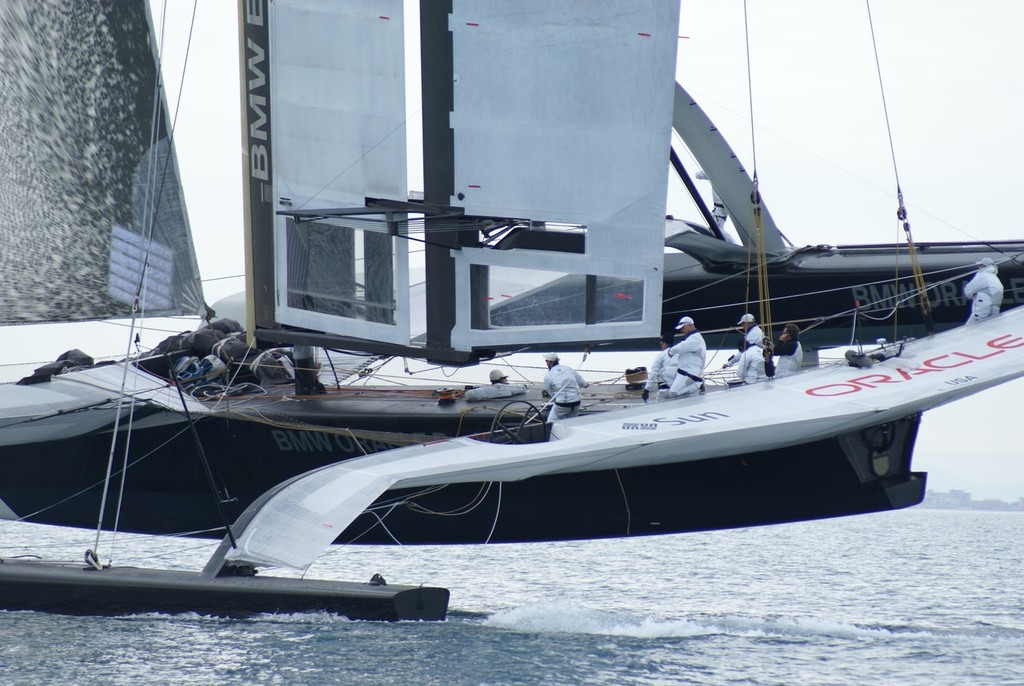
Two wingsails will now be required in the AC72 class SW
A revised version of the measurement rule has been released which will be used for the new AC72 class of catamaran to be sailed in the 34th America's Cup.
As with any rule revision, the second release - just a few weeks after the first, tidies up some areas and clarifies others.
A new feature is the specification of a second smaller wingsail. The intention with the second wingsail is to provide a rig suitable for stronger winds.
Not included in the rule is the suggestion in an earlier draft, published on valenciasailing.com http://valenciasailing.blogspot.com/2010/10/ac72-sail-area-reduction-concept.html!which_reads:
Attached are diagrams showing the wing measurement grid and conceptual sailplans for the standard and small wings. The small wing will effectively be very similar in profile of the standard wing but with the height reduced by approximately 10 meters. We believe this wing reduction method includes the following benefits over other choices:
1. A reduction of 10m in wing height will significantly improve the safety and controllability of an AC72 in higher wind speeds. The minimum hull-flying true wind speed is estimated to increase from approximately six knots (with the 40m wing and Code 0) to twelve knots with the 30m tall wing without headsail.
2. Competitors can utilize existing lower sections of the wing spar and simply add a new, smaller upper section of wing spar.
3. Competitors could convert a standard wing to the small wing while using as much of the standard wing parts as possible.
4. When a small wing is used, only one Gennaker is to be on board the yacht.
We recommend that the following also be implemented:
* Requirement for teams to have a small wing be delayed until late 2012 or early 2013. This may allow teams time to modify an existing standard wing.
* The Regatta Director to determine what wing is to be used by Competitors for a regatta or on days within a regatta.
* The Protocol be amended to allow for an extra two small wing mast sections be included within the wing spar limits and to allow the change from a full wing spar to a small wing spar without that spar being counted as a new wing spar.
This does not limit teams to only two small wing spar sections but reflects the requirement to allow wing spar development over both wing configurations.
It is perhaps understandable that a second rig could be required for competition in the America's Cup World Championship events - the 13 regatta circuit to be sailed in 2011 - 2013, ahead of the Challenger Selection Series for the 34th America's Cup.
In such regattas, the yachts may be at sea for 8-12 hours, and it makes sense for the Regatta Director to specify a rig that will get boats through that day, without requiring a change of rig, should winds increase or decrease significantly.
However for the America's Cup (and a Challenger Selection Series), giving the ability for the Regatta Director, or any other official, to be able to specify a rig for the competitors is a novel approach, and unprecedented in America's Cup history.
(Ironically this particular Regatta Director, one Iain Murray, won his first World 18fter Championship on the final run of the final race through carrying a big kite, when his leading competitors played a more conservative line and two sailed down the run.)
With the weather resources available to the teams it would normally be their call, as in 12 and 18fters, as to what sails they should race with, given the conditions they expect to prevail in the race.
Further it is an area of technological development that teams would normally explore to work out a way of rig reduction, maybe between races, rather than have that decision made for them by a race official.
While the thrust of the AC72 catamaran is to create a boat which can be used for World circuit, some would say circus, racing in the America's Cup regatta has traditionally allowed the crews to make racing and rig decisions - which has led to a number of innovations over the 160 years of Cup history.
Essentially BMW Oracle have retained their big areas of advantage in the publication of the rule - which is their experience with wingsails, and also the on board technology used with devastating effect in the 33rd America's Cup.
Still, there is no limitation on the technology that can be used on board, such as the use of a large numbers of load sensors (250 on USA-17), and having that data transmitted to a chase boat in real time (USA-17 generated almost 4,000 variables 10 times a second). The use of a 'wireless boat' allows the transmission of data around the boat, and able to be picked up by various wireless devices worn by the crew.
While the Defender has always been quick to play up the fact that such devices are almost available off the shelf, and are not particularly special, the fact is that the underlying software is not cheap, nor quick to develop, and is certainly not available off the shelf.
During the 33rd America's Cup several presentations were made as to the use of such software, and impressive it was, too. Further, it was entirely appropriate for a no-holds barred Deed of Gift Match. (http://www.sail-world.com/NZ/BMW-Oracle-Racings-design-team-explain-USA-17s-winning-Technology/66850!click_here for the technology video of the media conference.
But in a more normal America's Cup (an oxymoron if ever there was one) is it appropriate for wingsail trimmers to be using a wrist pad screen device to optimise wingsail camber against the computer determined shape for that wind condition? Many would say not.
The simple solution would be to limit on board instrumentation to wind speed, boat speed, true and apparent wind angle, plus compass heading and ban everything else.
Use of such technology is in apparent contradiction with the aims of cost reduction espoused by the Challenger and Defender.
Next milestone for the 34th America's Cup is the opening of the entry window on 1 November, followed by the launching of the first of the smaller AC45 wingsailed one designs in December 2010.
The venue for the 34th America's Cup is expected to be announced before 31 December 2010.
As yet, aside from the Challenger, Club Nautico do Roma, no clubs have indicated they will be definite Challengers ahead of the opening of the period from 1 November 2010 to 31 March 2011 in which additional Challenges will be accepted. The defending club, Golden Gate Yacht Club, has reserved the right to accept late challenges.
The official release reads:
From concept to completed Class Rule in less than four months, full details of the new high-performance wingsailed catamaran were published today.
The spectacular AC72 catamaran ensures that the 34th America’s Cup will feature the best sailors in the world on the fastest boats.
The AC72 Class Rule moves America’s Cup racing to catamarans with a speed potential of three times the wind speed, putting the venerable competition back at the forefront of technology.
Morrelli & Melvin Design & Engineering Inc to create a new boat on behalf of the America’s Cup community.
On July 2, to ensure the rule was created independently, the defending Golden Gate Yacht Club and its sailing team BMW ORACLE Racing presented a two page concept paper to US SAILING and Morrelli & Melvin and asked them to turn it into a fully formed multihull design rule.
Throughout the AC72’s gestation, the fundamental requirements have remained unchanged:
• Ensure fast, exciting racing
• Challenge sailors and designers
• Capture fans’ imagination
• Be versatile across the wind range, to minimize race delays
• Be capable of competitive racing in light and strong winds
• Incorporate wide-ranging cost-reduction features
'The AC72s will look amazing, will be very fast, and will take the America’s Cup into a
new dimension,' said Melvin, himself a multihull champion.
'There will be nothing else like them, which perfectly matches the allure and appeal of the America’s Cup,' Melvin added. 'We are grateful for the input of many, many designers, sailors and other experts.'
On September 16 a draft was circulated to potential teams and the sailing community at large. Since then over 500 comments were received and assimilated by Melvin’s team. Many have been incorporated into the final rule.
Teams may design and build a maximum of two AC72 catamarans. The AC72s will be raced from the 2012 season onwards in America’s Cup World Series events that will lead to the Selection Series and the America’s Cup Match in 2013.
In 2011, teams will compete in identical AC45’s, 'the little sister with attitude.' This one-design catamaran will provide teams with state-of-the-art wingsail technology and fast-track their multihull racing skills.
The AC72 Class Rule is available for download at: www.americascup.com/official-documents
AC72 Catamaran Fact Sheet
AC72 Key Features:
Hull Length 22.00 m (72 feet)
Length Overall 26.20 m (85 feet)
Beam 14.00 m (46 feet)
Weight (w/o crew) 5900 kg (13,000 pounds)
Crew 11
Maximum Draft 4.40 m (14 feet)
Wingsail Height 40.00 m (131 feet)
Tall Wingsail Area 260.0 m2 (2,800 square feet)
Short Wingsail Area 230.0 m2 (2,475 square feet)
Projected Top Speed 32 knots
Onboard cameramen 2 maximum
Cameramen positions 3 (1 aft, 1 forward in each hull)
Remote TV cameras 7
High quality audio microphones 18 (including 11 crew)
Easy assembly/disassembly Under 48 hours
Cost Reductions compared to 32nd America’s Cup:
• 11-person crews (reduced from 17 on ACC class monohulls)
• Boat lengths reduced to 72 feet from 82 feet
• No-sailing periods enforced
• Simple crane lift in/lift out – no special hoists or docks required
• Shipping and centralized logistics paid for by event
• Liberalized design rules encouraging non-exclusive design
• Consolidated competitor facilities at World Series: sail lofts, workshop etc
• World Series negates need for permanent team fixed-bases
• Centralized meteorological service and ban on weather boats
If you want to link to this article then please use this URL: www.sail-world.com/75876