America's Cup- First wingsailed AC45 well advanced at Warkworth
by Richard Gladwell on 6 Oct 2010
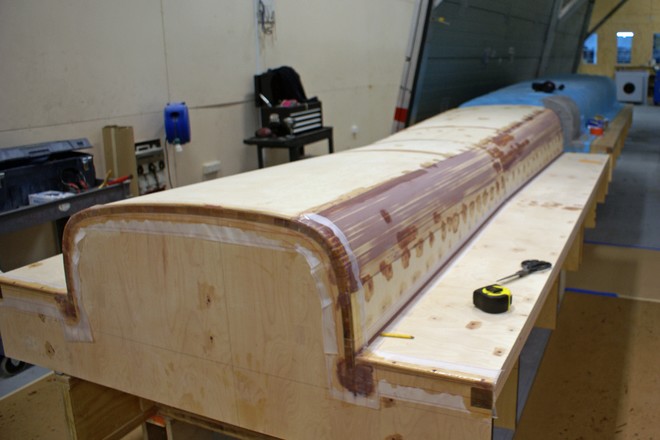
Transom sections before epoxy putty is applied for milling to design shape - Core Composites - AC45 construction 5 October 2010 Richard Gladwell
www.photosport.co.nz
The first of the AC45 class continues to take shape in the Warkworth building facility of Core Composites.
The 45ft one design wingsailed catamarans are intended to be used in the first of the America's Cup World Championship regattas, before being turned over to Youth teams, to compete on the same circuit when the larger AC72 class comes into being in March 2012.
Currently tooling for the construction of the hull moulds is well advanced. And in another area of the very ample factory, the wing sail mould is taking shape.
The snapshot of the building floor action is that the male moulds are being built from which the female moulds will then be taken. Then the construction proper of the first AC45 will commence - due for launching in Auckland in February 2012.
Although a longer process than usual, the finely milled male moulds allow the construction of several sets of female moulds which can be sent to builders elsewhere in New Zealand, and in the longer term internationally, to keep pace with the anticipated delivery schedule.
The intention is that six of the AC45's one designs will be racing on the America's Cup World Championship circuit by June 2011, and each team in the 34th America's Cup will have to own one of the AC45's and some will have two. They will be used for racing in the series and to familiarise crews with wingsail technology.
[Sorry, this content could not be displayed]
The larger AC72 designs, to be used in the America's Cup, will be unique designs to the AC72 rule, set down for publication on 6 October.
The key to this process is the CNC maching centre, which is used to precisely mill the hull sections to the exact design shape. As mentioned in the last report from Warkworth, the CNC lathe installed at Core Composites is the largest in New Zealand, capable of taking sections measuring 6x3x1.5 metres - and it can mill material in three dimensions using five rotating heads.
'If you look at the moulds you will see that there is hardly a straight line on them', explains builder Tim Smythe. There are curves everywhere, it would be very difficult to do as accurately by hand'
Yet to be installed is a second CNC machining centre which is four times the size of the current 'Baby'.
For those unfamiliar with this construction process, the first step as we saw previously is to build male hull moulds, in half sections, in the usual strip planked manner.
The 45ft moulds are covered in a blue coloured epoxy putty paste, from Adhesive Technologies, before being cut into three sections and positioned in the CNC lathe. The epoxy putty is milled to the designed hull shape, including the mating faces.
Next the milled male moulds are sanded lightly by hand to remove milling troughs before being painted and sanded to a high quality finish. The sections are then joined back into one continuous canoe body.
Because each hull is built as a vertically cut half section, there are two moulds required for the hull.
These two male halves then have a female mould taken off them, which is used to contruct the actual hulls, which are laid inside each half mould, and then the finished mouldings are joined down the centre to form the finished boats. The female moulds are built to allow Pre Preg carbon/epoxy high temp hull constriction to take place, while the purpose of the male mould is just to provide the perfect shape for female component.
If it all sounds very complicated, there is a method in the madness which is that the male moulds remain outside the building process and are used to take as many females moulds as may be required around the world. this process is similar to that followed with strict one design dinghies used in the Olympics, where no variation in hull shape is permitted, and the milled male mould guarantees uniform and very fair, and fast hull shape.
Of course, once the 24 metre CNC maching centre is installed, there will be no need to cut the plugs from the first stage into sections and the complete hull length of any boat up to 23 metres long by three metres high by six metre wide can be milled in a single pass. For bigger sizes the male moulds are milled in sections as for the AC45's at present.
For the AC45, the 1.4metre detachable transoms will be built as a separate unit and then attached to the boats for racing, before being detached to fit into a 40ft container for shipping. 'There's not a lot of point in making it on the boat', explains builder Tim Smythe. 'One of the virtues of the milling technology is that they should be a perfect fit, unless there is some human intervention to screw up the process!'
The wingsail is being constructed in a different manner and looks like a major part from a model aircraft wing kitset.
The leading edge of the wingsail will be machined, but otherwise the mould will be constructed in a reasonably conventional manner with each section laser cut to the precise design shape.
'The technology is being applied only where it really pays, we are trying to keep the costs down to the teams, this includes getting various components built by the best builders for the best price,' says Smythe
'We expect to grow to about 30 builders here, while the AC45's are being built then there will be a hiatus until we start building the AC72's'
No decision has yet been made as to whether to develop a second set of tooling for the wingsails, which may be too expensive to be justified and the cheaper solution could be to just produce more from Warkworth. 'One of the options is that we produce the basic components of the wings and then flat pack them and give them to the teams to finish and assemble. There is a lot of work in putting them together', Smythe adds.
'We have to balance getting one boat in the water and sailing early, using a one-off building method, against producing the tooling to produce many, before constructing the first ten boats by the required time.
'If you are going to have more than one builder, you have to have tooling, and as anyone who is in the boatbuilding business knows, it is that tooling that takes the time and is what costs.
'If you are driven to repeatability and class conformity then you are driven towards systems which can duplicate themselves.
'The end result will be worth it, because we want to produce a quality product at a fair price. We know that we can manage it properly in New Zealand. We have the ability to punch these out. We know that we can get a better price and people are signing up for that.'
[Sorry, this content could not be displayed]
If you want to link to this article then please use this URL: www.sail-world.com/75460