Permanently installed preventer - The case for (and a cautionary tale)
by Edwin G. Fischer, MD/ Bob Hickson on 28 Jul 2010
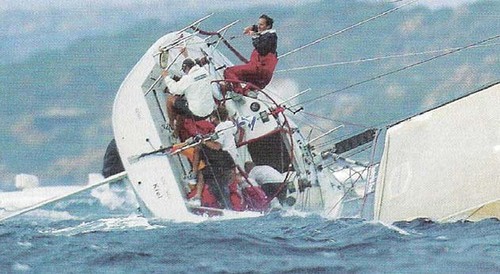
After an accidental jibe, by Francisco Ferri SW
The incidence of injury from accidental or premature jibes is unknown but the problem is not insignificant.
I became aware of the immediacy and seriousness of such accidents during the 1989 Marion Bermuda Race when a pediatrician at the helm of a fellow neurosurgeon’s boat had a fatal head injury during an accidental jibe at night. He was struck by the mainsheet as it whipped across the cockpit. The binnacle was also badly damaged by the mainsheet.
Subsequently I assembled an incomplete list of 18 fatal head and/or neck injuries that occurred on 'offshore' yachts during accidental jibes. A surprising number occurred in various racing venues, as follows.
Racing Venues with Well Documented Fatal Jibe Head Injuries
1979 SORC boom injury
1981 Practice - USCG Academy Sailing Team boom injury
1989 Marion Bermuda Race mainsheet injury
1992 Cowe’s Week mainsheet injury
1996 Antigua Race Week mainsheet injury
1998 Ft. Lauderdale-Key West Race boom injury
2007 Atlantic Rally for Cruisers (ARC) boom or mainsheet injury
In addition, in 1990 a midshipman at the US Naval Academy was in coma after a head injury during an accidental jibe and his recovery was not good enough to return to school.
Accidental jibes can be avoided only if a preventer is always in place. Phil Garland, of Hall Rigging, designed a permanently installed preventer that we have used with ease on our Morris 46 in four Newport Bermuda Races and 2 roundtrip transatlantic passages.
A Permanently-Installed Preventer (designed by Phil Garland)
A. Equipment
a. A pad-eye or bail on the undersurface of the boom, aft of the vang (about 1/3rd the distance from the gooseneck to the boom end, but the exact location is not critical)
b. Two blocks on the deck, one on each side, located in the vicinity of the shrouds (will vary with the boat)
c. Two line stoppers, one each side, located by the cockpit in easy reach of the helmsman
d. Two lines long enough (about half the length of the boom plus the distance from the deck block to the line stopper, plus several extra feet)
B. Set-Up
a. Both preventer lines start at the pad eye or bail on the boom, one running forward to the block and then aft to the line stopper on the starboard side, the other running similarly on the port side.
b. On our Morris 46, a piece of PVC tubing on the aft lower shroud prevents line chafe.
C. Operation
a. The entire system can be run by the helmsman: releasing the old leeward line from the stopper before or during the jibe and tightening the line in the stopper on the other side after the jibe.
b. The helmsman can also trim the line as the mainsheet is let out or taken in.
c. Occasionally, one of the lines hangs up on a Dorade.
d. Upwind both lines are slack and do not need attention.
e. The initial force of the jibe is minor compared to the full force of the jibe after the accelerating boom has crossed the centerline.
Above and below: Preventer lines set-up on a Morris 46 (DIVA)
Dr Fischer is Fleet Surgeon for the Cruising Club of America
...............................
This cautionary tale on the use of the preventer was received from Bob Hickson, Skipper of Airborne 2, a Viking 28 yacht:
The preventer described in the above information could be dangerous and it lulls an unsuspecting sailor into a false sense of security.
I speak from personal experience.
During the Lake Ontario 300, I had a similar preventer rigged while sailing downwind in 20 knots of true wind.
A large wave kicked the stern to the side and caused an accidental gybe.
The boom of the boat bent at a 90 degree angle where the preventer was attached to the boom.
The good news is that the preventer saved my life. Without the preventer, the boom would have hit me in the side of my head causing critical injury, or death.
The important lesson is that the gybe preventer must be attached much further away from the mast so that the boom does not fail as it did in my case. As a minimum, the preventer must be attached at the mid point of the boom. Further towards the outer end would be even better.
Obviously, the geometry involved means that the attachment point of the preventer to the hull must move forward much closer to the bow of the boat.
I WILL be rigging permanent preventers on my boat similar to those described in the article with an important modification.
The preventer must be attached much further out on the boom. My plan is to attach the preventer to the outer quarter of the boom. This should reduce the force that the wind in the sail can exert on the outer (unsupported) end of the boom.
Hopefully, this would prevent a catastrophic failure of the boom during an accidental gybe.
The image above right shows the damage as described incurred during the incident described above
If you want to link to this article then please use this URL: www.sail-world.com/72598