North Sails start TP52 and Volvo sail testing in Twisted Flow Tunnel
by Zoe Hawkins on 15 Jun 2010
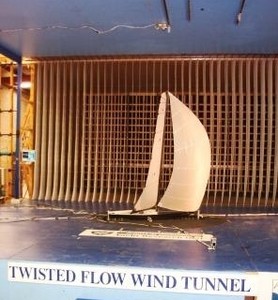
The Twisted Flow Wind Tunnel at University of Auckland SW
North Sails and Emirates Team New Zealand head sail designer Burns Fallow has been involved with the Twisted Flow Wind Tunnel at the University of Auckland since its construction in 1994.
Sixteen years later, the tunnel is still an invaluable component of sail design. Already this year it has been utilised for two major projects: The finessing of TP52 sails following rule changes, and initial testing for Team New Zealand’s entry in the Volvo Ocean Race. at the University of Auckland since its construction in 1994. Sixteen years later, the tunnel is still an invaluable component of sail design. Already this year it has been utilised for two major projects: The finessing of TP52 sails following rule changes, and initial testing for Team New Zealand’s entry in the Volvo Ocean Race.
Two TP52 teams – Emirates Team New Zealand and Artemis – returned to the wind tunnel because of new rules that allowed bowsprits, and the class’s thrust towards a more IRC style of racing.
'We knew the geometry would change quite a bit with the introduction of prods,' explains Burns. 'The sail restrictions had also changed. We had some ideas about what we wanted to look at, and worked with Mickey Ickert and some of the ETNZ trimmers.'
Two days were spent in the tunnel, experimenting with 10-15 different designs.
The wind tunnel provides real, simulated conditions utilising model boats that are approximately 2m in height, and the findings drove the sails that were initially built in Auckland, when Emirates Team New Zealand conducted load testing over summer, and ultimately became the sail wardrobe used for the MedCup regatta.
'The Emirates Team New Zealand sailors are very happy with the sails,' comments Burns.
ETNZ has also dedicated time to the wind tunnel for its Volvo Ocean Race entry, which will be sponsored by the Spanish footwear company, Camper.
'It’s very early in the process,' says Burns, explaining that there are two reasons that a new project will go to the wind tunnel. Firstly, it gives the naval architects data to work with as they design the boat in terms of sail forces.
Secondly, new sail restrictions mean each entry is limited to a wardrobe of just 17 sails for the entire race, with restrictions on specific sail types – for example, three spinnakers, including two masthead, can be onboard at any one time.
That means consideration of the wind speeds and angle spectrums any particular sail will cover, and which jobs it will do leg by leg, are critical.
Spending time in the wind tunnel with the actual sail trimmers assists the team with getting to grips with what will pan out on the water once the race gets underway.
The Volvo Ocean Race commences in Alicante, in Spain, in October 2011. The Team New Zealand entry is being built in Auckland and will launch early next year.
If you want to link to this article then please use this URL: www.sail-world.com/70798